
Post Quantum Cryptography Why Your Current Encryption is Obsolete in 2026
A
Admin
14 min read
53 views
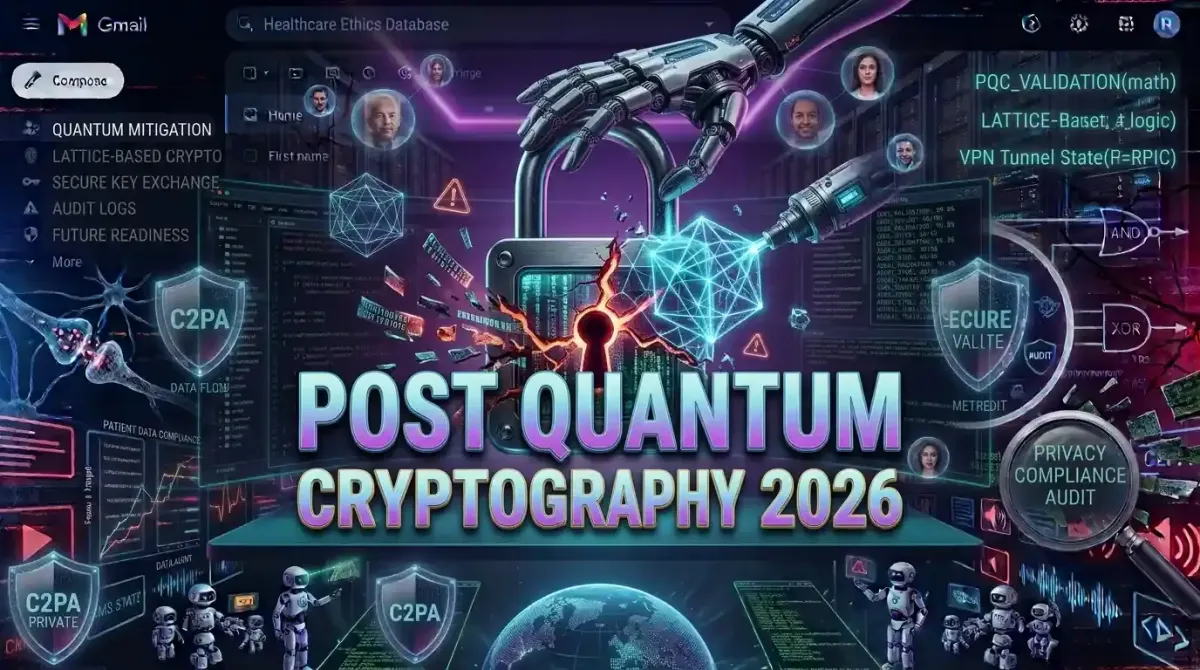
Post quantum cryptography represents the most critical paradigm shift in digital security since the invention of public key encryption. As quantum computers rapidly approach the threshold of practical utility, traditional cryptographic algorithms like RSA and Elliptic Curve Cryptography are becoming fundamentally obsolete. The threat is not merely theoretical; the "store now, decrypt later" strategy employed by state sponsored actors and cybercriminal syndicates means that data encrypted today with classical algorithms is already at risk of future exposure. In 2026, transitioning to quantum resistant algorithms, such as those recently standardized by the National Institute of Standards and Technology, is no longer a forward looking research initiative but an immediate operational imperative. This comprehensive guide details the mechanics of the quantum threat, the mathematical foundations of post quantum cryptography, and a step by step migration framework to future proof your enterprise infrastructure against the impending cryptographic collapse.
The Quantum Threat to Classical Cryptography
Direct Answer: Current encryption methods like RSA and ECC rely on mathematical problems, such as integer factorization and discrete logarithms, that are computationally infeasible for classical computers to solve. However, quantum computers utilizing Shor algorithm can solve these problems exponentially faster, rendering classical encryption obsolete. Post quantum cryptography utilizes alternative mathematical foundations, such as lattice based or hash based cryptography, which remain secure against both classical and quantum computational attacks.
To understand the urgency, one must understand the mechanics of the threat. Modern public key cryptography, which secures everything from HTTPS web traffic to encrypted messaging and digital signatures, relies on trapdoor functions. These are mathematical operations that are easy to compute in one direction but practically impossible to reverse without a specific piece of information, the private key. For decades, the security of the internet has rested on the assumption that factoring large prime numbers or solving elliptic curve discrete logarithm problems would take classical supercomputers thousands of years.
Quantum computers disrupt this assumption entirely. By leveraging the principles of quantum mechanics, specifically superposition and entanglement, quantum bits or qubits can exist in multiple states simultaneously. In 1994, mathematician Peter Shor developed an algorithm proving that a sufficiently powerful quantum computer could use quantum Fourier transforms to find the period of a function, effectively solving the integer factorization and discrete logarithm problems in polynomial time. While we do not yet have fault tolerant quantum computers with the millions of logical qubits required to break 2048 bit RSA, the trajectory of hardware development suggests this "Q day" or quantum apocalypse is closer than many organizations anticipate.
The Store Now Decrypt Later Attack Vector
A common misconception is that organizations can wait until large scale quantum computers are publicly available before upgrading their cryptographic infrastructure. This is a catastrophic strategic error due to the "store now, decrypt later" attack vector, also known as harvest now, decrypt later.
Adversaries, including well funded nation states and organized cybercrime groups, are actively intercepting and storing massive volumes of encrypted data traversing the internet today. They do not need to decrypt this data immediately. They simply store it in massive data warehouses, waiting for the day when quantum computing power becomes sufficient to break the classical encryption protecting it. Once that day arrives, years of intercepted communications, intellectual property, financial records, and state secrets will be laid bare.
This reality fundamentally changes the timeline for cryptographic migration. Data with a long confidentiality requirement, such as healthcare records protected under HIPAA, government classified information, and long term financial contracts, must be protected by quantum resistant algorithms today. Understanding the importance of GDPR and modern data privacy laws highlights that regulatory frameworks are increasingly recognizing this threat, mandating proactive data protection measures that account for future computational capabilities, not just present day threats.
The Mathematical Foundations of Post Quantum Cryptography
Post quantum cryptography does not rely on quantum mechanics to secure data; rather, it relies on complex mathematical problems that are believed to be hard for both classical and quantum computers to solve. The National Institute of Standards and Technology has spent years evaluating and standardizing these algorithms to ensure global interoperability and security.
Lattice Based Cryptography
Lattice based cryptography is the most prominent and widely adopted family of post quantum algorithms. A lattice is a grid like structure of points in multi dimensional space. The security of these algorithms relies on problems like the Shortest Vector Problem or the Learning With Errors problem. Essentially, finding the shortest path between points in a high dimensional lattice, especially when random "noise" or errors are introduced, is computationally intractable even for quantum algorithms. Algorithms like CRYSTALS Kyber, now standardized as ML KEM, utilize this foundation for secure key encapsulation and exchange.
Hash Based Cryptography
Hash based cryptography relies on the security of cryptographic hash functions, which have proven remarkably resilient to quantum attacks. While Grover algorithm can theoretically speed up the process of finding hash collisions, simply doubling the output size of the hash function neutralizes this advantage. Algorithms like SPHINCS Plus, standardized as SLH DSA, provide stateless digital signatures that are highly secure, albeit with larger signature sizes and slower performance compared to lattice based alternatives. They serve as a crucial conservative backup in the post quantum ecosystem.
Code Based and Multivariate Cryptography
Code based cryptography, exemplified by the Classic McEliece algorithm, relies on the difficulty of decoding a general linear code. It has withstood decades of cryptanalysis and offers very fast decryption, though it suffers from extremely large public key sizes. Multivariate cryptography relies on the difficulty of solving systems of multivariate polynomial equations over finite fields. While promising for digital signatures, it has historically been vulnerable to structural attacks, making it a secondary focus in current standardization efforts.
Step by Step Guide to Post Quantum Cryptographic Migration
Transitioning an enterprise IT infrastructure to post quantum cryptography is a complex, multi year endeavor that requires meticulous planning. It is not a simple software patch; it is a fundamental architectural overhaul. Organizations must follow a structured, phased approach to mitigate risk and ensure business continuity.
Phase 1: Cryptographic Discovery and Inventory
You cannot protect what you do not know exists. The first step is to conduct a comprehensive cryptographic inventory. This involves scanning your entire IT environment, including network infrastructure, applications, databases, and IoT devices, to identify every instance where cryptography is used. You must document the algorithms in use, key sizes, protocols, and the specific business processes they protect. Automated discovery tools are essential for this phase, as manual auditing is impossible in modern, complex environments.
Phase 2: Risk Assessment and Prioritization
Not all cryptographic implementations carry the same level of risk. Once the inventory is complete, classify each asset based on the sensitivity of the data it protects and its vulnerability to the "store now, decrypt later" threat. High value, long life data systems, such as core banking databases, healthcare record repositories, and intellectual property vaults, must be prioritized for immediate migration. Less critical systems with short data retention policies can be scheduled for later phases.
Phase 3: Hybrid Cryptography Implementation
The most prudent approach to migration is the implementation of hybrid cryptography. This involves combining a classical algorithm, such as Elliptic Curve Diffie Hellman, with a post quantum algorithm, such as ML KEM, during the key exchange process. The resulting shared secret is derived from both algorithms. This ensures that the connection remains secure even if one of the algorithms is compromised. If the post quantum algorithm contains an undiscovered mathematical flaw, the classical algorithm provides a safety net, and vice versa. Implementing why end to end encryption is more important than ever in this context means ensuring that your hybrid cryptographic layers are applied consistently across all communication channels, leaving no vulnerable interception points.
Phase 4: Testing, Validation, and Full Deployment
Before deploying post quantum algorithms in production, extensive testing is mandatory. This includes performance benchmarking, as post quantum algorithms often require larger key sizes and more computational overhead, which can impact network latency and system throughput. Interoperability testing with third party vendors and partners is also critical to ensure that the new cryptographic standards do not break existing integrations. Once validated, a phased rollout should be executed, starting with non critical systems and gradually expanding to core infrastructure.
Technical Challenges in Post Quantum Adoption
While the mathematical foundations of post quantum cryptography are sound, the practical implementation presents significant technical hurdles that organizations must actively manage.
Performance Overhead and Bandwidth Constraints
Post quantum algorithms generally require larger key sizes and produce larger signatures compared to their classical counterparts. For example, an ML KEM public key is significantly larger than a standard 256 bit elliptic curve key. In high throughput environments or on bandwidth constrained IoT devices, this increased payload size can lead to noticeable latency and increased network congestion. Optimizing network protocols and upgrading hardware infrastructure may be necessary to absorb this overhead without degrading user experience.
Legacy System Incompatibility
Many organizations rely on legacy systems, mainframes, or embedded devices that have fixed hardware constraints and cannot be easily updated. These systems may lack the memory or processing power required to handle the larger key sizes and complex mathematical operations of post quantum algorithms. In some cases, the only viable solution is to place a modern cryptographic gateway in front of the legacy system, handling the post quantum negotiations externally while maintaining classical encryption internally. Understanding SaaS vs self hosted which is better for data privacy and control becomes relevant here, as migrating away from inflexible legacy on premise systems to modern, updatable cloud or self hosted architectures can simplify the cryptographic transition.
The Global Cryptographic Talent Gap
There is a severe shortage of professionals with expertise in both classical cryptography and emerging post quantum standards. Implementing these algorithms incorrectly can introduce catastrophic vulnerabilities. Organizations must invest heavily in training their existing security teams and consider partnering with specialized cybersecurity firms that possess deep expertise in cryptographic migration.
Industry Specific Impacts and Use Cases
The urgency and specific challenges of post quantum migration vary significantly across different industries, dictated by their unique regulatory environments and threat models.
Healthcare and Life Sciences
Healthcare data has an exceptionally long confidentiality requirement. A patient's genomic data or medical history remains sensitive for decades. Healthcare providers are prime targets for "store now, decrypt later" attacks. Migrating to post quantum cryptography is essential not only for protecting patient privacy but also for maintaining compliance with evolving regulatory standards that will soon mandate quantum resistant safeguards for protected health information.
Financial Services and Blockchain
The financial sector relies entirely on the integrity of digital signatures and secure key exchanges. The advent of quantum computing poses an existential threat to current blockchain technologies, many of which rely on elliptic curve cryptography for wallet addresses and transaction signing. A quantum computer could theoretically derive a private key from a public key, allowing an attacker to drain digital wallets. Financial institutions and blockchain developers are already actively researching and implementing quantum resistant signature schemes to prevent a total collapse of trust in digital financial systems. Learning how to automate your accounting using modern SaaS tools must now include verifying that the underlying APIs and data pipelines of these financial tools are transitioning to quantum resistant protocols.
Government and National Security
Nation states are leading the charge in post quantum adoption. The United States government, through directives from the Office of Management and Budget, has mandated that federal agencies begin the transition to quantum resistant cryptography immediately. The protection of classified intelligence, military communications, and critical national infrastructure from foreign quantum capabilities is a matter of supreme national security.
The Role of Artificial Intelligence in Cryptographic Migration
Artificial intelligence is emerging as a powerful ally in the complex process of post quantum migration. The sheer scale of cryptographic discovery and code refactoring required across enterprise environments makes manual execution impractical.
Automated Cryptographic Discovery and Refactoring
Machine learning models can be trained to scan millions of lines of code, identifying hardcoded cryptographic libraries, deprecated algorithms, and insecure key management practices. AI driven code assistants can then suggest or automatically generate refactored code that implements the new post quantum standards, significantly accelerating the migration timeline and reducing human error.
Anomaly Detection in Hybrid Environments
During the transitional phase, where hybrid classical and post quantum systems coexist, the attack surface temporarily expands. AI powered network monitoring tools can analyze traffic patterns in real time, detecting subtle anomalies that might indicate an adversary attempting to exploit vulnerabilities in the new cryptographic implementations or attempting to downgrade attacks to force the use of weaker classical algorithms. Utilizing top 10 open source security tools to protect your network can provide a foundational layer of monitoring, which can then be enhanced with specialized AI driven cryptographic anomaly detection modules.
Quantum Key Distribution vs Post Quantum Cryptography
When discussing quantum safe security, it is important to distinguish between post quantum cryptography and Quantum Key Distribution. While both aim to secure communications against quantum threats, they operate on entirely different principles.
Post quantum cryptography is a software based solution. It relies on new mathematical algorithms that can run on existing classical hardware, making it highly scalable and easy to deploy via software updates. Quantum Key Distribution, on the other hand, is a hardware based solution that uses the principles of quantum mechanics to securely distribute encryption keys. Any attempt to intercept the quantum key inherently alters its state, immediately alerting the communicating parties to the presence of an eavesdropper.
While QKD offers theoretically perfect security, it is currently limited by significant practical constraints. It requires specialized, expensive hardware, such as single photon detectors, and is generally restricted to short distances over dedicated fiber optic networks. For the vast majority of organizations, software based post quantum cryptography is the only viable, scalable path forward. QKD may eventually find a niche in ultra high security, point to point government or financial communications, but it will not replace the need for post quantum algorithms in general purpose computing.
Future Trends and the Road Ahead
The landscape of post quantum cryptography will continue to evolve rapidly as research advances and the first generation of standardized algorithms faces real world scrutiny.
Continuous Algorithm Evaluation and Updates
The algorithms standardized today are not guaranteed to be secure forever. As cryptanalysis techniques improve, vulnerabilities may be discovered in current post quantum candidates. The cryptographic community must remain vigilant, continuously evaluating these algorithms and preparing for the eventual need to transition to second or third generation post quantum standards. This necessitates building cryptographic agility into systems, allowing algorithms to be swapped out with minimal disruption.
Integration with Zero Trust Architectures
Post quantum cryptography is a critical component of the broader Zero Trust security model. In a Zero Trust environment, no user or device is trusted by default, and every communication must be authenticated and encrypted. Implementing zero knowledge proofs the future of verifying identity without sharing data alongside post quantum key exchange will create incredibly robust, privacy preserving authentication systems that are resilient to both classical and quantum attacks.
Conclusion
The obsolescence of current encryption methods is not a distant, speculative future; it is an imminent reality that demands immediate action. The "store now, decrypt later" threat means that the data your organization is encrypting today with RSA or ECC is already vulnerable to future quantum decryption. Waiting for the arrival of large scale quantum computers before initiating a migration is a strategy that guarantees catastrophic data exposure.
Transitioning to post quantum cryptography is a complex, resource intensive undertaking, but it is a non negotiable requirement for long term digital survival. By conducting thorough cryptographic inventories, prioritizing high risk assets, implementing hybrid cryptographic solutions, and leveraging artificial intelligence to manage the transition, organizations can future proof their infrastructure. The time to evaluate your cryptographic posture, engage with post quantum standards, and begin the migration process is now. The quantum era is arriving, and only those who prepare today will secure their digital tomorrow.
Related Posts

Resolving Model Collapse in Private AI Agents A Security Maintenance Guide in 2026
13 min · Aug 11, 2026

How to Fix Common Firewall Misconfigurations That Lead to Data Breaches in 2026
15 min · Aug 10, 2026

How to Fix DNS Leak Issues When Using a Personal VPN in 2026
15 min · Aug 08, 2026

Resolving Cross Site Scripting XSS Vulnerabilities in Legacy Web Apps in 2026
14 min · Aug 04, 2026