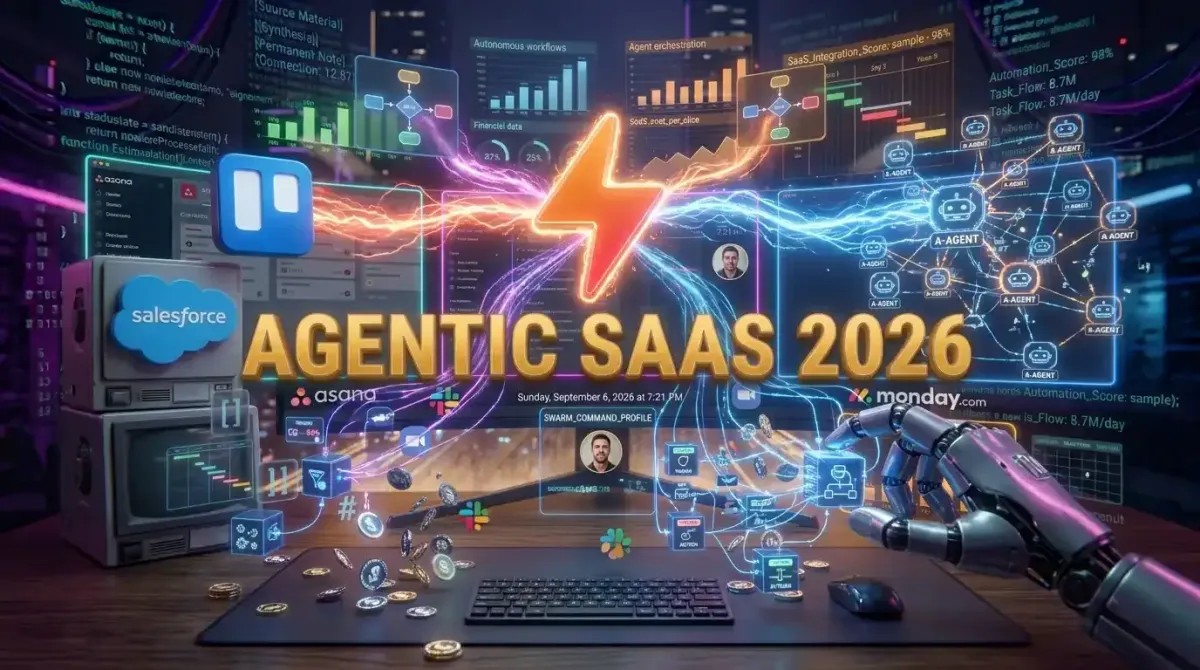
The software as a service industry is undergoing a fundamental transformation from static, user driven applications to dynamic, agentic workflows powered by autonomous artificial intelligence. Traditional SaaS platforms require users to manually navigate interfaces, input data, and execute tasks. Agentic workflows reverse this paradigm, deploying intelligent agents that proactively analyze data, make decisions, and execute complex multi step processes with minimal human intervention. This evolution represents the most significant shift in enterprise software since the move from on premise to cloud computing. By 2026, organizations implementing agentic architectures are reporting 60 to 80 percent reductions in manual workflow execution time, dramatic improvements in operational efficiency, and the ability to scale operations without proportional increases in headcount. This comprehensive guide explores the technical architecture, implementation strategies, and business implications of transitioning from static applications to agentic workflows.
Understanding the Shift from Static to Agentic Software
Direct Answer: Agentic workflows replace manual user interactions with autonomous AI agents that observe, decide, and act within defined parameters. Unlike static SaaS applications that wait for user input, agentic systems proactively analyze data, identify opportunities for action, and execute workflows autonomously while maintaining human oversight through configurable guardrails and approval processes.
Traditional SaaS applications operate on a request response model. A user logs in, navigates to a specific feature, inputs data, clicks buttons, and the application responds. This model has dominated enterprise software for two decades, but it creates significant friction and inefficiency. Knowledge workers spend countless hours performing repetitive tasks like data entry, report generation, status updates, and cross platform synchronization.
Agentic workflows eliminate this friction by deploying intelligent software agents that operate autonomously within defined boundaries. These agents continuously monitor data sources, apply business logic, make decisions based on predefined criteria, and execute actions across multiple systems without requiring manual intervention. The shift from static to agentic is not merely an incremental improvement; it represents a fundamental reimagining of how software serves human needs.
Understanding the rise of autonomous AI agents who is responsible when things go wrong is crucial for organizations implementing agentic workflows, as it addresses the governance, accountability, and risk management frameworks necessary for deploying autonomous systems in production environments.
Core Characteristics of Agentic Workflows
Agentic workflows differ from traditional automation in several critical ways. While traditional automation follows rigid, predetermined scripts, agentic systems possess the ability to perceive their environment, reason about situations, make decisions, and adapt their behavior based on outcomes.
Autonomy and Proactive Action
Agentic systems do not wait for user commands. They continuously monitor their environment for triggers and opportunities. For example, an agentic sales workflow might monitor incoming leads, score them based on predefined criteria, automatically route high value prospects to senior sales representatives, schedule initial discovery calls, and send personalized follow up emails, all without human intervention.
Contextual Awareness and Reasoning
Unlike simple automation scripts, agentic workflows maintain context across multiple interactions and systems. They can reason about complex situations, weighing multiple factors before taking action. An agentic customer support system might analyze a customer's purchase history, previous support tickets, current sentiment, and product usage patterns to determine the optimal resolution path, escalating to human agents only when necessary.
Learning and Adaptation
Advanced agentic systems incorporate machine learning to improve their performance over time. They analyze outcomes, identify patterns, and adjust their decision making processes. This continuous learning capability allows agentic workflows to become more efficient and accurate without requiring manual reconfiguration.
Multi System Orchestration
Agentic workflows excel at coordinating actions across multiple disparate systems. They can extract data from a CRM, update records in a project management tool, send notifications via Slack, and generate reports in a business intelligence platform, all within a single cohesive workflow. This orchestration capability eliminates the siloed nature of traditional SaaS applications.
Technical Architecture of Agentic SaaS Platforms
Building agentic workflows requires a fundamentally different technical architecture than traditional SaaS applications. The architecture must support continuous monitoring, decision making, action execution, and state management across distributed systems.
Event Driven Architecture
Agentic systems rely on event driven architecture rather than request response patterns. Events from various sources trigger agent evaluation and potential action. These events might include database changes, API webhook notifications, scheduled time intervals, or external system alerts. The architecture must support high throughput event processing with low latency to ensure timely responses.
State Management and Persistence
Agents must maintain state across multiple interactions and decision cycles. This requires robust state management systems that can persist agent context, decision history, and workflow progress. Distributed databases with strong consistency guarantees are essential for maintaining state across multiple agent instances and ensuring data integrity.
Decision Engines and Rule Systems
The core of any agentic workflow is its decision engine. This component evaluates incoming events against business rules, machine learning models, and contextual data to determine appropriate actions. Modern decision engines combine deterministic rule based logic with probabilistic AI models, allowing agents to handle both structured business processes and ambiguous situations requiring judgment.
Action Execution Framework
Once a decision is made, agents must execute actions across various systems. This requires a flexible action execution framework that can interface with multiple APIs, handle authentication, manage rate limits, and implement retry logic for failed operations. The framework must also support transaction management to ensure data consistency when actions span multiple systems.
Implementation Strategies for Agentic Workflows
Transitioning from static applications to agentic workflows requires careful planning and phased implementation. Organizations should follow a structured approach to minimize risk and maximize value.
Phase 1: Identify High Value Use Cases
Not all workflows are suitable for agentic automation. Focus on processes that are repetitive, rule based, involve multiple systems, and consume significant human time. Common candidates include lead qualification, invoice processing, customer onboarding, inventory management, and report generation. Conduct a thorough process audit to identify workflows that meet these criteria and calculate the potential time savings and efficiency gains.
Phase 2: Define Guardrails and Approval Processes
Before deploying autonomous agents, establish clear guardrails and approval processes. Determine which actions agents can take autonomously and which require human approval. Implement monitoring and alerting to detect anomalous behavior. Create rollback procedures for situations where agent actions produce undesired outcomes. Understanding balancing innovation and ethics regulating AI development provides frameworks for establishing appropriate governance structures.
Phase 3: Build or Integrate Agent Frameworks
Organizations can build custom agent frameworks or leverage existing platforms. Custom development provides maximum flexibility but requires significant engineering resources. Third party platforms offer faster deployment but may have limitations in customization. Evaluate options based on technical requirements, budget, and timeline. For teams looking to accelerate development, exploring top 10 no code platforms for building scalable web applications can reveal tools that simplify agent development without extensive coding.
Phase 4: Pilot and Iterate
Start with a limited pilot focused on a single workflow or department. Monitor performance closely, gather feedback from users, and refine agent behavior based on real world results. Gradually expand to additional workflows as confidence in the system grows. This iterative approach allows organizations to learn and adapt without risking critical business operations.
Real World Applications and Use Cases
Agentic workflows are already transforming business operations across industries. Understanding concrete use cases helps organizations identify opportunities within their own operations.
Sales and Marketing Automation
Agentic sales workflows can monitor inbound leads from multiple sources, score prospects based on demographic and behavioral data, automatically enrich lead records with external data sources, route qualified leads to appropriate sales representatives, schedule discovery calls, and send personalized follow up sequences. These agents work continuously, ensuring no lead falls through the cracks and sales representatives focus only on high value opportunities.
Customer Support and Success
Agentic customer support systems can triage incoming tickets, categorize issues based on content analysis, route tickets to appropriate teams, suggest solutions based on historical data, escalate critical issues to human agents, and follow up to ensure resolution satisfaction. These agents reduce response times, improve consistency, and free human agents to handle complex situations requiring empathy and judgment.
Financial Operations
Agentic finance workflows can process invoices automatically, match purchase orders to receipts, flag discrepancies for review, schedule payments based on cash flow optimization, reconcile bank transactions, and generate financial reports. These agents reduce manual data entry errors, accelerate payment cycles, and provide real time financial visibility.
Human Resources and Recruitment
Agentic HR systems can screen resumes against job requirements, schedule interviews with qualified candidates, send offer letters, onboard new employees by provisioning accounts and equipment, and track completion of required training. These agents streamline hiring processes, improve candidate experience, and ensure compliance with onboarding requirements.
Comparing Agentic Workflows to Traditional Automation
Understanding the differences between agentic workflows and traditional automation helps organizations make informed technology decisions.
| Characteristic | Traditional Automation | Agentic Workflows |
|---|---|---|
| Decision Making | Predefined scripts, no adaptation | Dynamic reasoning, learns from outcomes |
| Trigger Mechanism | User initiated or scheduled | Event driven, proactive monitoring |
| Context Awareness | Limited to script parameters | Maintains state across systems |
| Error Handling | Requires manual intervention | Self correcting with human escalation |
| Scalability | Linear, requires script updates | Exponential, agents learn and adapt |
| Implementation Complexity | Low to moderate | Moderate to high |
Challenges and Risk Management
While agentic workflows offer significant benefits, they also introduce unique challenges that organizations must address proactively.
Accountability and Governance
When autonomous agents make decisions that impact business outcomes, establishing clear accountability becomes complex. Organizations must define who is responsible for agent actions, implement audit trails for all agent decisions, and create escalation procedures for situations requiring human judgment. Understanding the rise of autonomous AI agents who is responsible when things go wrong provides frameworks for establishing appropriate governance structures.
Security and Access Control
Agentic workflows require access to multiple systems and sensitive data. Implementing robust authentication, authorization, and encryption is essential. Agents should operate with least privilege access, receiving only the permissions necessary for their specific functions. Regular security audits and penetration testing help identify vulnerabilities before they can be exploited.
Data Privacy and Compliance
Agents processing personal data must comply with regulations like GDPR, CCPA, and industry specific requirements. Implement data minimization principles, ensure agents only access necessary data, and maintain detailed logs for compliance audits. For organizations handling sensitive information, reviewing building privacy first AI techniques for secure data processing provides strategies for protecting data while maintaining agent functionality.
Unintended Consequences
Autonomous agents operating at scale can produce unintended consequences. An agent optimizing for one metric might negatively impact another. Implement comprehensive monitoring, establish key performance indicators for agent performance, and create feedback loops that allow humans to intervene when agents produce undesired outcomes.
Integration with Existing SaaS Ecosystems
Most organizations operate complex SaaS ecosystems with dozens of applications. Agentic workflows must integrate seamlessly with these existing tools to deliver value.
API First Design
Modern SaaS applications provide APIs that enable integration. Agentic workflows should leverage these APIs to read data, trigger actions, and synchronize state across systems. When evaluating SaaS platforms for agentic integration, prioritize applications with robust, well documented APIs and webhook support for real time event notifications.
Middleware and Integration Platforms
Integration platforms like Zapier and Make.com provide pre built connectors for thousands of applications, simplifying the integration process. These platforms can serve as the orchestration layer for agentic workflows, handling authentication, data transformation, and error handling. Understanding Make.com vs Zapier which automation tool wins for complex logic helps organizations choose the right integration platform for their agentic workflow requirements.
Custom Connectors and Adapters
For applications without robust APIs or pre built connectors, organizations may need to build custom adapters. These connectors translate between the agent's internal data model and the application's API, handling authentication, rate limiting, and error recovery. Investing in reusable connector frameworks reduces the cost and complexity of integrating new applications.
Measuring ROI and Business Impact
Implementing agentic workflows requires investment in technology, development, and change management. Organizations must measure return on investment to justify continued investment and expansion.
Time Savings and Efficiency Metrics
Track the time previously spent on manual tasks that are now automated by agents. Calculate the fully loaded cost of employee time and multiply by hours saved to quantify direct labor cost reductions. Additionally, measure process cycle times to identify efficiency improvements. Agentic workflows often complete tasks faster than humans, accelerating business processes and improving customer satisfaction.
Error Reduction and Quality Improvements
Manual processes are prone to errors. Agents operating with consistent logic reduce error rates significantly. Track error rates before and after agent implementation, calculating the cost of errors including rework, customer dissatisfaction, and compliance risks. Quality improvements often provide greater value than direct labor savings.
Scalability and Growth Enablement
Agentic workflows enable organizations to scale operations without proportional increases in headcount. Measure the ratio of revenue or transaction volume to employee count before and after implementation. Improvements in this ratio indicate that agentic workflows are enabling scalable growth.
Future Trends in Agentic SaaS
The agentic workflow revolution is still in its early stages. Several emerging trends will shape the evolution of agentic SaaS over the next few years.
Multi Agent Collaboration
Future agentic systems will feature multiple specialized agents collaborating to accomplish complex objectives. A sales agent might coordinate with a marketing agent to optimize lead generation, while a finance agent ensures deals meet profitability targets. This multi agent collaboration will enable more sophisticated automation of end to end business processes.
Natural Language Agent Configuration
Configuring agentic workflows currently requires technical expertise. Future platforms will allow business users to define agent behavior using natural language. Users will describe desired outcomes in plain English, and AI will generate the necessary workflows, rules, and integrations. This democratization will accelerate adoption across organizations.
Explainable AI and Transparency
As agents make more consequential decisions, organizations will demand transparency into agent reasoning. Explainable AI techniques will allow agents to articulate why they took specific actions, building trust and enabling human oversight. Understanding how researchers are solving the AI black box problem with explainable AI XAI reveals the techniques enabling this transparency.
Getting Started with Agentic Workflows
Organizations ready to begin their agentic journey should follow a structured approach to ensure success.
Assess Organizational Readiness
Evaluate technical capabilities, data quality, and change management readiness. Agentic workflows require clean, structured data and APIs for integration. Organizations with fragmented data silos or legacy systems without APIs may need to invest in modernization before implementing agentic workflows.
Build Cross Functional Teams
Agentic workflows span multiple business functions. Form cross functional teams including business process owners, IT specialists, and data analysts. These teams ensure that agent implementations address real business needs and integrate smoothly with existing systems.
Start Small and Scale Gradually
Begin with a pilot project focused on a single, well defined workflow. Demonstrate value, learn from challenges, and refine your approach before expanding to additional use cases. This incremental approach builds organizational confidence and allows for course correction based on real world experience.
Invest in Training and Change Management
Agentic workflows change how employees work. Provide training to help employees understand agent capabilities and limitations. Address concerns about job displacement by emphasizing how agents augment human capabilities rather than replace them. Celebrate early wins to build momentum and demonstrate value.
Conclusion
The transition from static SaaS applications to agentic workflows represents a fundamental shift in how software serves business needs. By deploying autonomous agents that observe, decide, and act, organizations can achieve dramatic improvements in efficiency, accuracy, and scalability. However, this transformation requires careful planning, robust governance, and a commitment to continuous learning and adaptation.
Organizations that embrace agentic workflows today will gain significant competitive advantages. They will operate with lower costs, faster response times, and greater consistency than competitors relying on manual processes. More importantly, they will free their human workforce to focus on strategic, creative, and relationship building activities that machines cannot replicate.
The technology is ready. The use cases are proven. The question is not whether to adopt agentic workflows, but how quickly your organization can make the transition. Start by identifying your highest value use cases, building cross functional teams, and launching pilot projects. Learn, iterate, and scale. The future of SaaS is agentic, and that future is now.