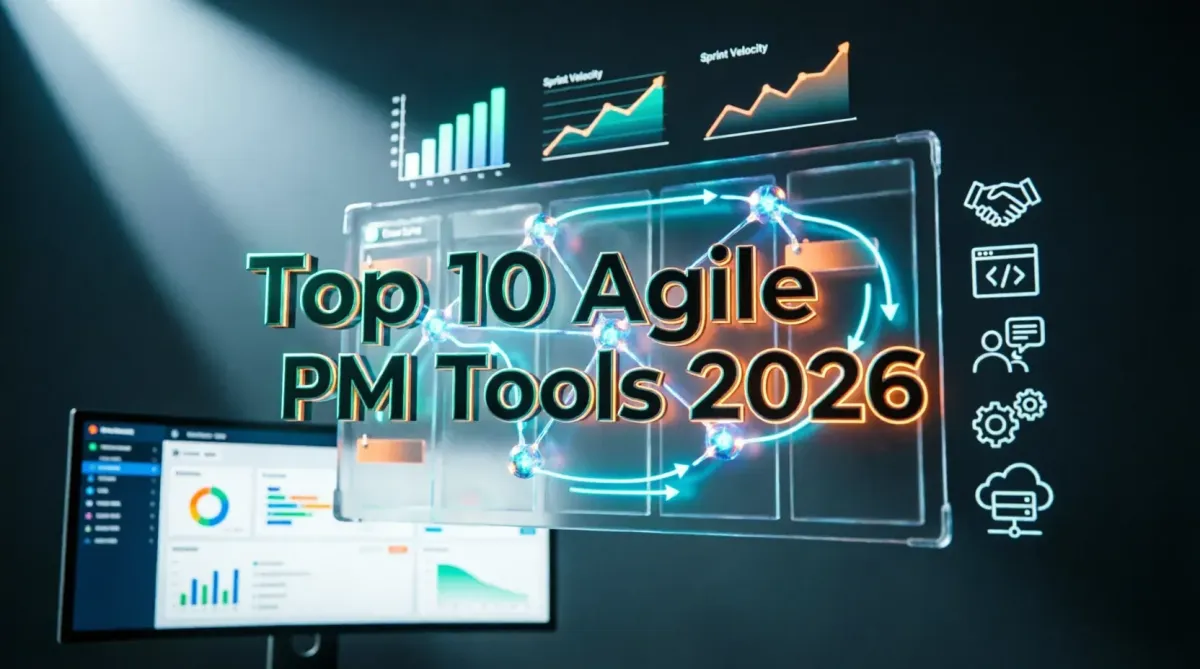
Top 10 Project Management Tools for Agile Teams: 2026 Edition
Agile project management in 2026 has evolved far beyond simple Kanban boards and manual sprint planning. The modern Agile toolkit is defined by AI-augmented workflows, predictive bottleneck analysis, autonomous task updating, and deep integrations with the software development lifecycle (SDLC). As remote and hybrid teams continue to dominate the tech landscape, the demand for project management tools that reduce administrative overhead and maximize developer flow state has never been higher. This comprehensive guide evaluates the top 10 project management tools for Agile teams in 2026, analyzing their AI capabilities, developer experience (DX), scalability, and pricing. Whether you are a fast-paced startup, a distributed enterprise, or a cross-functional product team, this comparison will help you select the platform that accelerates your delivery velocity while maintaining strategic alignment.
The Evolution of Agile Tools in 2026
The defining characteristic of Agile software in 2026 is the shift from passive tracking to active assistance. Legacy tools required developers to manually update ticket statuses, write detailed bug reports, and estimate story points based on gut feeling. Today's leading platforms leverage large language models (LLMs) and machine learning to automate the administrative burden of Agile.
AI agents now monitor GitHub or GitLab commits to automatically transition tickets, generate release notes from merged pull requests, and even suggest sprint capacity adjustments based on historical team velocity and individual developer workload. This paradigm shift allows engineering managers to focus on strategic unblocking rather than ceremonial Jira grooming. For tech leaders optimizing their team's output, integrating these modern PM tools with 10 productivity frameworks that actually work for tech founders ensures that project management aligns with broader organizational efficiency goals.
1. Jira: The Enterprise Standard Evolved
Jira remains the undisputed heavyweight champion of enterprise Agile, but its 2026 iteration is vastly different from the clunky interface of the past. Powered by Atlassian Intelligence, Jira now features natural language querying, automated sprint retrospectives, and AI-assisted issue creation.
Key 2026 Features:
- Atlassian Intelligence: Summarizes long ticket threads, suggests action items from meeting transcripts, and auto-fills ticket descriptions based on brief prompts.
- Advanced Roadmaps: Cross-project dependency tracking with predictive delay alerts based on historical team performance.
- Deep Ecosystem Integration: Seamless connectivity with Confluence, Bitbucket, and thousands of marketplace apps.
- Enterprise Governance: Granular permission schemes, data residency controls, and SOC 2 compliance.
Best For: Large enterprises, complex organizations requiring SAFe (Scaled Agile Framework), and teams deeply embedded in the Atlassian ecosystem.
Considerations: Despite UI improvements, Jira's sheer feature density can still overwhelm small teams. Configuration and administration often require a dedicated Jira Admin.
2. Linear: The Developer-Centric Speed Demon
Linear has cemented its status as the favorite tool for high-velocity software teams. Built with a relentless focus on performance, keyboard shortcuts, and developer experience, Linear treats project management as a software engineering problem. In 2026, Linear's offline-first architecture and instant sync capabilities make it feel like a local code editor rather than a web app.
Key 2026 Features:
- Git-First Workflow: Automatically links branches, commits, and PRs to issues, updating statuses without developer intervention.
- AI Issue Triage: Automatically routes incoming bug reports to the correct team and suggests similar historical issues.
- Cycles and Insights: Automated sprint cycles with predictive burn-down charts that account for holidays and PTO.
- Sub-50ms Latency: Unmatched UI responsiveness that keeps developers in their flow state.
Best For: Startups, mid-market software companies, and engineering teams that prioritize speed, keyboard-driven workflows, and a minimalist aesthetic.
For development teams using Linear, pairing it with how AI-powered debugging tools are saving hours of coding creates a seamless pipeline from bug identification to resolution tracking.
3. Shortcut (Formerly Clubhouse): The Balanced Agile Hub
Shortcut strikes the perfect balance between the overwhelming complexity of Jira and the rigid simplicity of Linear. It is designed for cross-functional product teams that include not just developers, but also designers, product managers, and marketers.
Key 2026 Features:
- Stories, Epics, and Milestones: A streamlined hierarchy that maps cleanly to Agile methodologies without excessive configuration.
- Workflow Automation: Visual rule builder to automate task assignments, status changes, and notifications.
- Reporting Dashboard: Real-time velocity charts, cycle time analysis, and workload distribution views.
- Branch Integration: Two-way sync with GitHub, GitLab, and Bitbucket.
Best For: Growing product teams that need robust Agile tracking but want a more intuitive, collaborative interface than Jira.
4. Asana: The Cross-Functional Work OS
While traditionally viewed as a generalist task manager, Asana has aggressively pivoted toward software development and Agile workflows. Its 2026 "Work Graph" architecture allows teams to view the same data as a Kanban board, a sprint backlog, or a timeline, catering to both engineering and business stakeholders.
Key 2026 Features:
- Asana AI Studio: Custom AI agents that can automate status updates, draft project briefs, and identify risks across portfolios.
- Developer Integrations: Native two-way sync with GitHub, GitLab, and Slack.
- Workload Management: Visual capacity planning to prevent team burnout.
- Forms and Intake: Standardized request forms for bug reports and feature requests from non-technical stakeholders.
Best For: Organizations where engineering must collaborate closely with marketing, sales, and operations on product launches.
5. Monday.com: The Visual and Customizable Powerhouse
Monday.com continues to dominate the "Work OS" space with its highly visual, color-coded, and deeply customizable interface. Its Agile templates are highly flexible, allowing teams to build bespoke sprint tracking systems without writing a single line of code.
Key 2026 Features:
- Monday AI Assistant: Natural language formulas, automated subtask generation, and meeting summary extraction.
- Custom Dashboards: Widget-based dashboards for sprint health, budget tracking, and team capacity.
- Automations: Robust native automation engine that connects with thousands of external apps.
- Resource Management: Built-in tools for tracking hours, budgets, and workload across multiple Agile squads.
Best For: Teams that require highly visual project tracking, custom workflows, and extensive non-engineering integrations.
To maximize Monday.com's potential, connecting it to Make.com vs Zapier which automation tool wins for complex logic allows teams to build sophisticated cross-platform Agile workflows that trigger actions across their entire SaaS stack.
6. ClickUp: The All-in-One Productivity Platform
ClickUp's "one app to replace them all" philosophy has matured into a highly cohesive platform. For Agile teams, ClickUp offers every view imaginable—Lists, Boards, Boxes, Gantt, and Mind Maps—along with built-in docs, whiteboards, and time tracking.
Key 2026 Features:
- ClickUp Brain: An AI neural network that connects tasks, docs, and people, allowing you to ask "What were the blockers in last week's sprint?" and get an instant, cited answer.
- Sprint Management: Dedicated Agile views with automated sprint rollovers and velocity tracking.
- Native Time Tracking: Built-in timers and timesheets for accurate billing and capacity planning.
- Custom Fields: Virtually unlimited customization for tracking specific Agile metrics.
Best For: Agencies, consultancies, and product teams that want to consolidate their tech stack into a single, highly customizable platform.
7. Targetprocess: The Enterprise Agile & SAFe Specialist
When Agile scales to hundreds or thousands of users, standard tools often break down. Targetprocess is built specifically for enterprise Agile, Scaled Agile Framework (SAFe), and LeSS (Large-Scale Scrum) implementations.
Key 2026 Features:
- Multi-Project Visualization: Interactive boards that map dependencies across dozens of teams and release trains.
- PI Planning Tools: Digital support for Program Increment planning, including capacity calculation and dependency mapping.
- Extreme Customizability: A visual entity manager that allows admins to create custom data structures without coding.
- Analytics & Forecasting: Monte Carlo simulations and advanced what-if scenario planning.
Best For: Large enterprises, financial institutions, and organizations strictly adhering to SAFe or scaled Agile methodologies.
8. Azure DevOps: The Microsoft Ecosystem Suite
For organizations deeply invested in the Microsoft ecosystem, Azure DevOps (formerly VSTS) provides a tightly integrated suite of Agile planning, source control, and CI/CD pipelines. Its 2026 updates have significantly modernized the UI and enhanced AI-driven code review integration.
Key 2026 Features:
- Azure Boards: Highly customizable Scrum and Kanban boards with deep integration into Microsoft Teams.
- Copilot Integration: AI-assisted work item creation, test case generation, and code summarization.
- Delivery Plans: Cross-team roadmap visualization with dependency tracking.
- Enterprise Security: Unmatched compliance, identity management via Entra ID, and data sovereignty options.
Best For: Enterprise teams using .NET, Azure cloud infrastructure, and Microsoft 365 for corporate communications.
For organizations handling sensitive intellectual property within Azure DevOps, reviewing building privacy-first AI techniques for secure data processing is essential for configuring AI features without compromising codebase security.
9. Taiga: The Open-Source Agile Champion
Taiga remains the go-to choice for open-source projects, NGOs, and teams that prioritize data sovereignty and community-driven development. Its interface is clean, focused strictly on Scrum and Kanban, and completely free to self-host.
Key 2026 Features:
- Pure Agile Focus: No feature bloat; just Epics, Backlogs, Sprints, and Kanban boards.
- Self-Hosted Option: Docker-based deployment for complete control over data and infrastructure.
- Integrations: Webhooks and API support for GitHub, GitLab, and Slack.
- Kanban WIP Limits: Strict enforcement of Work In Progress limits to maintain flow efficiency.
Best For: Open-source communities, privacy-focused organizations, and teams that want a no-frills, self-hosted Agile tool.
For developers who appreciate Taiga's open-source ethos, exploring top 10 open source alternatives to Adobe Creative Cloud reveals how the broader tech industry is shifting toward transparent, community-owned software ecosystems.
10. Height: The AI-Native Autonomous PM Tool
Height represents the bleeding edge of project management. Launched with the premise that "tasks should manage themselves," Height uses AI to automatically prioritize backlogs, archive stale issues, and update statuses based on linked Slack messages and code commits.
Key 2026 Features:
- Autonomous Workflows: AI agents that continuously monitor project health and execute predefined rules without human prompting.
- Contextual AI Chat: Ask the database questions like "Which bugs are blocking the v2.0 release?" and get instant, filtered views.
- Database-Like Architecture: Treats tasks as a relational database, allowing for complex queries and views.
- Frictionless Input: Capture tasks directly from Slack threads or emails with AI parsing the intent and priority.
Best For: Forward-thinking startups, AI-native companies, and teams tired of manual ticket grooming who want to experiment with autonomous project management.
Comparison Matrix: Choosing the Right Tool
| Tool | Best Use Case | AI Capabilities | Developer Experience | Starting Price |
|---|---|---|---|---|
| Jira | Enterprise / SAFe | High (Atlassian Intelligence) | Moderate | Free / $8.15/user |
| Linear | High-velocity Dev Teams | Medium (AI Triage) | Exceptional | Free / $10/user |
| Shortcut | Product Teams | Medium | High | Free / $8.50/user |
| Asana | Cross-Functional | High (AI Studio) | Moderate | Free / $10.99/user |
| Monday | Visual / Custom Workflows | High (Monday AI) | Low | Free / $9/seat |
| ClickUp | All-in-One / Agencies | High (ClickUp Brain) | Moderate | Free / $7/user |
| Targetprocess | Scaled Agile / Enterprise | Medium | Low | Custom Pricing |
| Azure DevOps | Microsoft Stack / Enterprise | High (Copilot) | Moderate | Free / $6/user |
| Taiga | Open Source / Self-Hosted | Low | High | Free / Hosted Plans |
| Height | AI-Native / Autonomous | Very High (Agents) | High | Free / $12/user |
Key Features to Demand in 2026
When evaluating Agile tools for your team, look beyond basic Kanban boards. The following features are now table stakes for high-performing teams:
1. Automated Sprint Ceremonies: Tools should automatically generate sprint reports, highlight completed vs. incomplete work, and even draft retrospective prompts based on cycle time anomalies.
2. Predictive Analytics: Machine learning models should analyze historical velocity to predict whether the current sprint backlog is overcommitted, alerting Scrum Masters days before the sprint ends.
3. Bi-Directional Code Sync: The PM tool must live where the code lives. Automatic status updates triggered by PR merges, branch creation, and CI/CD pipeline failures are mandatory to reduce manual overhead.
4. Natural Language Querying: Product managers should be able to type "Show me all high-priority bugs assigned to the backend team that haven't been updated in 3 days" and receive an instant, filtered view without learning complex JQL (Jira Query Language).
Integrating Agile Tools with the Modern Tech Stack
An Agile tool does not exist in a vacuum. In 2026, the best PM platforms act as the central nervous system, connecting design, development, and deployment.
For distributed teams, integrating your PM tool with communication platforms is critical. Utilizing top 5 SaaS platforms for managing global remote teams ensures that your Agile boards sync seamlessly with Slack or Teams, keeping asynchronous workers aligned without constant meetings.
Furthermore, linking your project management data to financial and resource planning tools is becoming standard practice. By connecting your Agile velocity metrics to how to automate your accounting using modern SaaS tools, engineering leaders can accurately forecast project costs, manage contractor billing, and align development output with business revenue goals.
Migration Strategies: Switching Agile Tools
Migrating from a legacy tool like Jira to a modern alternative like Linear or Shortcut can be daunting. Follow these best practices to ensure a smooth transition:
- Audit Your Data: Before migrating, archive closed tickets older than 12 months. Migrating historical noise clutters the new system and slows down AI indexing.
- Map Workflows First: Do not simply replicate your old Jira workflow. Use the migration as an opportunity to simplify statuses and eliminate unnecessary approval gates.
- Run Parallel Sprints: For the first two weeks, run the new tool alongside the old one. This allows developers to build muscle memory without the risk of losing critical sprint data.
- Champion the DX: Appoint a "Developer Champion" to configure Git integrations and keyboard shortcuts, proving to the team that the new tool respects their time and workflow.
The Future of Agile Management: Autonomous Agents
As we look toward the end of the decade, the concept of "managing" projects will shift toward "directing" autonomous agents. We are already seeing the early stages of this with tools like Height and Jira's AI initiatives. Soon, AI agents will not just track tasks; they will actively participate in the SDLC. Imagine an AI agent that notices a spike in error logs, automatically creates a bug ticket, assigns it to the engineer who wrote the affected code, and drafts a potential fix based on the repository's historical patterns.
For organizations preparing for this shift, understanding the future of SaaS top trends to watch this year provides a roadmap for how autonomous AI agents will reshape not just project management, but the entire software delivery lifecycle.
Conclusion: Selecting Your 2026 Agile Stack
The "best" Agile project management tool in 2026 is entirely dependent on your team's composition, scale, and culture. If you are an enterprise managing hundreds of developers across multiple time zones, Jira and Targetprocess remain the safest, most robust choices. If you are a high-velocity startup where developer happiness and speed are paramount, Linear is unmatched. For cross-functional teams bridging the gap between engineering and marketing, Asana and Monday.com offer the necessary flexibility.
However, the universal truth of 2026 is that AI is no longer an optional add-on; it is the core engine of modern Agile. Tools that fail to offer automated triage, predictive analytics, and natural language querying are already obsolete. When evaluating your options, prioritize platforms that reduce the time your team spends managing work so they can spend more time doing work.
Take advantage of free trials, import a subset of your backlog, and let your developers test the keyboard shortcuts and UI responsiveness. The right tool will feel invisible, allowing your team's creativity and engineering prowess to take center stage. Choose wisely, automate ruthlessly, and ship faster.