
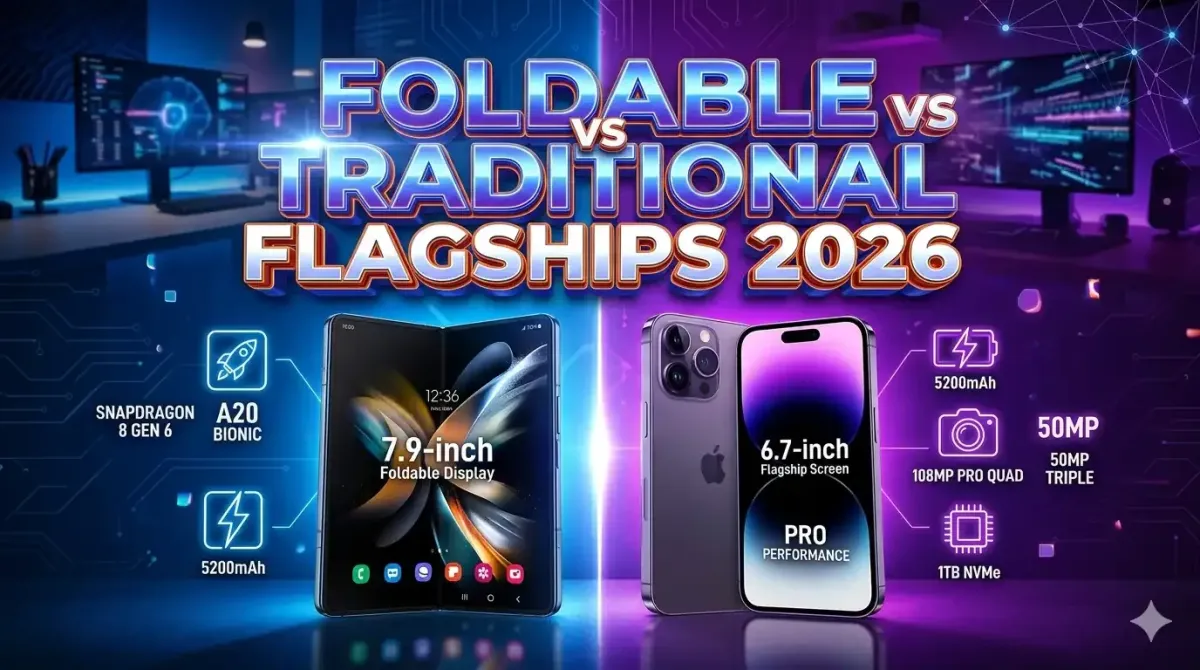
The 2026 Smartphone Buyer's Guide: Foldable vs. Traditional Flagships
The smartphone market in 2026 has reached a fascinating inflection point where foldable devices have matured from experimental novelties into legitimate flagship contenders, challenging the dominance of traditional slab-style flagships. As consumers face this critical purchasing decision, understanding the trade-offs between innovative foldable designs and proven traditional flagships becomes essential for making an informed investment. This comprehensive technical guide examines both form factors across critical dimensions including display technology, durability, performance, battery life, camera capabilities, software optimization, and total cost of ownership. Whether you're a productivity-focused professional seeking maximum screen real estate, a content creator demanding the best camera system, or a tech enthusiast weighing innovation against reliability, this guide provides the detailed analysis needed to select the smartphone that aligns with your usage patterns, budget constraints, and long-term technology roadmap. By understanding the architectural differences, real-world performance characteristics, and ecosystem considerations, you can confidently choose between the cutting-edge versatility of foldables and the refined reliability of traditional flagships in 2026.
Understanding the 2026 Smartphone Landscape
The smartphone industry in 2026 represents a mature market where incremental improvements have become the norm, but foldable technology has finally crossed the threshold from early adoption to mainstream viability. Major manufacturers including Samsung, Google, OnePlus, and emerging Chinese brands have invested heavily in refining foldable designs, addressing early concerns about durability, crease visibility, and software optimization.
Traditional flagships continue to dominate market share, offering refined designs, exceptional camera systems, and proven reliability that appeals to the majority of consumers. However, foldables have carved out a significant niche, particularly among productivity-focused users, tech enthusiasts, and professionals who value the enhanced multitasking capabilities that larger, flexible displays provide.
For professionals evaluating smartphone productivity features, understanding top 10 must-have apps for professional productivity in 2026 provides context for how different form factors impact app utilization and workflow efficiency across various professional scenarios.
Foldable Smartphones: Technology Evolution and Current State
Foldable smartphones in 2026 have evolved significantly from their 2019 debut, with manufacturers addressing early criticisms and refining the technology through multiple generations. The current landscape features two primary form factors: book-style foldables that open like a book to reveal a tablet-sized internal display, and clamshell designs that fold vertically for enhanced portability.
Display Technology Advances:
- Ultra-Thin Glass (UTG): Replaced plastic substrates, providing better durability and reduced crease visibility while maintaining flexibility
- Improved Hinge Mechanisms: Multi-link hinge designs with 200,000+ fold ratings, addressing durability concerns from early generations
- Reduced Crease: Advanced display lamination techniques have minimized the visible crease, though it remains detectable under certain lighting conditions
- Higher Refresh Rates: 120Hz LTPO displays on both cover and internal screens for smooth scrolling and adaptive refresh rates
Software Optimization:
Android 15 and manufacturer skins have matured significantly for foldable devices, with:
- App Continuity: Seamless transition between cover display and internal display without app restarts
- Multi-Window Enhancements: Native support for running 3-4 apps simultaneously on larger internal displays
- Taskbar Implementation: Desktop-style taskbars for quick app switching and multitasking
- Flex Mode: Optimized UI when device is partially folded for hands-free video calls and content consumption
2026 Flagship Foldable Models:
- Samsung Galaxy Z Fold 6: $1,899 starting price, 7.6" internal display, refined hinge design
- Google Pixel Fold 2: $1,799 starting price, superior camera system, clean Android experience
- OnePlus Open 2: $1,699 starting price, competitive pricing with flagship specs
- Samsung Galaxy Z Flip 6: $999 starting price, clamshell design, improved cover screen functionality
For users concerned about maximizing device longevity, understanding maximizing battery life on your smartphone proven AI-optimized tips becomes particularly relevant for foldable devices where battery optimization is crucial given the larger displays and additional power demands.
Traditional Flagships: The Proven Formula
Traditional flagship smartphones in 2026 continue to represent the safest, most reliable choice for the majority of consumers. These devices benefit from years of refinement, with manufacturers perfecting every aspect from ergonomics to camera performance.
Display Excellence:
- Peak Brightness: 2,500-3,000 nits peak brightness for excellent outdoor visibility
- LTPO Technology: Adaptive 1-120Hz refresh rates balancing smoothness with battery efficiency
- Resolution: QHD+ (1440p) displays providing exceptional clarity without excessive battery drain
- Durability: Gorilla Glass Victus 3 or equivalent with proven drop resistance
Camera System Dominance:
Traditional flagships maintain a significant advantage in camera technology:
- Larger Sensors: 1-inch main sensors capturing more light for superior low-light performance
- Advanced Telephoto: 5x-10x optical zoom with periscope lenses
- Computational Photography: Mature AI processing for HDR, night mode, and portrait photography
- Video Capabilities: 8K recording, advanced stabilization, and professional video features
Battery and Charging:
- Capacity: 5,000-5,500 mAh batteries providing all-day battery life
- Fast Charging: 45-120W wired charging, 15-50W wireless charging
- Efficiency: Optimized power management delivering 7-9 hours screen-on time
2026 Traditional Flagship Models:
- Samsung Galaxy S26 Ultra: $1,299 starting price, S Pen integration, 200MP camera
- iPhone 18 Pro Max: $1,199 starting price, iOS ecosystem, superior video recording
- Google Pixel 10 Pro: $999 starting price, best-in-class computational photography
- OnePlus 13: $899 starting price, flagship specs at competitive pricing
For users prioritizing device security, reviewing how to secure your mobile device from advanced cyber threats provides essential guidance applicable to both foldable and traditional flagship devices in protecting sensitive data and maintaining privacy.
Detailed Comparison: Display Quality and Usability
Display technology represents one of the most significant differentiators between foldable and traditional flagships, with each form factor offering distinct advantages.
| Feature | Foldable Flagships | Traditional Flagships | Winner |
|---|---|---|---|
| Screen Size (Primary) | 7.6-8.0" unfolded | 6.7-6.9" | Foldable |
| Cover Display | 6.2-6.5" (usable but smaller) | 6.7-6.9" (full-size) | Traditional |
| Resolution | QXGA+ (2176x1812 internal) | QHD+ (3120x1440) | Traditional |
| Refresh Rate | 1-120Hz LTPO | 1-120Hz LTPO | Tie |
| Peak Brightness | 1,800-2,200 nits | 2,500-3,000 nits | Traditional |
| Durability | UTG, improving but concerns remain | Gorilla Glass Victus 3 | Traditional |
| Multitasking Space | Excellent (tablet-sized) | Limited (split-screen only) | Foldable |
Foldable Display Advantages:
The larger internal display on foldables provides genuine productivity benefits, allowing users to run multiple apps simultaneously with comfortable sizing. Reading documents, editing spreadsheets, and viewing multimedia content becomes significantly more comfortable on the 7.6-8 inch display. The ability to use the device as a tablet replacement for light productivity tasks adds genuine value for business users and content consumers.
Traditional Display Advantages:
Traditional flagships offer superior display quality in measurable ways: higher peak brightness for outdoor visibility, better color accuracy, higher resolution density, and proven long-term durability. The single, rigid display doesn't suffer from crease visibility or potential hinge-related issues that can develop over years of use.
For users concerned about managing screen time across different device form factors, understanding managing digital wellbeing best apps to control screen time provides strategies for maintaining healthy usage patterns regardless of whether you choose a foldable or traditional flagship.
Performance and Multitasking Capabilities
Both foldable and traditional flagships in 2026 utilize flagship-tier processors, but the real-world performance experience differs significantly based on form factor and software optimization.
Processor Parity:
- Qualcomm Snapdragon 8 Gen 4: Powers most Android flagships in both categories
- Apple A18 Pro: Exclusive to iPhone 18 Pro series (traditional only)
- Google Tensor G5: Powers Pixel 10 series (traditional only)
- Samsung Exynos 2500: Regional variant in some markets
Multitasking Advantages - Foldables:
- True Multi-Window: Run 3-4 apps simultaneously with usable screen real estate for each
- Drag and Drop: Move content between apps seamlessly on large internal display
- App Pairing: Save and launch app combinations optimized for split-screen workflows
- Desktop Mode: Some models offer PC-like desktop environments when connected to external displays
Multitasking - Traditional Flagships:
- Split Screen: Limited to 2 apps with constrained screen real estate
- Pop-Up Windows: Floating windows for quick access but limited usability
- Optimization: Better single-app performance with full screen resources
Real-World Performance:
For productivity tasks, foldables provide genuine advantages. Users can reference documents while writing emails, monitor communications while video conferencing, and edit photos while browsing reference materials—all without constant app switching. Traditional flagships require more frequent context switching, which can impact workflow efficiency.
However, traditional flagships often deliver better sustained performance in gaming and intensive single-app tasks, as they don't need to manage the thermal and power demands of larger displays or the additional complexity of foldable mechanisms.
Camera Systems: Quality vs. Innovation
Camera capabilities represent one of the most significant differentiators, with traditional flagships maintaining a clear advantage in 2026.
Traditional Flagship Camera Advantages:
- Larger Sensors: Physical space allows for 1-inch main sensors capturing significantly more light
- Advanced Telephoto: Dedicated periscope lenses with 5x-10x optical zoom
- Better Low Light: Larger pixels and superior image processing
- Video Recording: 8K recording, advanced stabilization, ProRes support
- Mature Software: Years of computational photography refinement
Foldable Camera Limitations:
- Space Constraints: Thinner profiles limit sensor size and lens complexity
- Compromise Design: Cameras must fit within hinge mechanism constraints
- Cover Display Limitations: Selfie cameras on cover displays often lower resolution
- Software Optimization: Less mature computational photography compared to traditional flagships
Camera Comparison (2026 Flagships):
| Feature | Premium Foldable | Premium Traditional |
|---|---|---|
| Main Sensor | 50MP, 1/1.56" | 200MP, 1-inch |
| Telephoto | 10MP, 3x optical | 50MP, 5-10x optical |
| Ultrawide | 12MP, 120° FOV | 50MP, 120° FOV |
| Video | 4K 60fps | 8K 30fps, 4K 120fps |
| Low Light | Good | Excellent |
The Verdict:
If camera quality is your primary concern, traditional flagships remain the superior choice in 2026. The physical constraints of foldable designs prevent manufacturers from implementing the large sensors and complex lens systems that deliver exceptional photography. However, foldable cameras have improved significantly and are perfectly adequate for most users' needs.
For content creators evaluating smartphone capabilities, exploring the best AI-powered gadgets for content creators and vloggers provides context for how different smartphone form factors integrate with broader content creation ecosystems and workflows.
Durability and Long-Term Reliability
Durability concerns remain one of the most significant barriers to foldable adoption, though 2026 models have made substantial improvements.
Foldable Durability in 2026:
- Hinge Ratings: 200,000-400,000 fold cycles (5-10 years of typical use)
- Ultra-Thin Glass: More durable than plastic but still more fragile than traditional glass
- Water Resistance: IPX8 rating on premium models, but dust resistance remains limited
- Crease Development: Visible crease persists, though less pronounced than earlier generations
- Repair Costs: Significantly higher than traditional flagships ($500-$800 for display replacement)
Traditional Flagship Durability:
- Proven Design: Years of refinement with established reliability track records
- Gorilla Glass Victus 3: Excellent drop and scratch resistance
- IP68 Rating: Comprehensive dust and water resistance
- Lower Repair Costs: $300-$500 for display replacement
- Long-Term Support: 5-7 years of software updates from major manufacturers
Real-World Reliability Concerns:
While foldable technology has matured significantly, long-term reliability data beyond 2-3 years remains limited. Traditional flagships benefit from decades of refinement and extensive real-world usage data. For users planning to keep devices for 3-5 years, traditional flagships offer more predictable long-term reliability.
However, manufacturers now offer comprehensive warranty programs and repair services specifically for foldables, reducing the financial risk of ownership. Samsung, Google, and OnePlus all provide specialized repair programs and extended warranty options for foldable devices.
Battery Life and Charging Performance
Battery performance represents a critical consideration, particularly for foldable devices that must power larger displays.
Battery Capacity Comparison:
- Foldable Flagships: 4,400-5,000 mAh (dual battery designs)
- Traditional Flagships: 5,000-5,500 mAh (single battery)
Real-World Battery Life:
| Usage Scenario | Foldable (Hours) | Traditional (Hours) |
|---|---|---|
| Screen-On Time | 6-8 hours | 8-10 hours |
| Video Playback | 12-14 hours | 15-18 hours |
| Mixed Usage | Full day (moderate use) | Full day+ (heavy use) |
| Heavy Multitasking | 5-6 hours | 7-8 hours |
Charging Speeds:
- Foldable Flagships: 25-45W wired, 10-15W wireless
- Traditional Flagships: 45-120W wired, 15-50W wireless
Battery Life Analysis:
Traditional flagships maintain a clear advantage in battery life due to larger battery capacity in similar physical footprints and more efficient single-display designs. Foldables must power two displays (cover and internal) and manage the additional complexity of hinge mechanisms, resulting in 15-25% shorter battery life in real-world usage.
However, foldables offer unique battery optimization opportunities: users can conserve battery by using only the smaller cover display for basic tasks, reserving the larger internal display for productivity sessions. This selective usage can extend battery life for users who don't constantly utilize the internal display.
For users seeking to maximize battery longevity across either device type, understanding maximizing battery life on your smartphone proven AI-optimized tips provides actionable strategies for extending battery lifespan and daily usage time.
Software Ecosystem and App Optimization
Software experience differs significantly between foldable and traditional flagships, with implications for daily usability.
Foldable Software Advantages:
- Enhanced Multitasking: Native support for running multiple apps with usable screen space
- App Continuity: Seamless transition between cover and internal displays
- Flex Mode: Optimized UI for partially folded usage scenarios
- Taskbar: Desktop-style quick access to frequently used apps
- Drag and Drop: Move content between apps intuitively
Traditional Flagship Software:
- App Optimization: All apps optimized for standard aspect ratios
- Consistency: Uniform experience across all usage scenarios
- Maturity: Years of refinement and bug fixes
- Feature Parity: No compromise features or scaled-back functionality
App Compatibility Concerns:
While Android 15 has significantly improved foldable app optimization, some apps still don't fully utilize the larger internal displays or properly handle transitions between cover and internal screens. Traditional flagships benefit from universal app optimization, ensuring consistent experiences across all applications.
For productivity-focused users, exploring top 10 must-have apps for professional productivity in 2026 reveals which applications best leverage the enhanced screen real estate of foldable devices versus traditional flagships.
Price Analysis and Value Proposition
Price represents a significant differentiator, with foldables commanding premium pricing that impacts overall value proposition.
| Category | Device | Starting Price | Price per Feature |
|---|---|---|---|
| Foldable | Samsung Z Fold 6 | $1,899 | Premium |
| Google Pixel Fold 2 | $1,799 | Premium | |
| OnePlus Open 2 | $1,699 | Competitive | |
| Traditional | Samsung S26 Ultra | $1,299 | Flagship |
| iPhone 18 Pro Max | $1,199 | Flagship | |
| Google Pixel 10 Pro | $999 | Value Flagship | |
| OnePlus 13 | $899 | Budget Flagship |
Total Cost of Ownership:
- Foldables: Higher initial cost + potential repair costs + premium accessories = $2,200-$2,800 over 3 years
- Traditional: Lower initial cost + standard repair costs + standard accessories = $1,400-$1,800 over 3 years
Value Analysis:
Foldables cost 40-60% more than comparable traditional flagships. The premium buys you:
- Larger, more versatile display
- Enhanced multitasking capabilities
- Innovative form factor
- Future-proofing for emerging software features
Traditional flagships provide better value for users prioritizing:
- Camera quality
- Battery life
- Long-term reliability
- Lower total cost of ownership
Use Case Analysis: Who Should Buy What
The optimal choice depends heavily on your primary use cases and priorities.
Choose a Foldable If:
- Productivity is Priority: You regularly multitask, edit documents, or need tablet-like functionality
- You Value Innovation: You appreciate cutting-edge technology and unique form factors
- Media Consumption: You watch videos, read, or browse extensively on your phone
- Business Professional: You need to review documents, respond to emails, and manage tasks on the go
- Budget Flexibility: You can afford the premium pricing and potential repair costs
- Early Adopter: You're comfortable with newer technology and potential minor issues
Choose a Traditional Flagship If:
- Camera Quality Matters: Photography and videography are primary concerns
- Battery Life Critical: You need all-day battery life with heavy usage
- Long-Term Reliability: You plan to keep your device for 3-5 years
- Budget Conscious: You want flagship performance without premium pricing
- Gaming Focus: You prioritize gaming performance and sustained performance
- Proven Technology: You prefer established, refined designs over innovation
Future-Proofing Considerations
Looking ahead, both form factors will continue evolving, but at different trajectories.
Foldable Future (2027-2029):
- Price Reduction: Expected to drop 15-20% as manufacturing scales
- Improved Durability: Next-generation hinges and display materials
- Software Maturation: Better app optimization and foldable-specific features
- Tri-Fold Designs: Emerging form factors with even larger displays
Traditional Flagship Future:
- Incremental Improvements: Refined designs with marginal upgrades
- Camera Advances: Continued sensor and computational photography improvements
- Battery Technology: Solid-state batteries potentially arriving 2027-2028
- AI Integration: Deeper AI integration for photography, productivity, and personalization
Resale Value:
Traditional flagships currently maintain better resale value due to broader market demand and established reliability. Foldables depreciate faster (30-40% in first year vs. 25-30% for traditional flagships) but this gap is narrowing as foldables gain mainstream acceptance.
Common Concerns and Misconceptions
Several myths persist about both form factors that deserve clarification.
Myth 1: "Foldables are too fragile"
Reality: 2026 foldables have undergone extensive durability testing. While not as rugged as traditional flagships, they're far more durable than early generations. Proper cases and careful handling make them viable for daily use.
Myth 2: "The crease ruins the experience"
Reality: The crease is visible under certain lighting conditions but doesn't impact functionality. Most users adapt within days and rarely notice it during normal usage.
Myth 3: "Traditional flagships are boring"
Reality: Traditional flagships continue innovating in camera technology, AI features, and performance optimization. They're refined, not stagnant.
Myth 4: "Foldables aren't worth the premium"
Reality: For productivity-focused users, the enhanced multitasking and larger display provide genuine value that justifies the premium. For casual users, traditional flagships offer better value.
Making Your Decision: A Framework
Use this decision framework to guide your purchase:
Step 1: Identify Primary Use Cases
- List your top 5 daily smartphone activities
- Rank them by importance and frequency
- Identify which form factor better serves each activity
Step 2: Assess Budget Constraints
- Determine maximum comfortable spending
- Factor in potential repair costs (higher for foldables)
- Consider total cost of ownership over 3 years
Step 3: Evaluate Priorities
- Camera quality vs. display versatility
- Battery life vs. multitasking capability
- Proven reliability vs. cutting-edge innovation
Step 4: Test Before Buying
- Visit retail stores to handle both form factors
- Test fold mechanism and cover display usability
- Evaluate size, weight, and ergonomics
Step 5: Consider Ecosystem
- Existing devices (tablet, laptop, smartwatch)
- Software preferences (Android vs. iOS)
- Cloud services and data synchronization
Conclusion: Choosing Your 2026 Smartphone
The 2026 smartphone market offers compelling options in both foldable and traditional flagship categories, each serving distinct user needs and preferences. There is no universally superior choice; the optimal device depends entirely on your specific requirements, usage patterns, and priorities.
Foldable smartphones have matured into legitimate flagship contenders, offering genuine productivity advantages through larger displays and enhanced multitasking capabilities. They're ideal for business professionals, productivity enthusiasts, and early adopters who value innovation and can accommodate premium pricing. The technology has advanced sufficiently to address most early concerns about durability and software optimization, though long-term reliability data remains limited compared to traditional designs.
Traditional flagships continue to excel in areas that matter most to the majority of users: camera quality, battery life, proven reliability, and value for money. They're the safer choice for photography enthusiasts, heavy users requiring all-day battery life, and anyone prioritizing long-term reliability over cutting-edge innovation.
Before making your decision, honestly assess your daily usage patterns, budget constraints, and long-term needs. Visit retail stores to handle both form factors, test the fold mechanism on foldables, and evaluate which device feels more intuitive for your workflow. Consider your ecosystem—existing devices, cloud services, and software preferences—as these factors significantly impact daily usability.
Remember that both categories will continue evolving. Foldables will become more affordable and durable, while traditional flagships will refine their camera systems and battery technology. Choose the device that serves your needs today while considering how well it will adapt to your needs over the next 2-3 years.
Your smartphone is a deeply personal tool that impacts your daily productivity, creativity, and connectivity. Whether you choose the innovative versatility of a foldable or the refined reliability of a traditional flagship, ensure your decision aligns with how you actually use your device, not just marketing promises or spec sheet comparisons. The best smartphone is the one that seamlessly integrates into your life and enhances your daily experiences.