
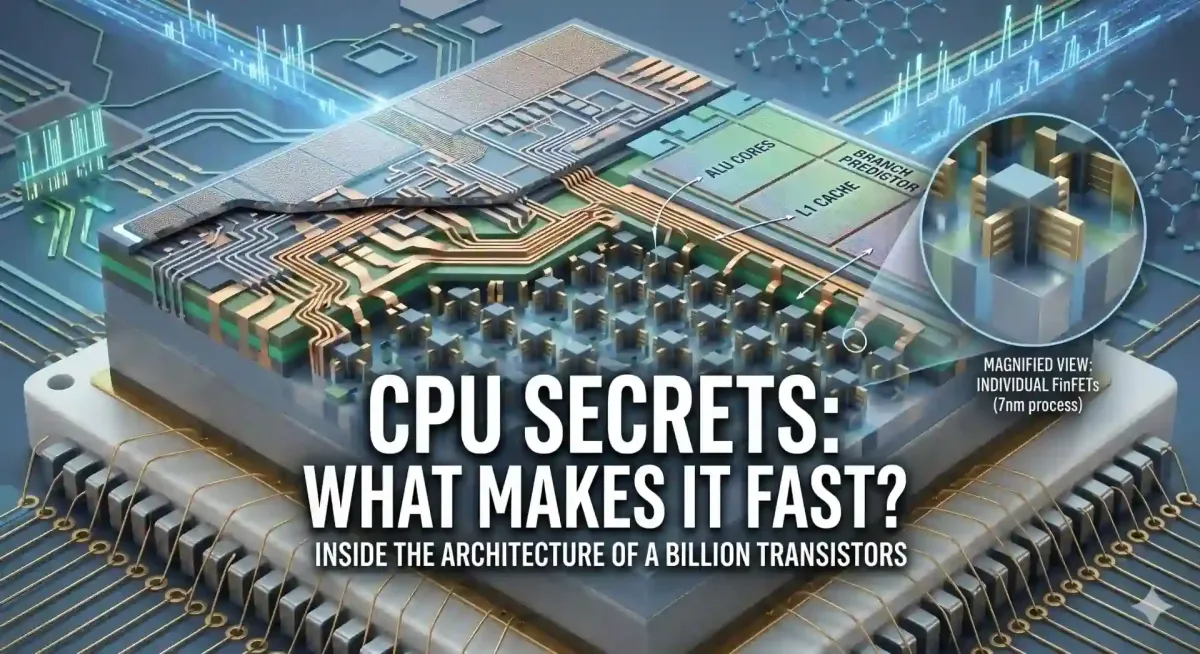
Understanding CPU Architecture: What Makes a Processor Fast in 2026
In 2026, we often hear about "5.5 GHz clock speeds" or "3nm process nodes," but what do these terms actually mean for your daily performance? A fast processor is not just about one single number; it is a complex symphony of millions of transistors, microscopic pathways, and intelligent scheduling. Understanding the architecture of your CPU is the key to making an informed decision for your next upgrade. At TipsForAITech, we are peeling back the silicon layers to explain what really makes a modern processor fast.
This 1500+ word comprehensive guide dives into the heart of the CPU. Whether you are comparing Intel and AMD or choosing a new development machine, mastering architecture is essential in 2026.
[Image showing a high-resolution die shot of a modern CPU, highlighting the cores, cache clusters, and the integrated NPU]1. Clock Speed: The Heartbeat of the CPU
Clock Speed, measured in Gigahertz (GHz), is the number of cycles a CPU executes per second. In 2026, while we have reached incredible speeds, clock speed alone isn't everything. A 5GHz processor from five years ago is significantly slower than a 5GHz processor today. This is because modern chips do more "work" per cycle, a concept essential for maintaining professional productivity.
2. IPC (Instructions Per Clock): The Real Efficiency
If Clock Speed is the "RPM" of an engine, IPC is the horsepower. IPC measures how many tasks a CPU can complete in a single clock cycle. In 2026, architectural improvements focus heavily on IPC, allowing chips to be faster without needing more power. This efficiency is what drives robotics and mobile computing where battery life is critical.
3. Cores and Threads: The Multi-tasking Masters
In 2026, we have moved into the era of Hybrid Architecture. Modern CPUs use a mix of:
- P-Cores (Performance Cores): For heavy tasks like gaming or compiling complex code.
- E-Cores (Efficiency Cores): For background tasks, ensuring smooth multi-tasking without draining your battery.
4. Cache Memory: The CPU’s "Near-Term" Memory
The CPU is much faster than your RAM. To prevent the processor from waiting, it uses Cache (L1, L2, and L3). In 2026, "Stacked Cache" technology (like AMD’s 3D V-Cache) has revolutionized performance. Larger cache means the CPU can store more data closer to the cores, drastically speeding up big data and spreadsheet processing.
5. The Nanometer Race: 3nm and 2nm Process Nodes
The "nm" number refers to the size of the transistors. In 2026, we are seeing the mainstream adoption of 2nm and 3nm technology. Smaller transistors mean more can be packed onto a single chip, leading to higher speeds and lower heat. This miniaturization is the foundation for quantum-ready silicon developments.
[Image showing a microscopic comparison: Transistor density of a 14nm chip vs. a 2026-era 2nm chip]6. The NPU: The New Core for AI
A fast processor in 2026 must have an NPU (Neural Processing Unit). This specialized part of the architecture handles AI tasks like background blur in video calls or running local AI writing assistants. By offloading these tasks to the NPU, the main CPU cores are free to focus on performance.
7. Thermal Throttling and Heat Management
Speed creates heat. If a CPU gets too hot, it slows itself down (throttling). In 2026, architecture designs include Advanced Heat Spreaders and AI-driven thermal management. Keeping your system cool is vital, especially when self-hosting your own cloud server.
8. Security: Architecture-Level Protection
Modern CPU architecture includes dedicated security enclaves. In 2026, these "secure zones" protect your passkeys and biometric data from hackers. Using open-source security tools alongside hardware protection ensures your small business remains safe from ransomware.
9. Using AI Writing Assistants to Simplify Technical Specs
Explaining CPU architecture to a non-technical audience is a challenge. In 2026, IT professionals use advanced writing assistants to translate complex specs into clear purchasing advice, maintaining maximum professional productivity.
10. Conclusion: The Future is More Than Just Speed
In 2026, a fast processor is a smart processor. It’s a machine that knows when to use raw power and when to be efficient. It’s a balance of clock speed, IPC, cache, and specialized AI cores. As we move toward even smaller nodes and more complex hybrid designs, the CPU remains the most impressive piece of engineering in the human world. When you understand what’s happening under the hood, you’re not just a user—you’re a master of your digital environment. Speed is the result; architecture is the reason. Choose wisely!
Stay at the forefront of the hardware and AI revolution by following TipsForAITech. Whether you're looking for financial automation tips or development frameworks, we are your partner in the 2026 technology landscape.