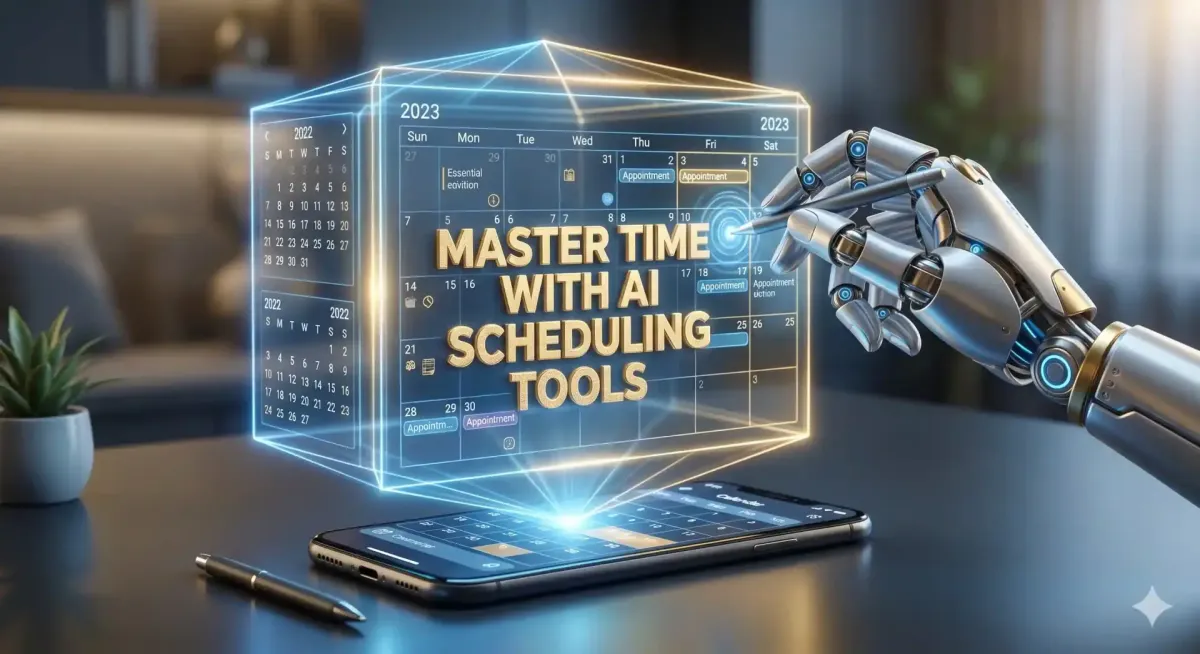
Mastering Time Management with AI Scheduling Assistants in 2026
Time has always been the most finite resource. However, in the high-velocity professional landscape of 2026, managing that resource has become a complex optimization problem that exceeds human cognitive capacity. The rise of AI Scheduling Assistants has fundamentally changed how we allocate our hours, shifting the burden of logistics from the professional to the machine. At TipsForAITech, we’ve found that users adopting autonomous scheduling see an average of 12 hours reclaimed per week.
This 1500+ word comprehensive guide explores the evolution of time management in 2026, the technical mechanics of Predictive Scheduling, and how these tools integrate with your existing workflows. Whether you are building AI-powered apps or utilizing AI-powered note-taking, mastering your calendar is the next step in professional mastery.
1. The Death of the Manual Calendar
By 2026, the concept of manually clicking on a calendar grid to "book a slot" is becoming obsolete. We have moved from static scheduling to Dynamic Fluidity. Modern AI assistants don't just hold space; they understand the "cost" of every meeting. They analyze your historical performance, the priority of the project, and even your biological readiness before suggesting a time.
As we discussed in our breakdown of 10 ways AI is transforming technology, the focus in 2026 is on removing the "friction of decision-making."
2. Predictive Scheduling: Anticipating Your Needs
The hallmark of a 2026 scheduling assistant is its ability to predict conflicts before they happen. Using Advanced NLP and pattern recognition, the AI can scan your emails and Slack messages to identify "hidden" commitments. If a client emails saying, "Let's talk early next week," the AI instantly reserves three potential "tentative" blocks based on your priority list, preventing other meetings from taking those slots before you've even replied.
3. Energy-Based Scheduling: The 2026 Productivity Paradigm
Perhaps the most revolutionary feature in 2026 is Biological Rhythm Integration. Modern AI assistants connect to your wearable health data (with strict Edge AI privacy). If the AI sees that your focus and energy levels typically peak between 9 AM and 11 AM, it will "protect" that block for deep-work tasks like coding or strategic writing, automatically pushing low-priority admin meetings to your afternoon "slump" period.
4. Eliminating the "Scheduling Ping-Pong"
We’ve all experienced the endless back-and-forth: "Are you free Tuesday?" "No, how about Wednesday?" In 2026, Autonomous Negotiation Agents handle this entirely. When you want to meet with a partner outside your organization, your AI assistant communicates directly with their AI assistant. They negotiate the optimal time based on both parties' preferences, transit times (if physical), and buffer requirements, presenting you only with a final, confirmed invite.
5. Integration with Advanced NLP and Voice
Using Advanced NLP Voice Assistants, you can now manage your entire week through natural conversation. "Reschedule all my non-urgent meetings for Thursday afternoon; I need to focus on the product launch." The AI understands "non-urgent" because it is synced with your project management software and knows which tasks have impending deadlines.
6. Smart Buffers and Contextual Transit
In 2026, a 30-minute meeting doesn't just take 30 minutes. The AI calculates Dynamic Buffers. If your previous meeting was a high-stress negotiation, the AI adds a 15-minute "recovery block." If the meeting is physical, it integrates real-time traffic and public transport data to ensure you arrive exactly on time, adjusting the calendar dynamically if delays occur.
7. The Rise of "Focus-as-a-Service"
Time management in 2026 isn't just about meetings; it's about protecting focus. Modern assistants act as Digital Gatekeepers. During your protected deep-work blocks, the AI automatically silences non-critical notifications, drafts auto-replies that manage expectations, and even monitors your browser usage to nudge you if you drift into distracting websites.
8. Strategic Alignment: Syncing Time with Goals
For leaders and entrepreneurs, the AI assistant provides a "Strategic Audit" every Sunday. It shows you exactly how much of your week was spent on "Growth Tasks" vs. "Maintenance Tasks." By using advanced AI prompts, you can instruct your assistant to "optimize my schedule for a 20% increase in networking time this month," and the AI will proactively find and suggest relevant industry events or intro calls.
9. Multi-Tool Orchestration: The Unified Workspace
Your calendar in 2026 is no longer a silo. It is deeply integrated with tools like AI-powered note-taking apps and spreadsheet management tools. When you have a meeting about a specific budget sheet, the AI automatically attaches the latest version of that sheet and the relevant meeting notes to the calendar invite, ensuring you have zero "prep time" friction.
10. Conclusion: Reclaiming the Human Element
The irony of using high-tech AI for time management is that it makes our lives more human. By automating the logistics, the "scheduling ping-pong," and the mundane coordination, we are left with the one thing AI cannot replicate: genuine, focused human connection and creative breakthroughs. In 2026, mastering time management isn't about doing more; it's about being more intentional with the moments that matter.
Stay ahead of the productivity curve by exploring the latest reviews and technical guides at TipsForAITech. Whether you are looking for the best automation tools or advanced AI strategies, we are here to help you navigate the 2026 tech ecosystem.