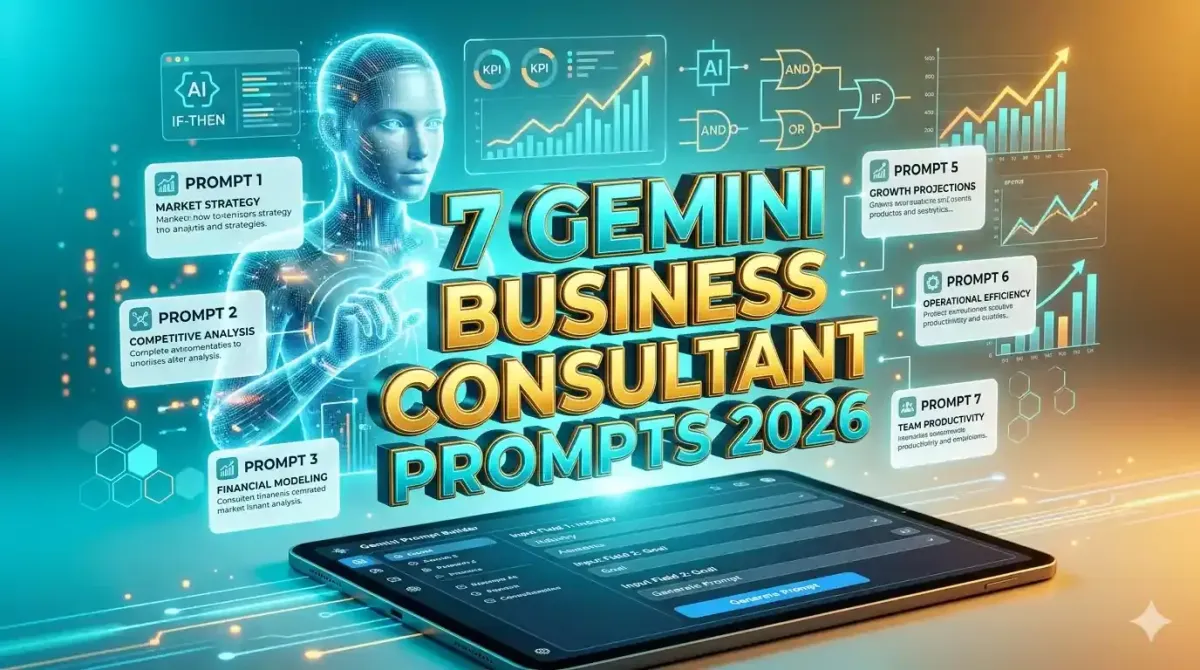
7 Prompts to Turn Gemini into a Professional Business Consultant
Transforming Gemini into a professional business consultant in 2026 requires moving beyond generic conversational inputs and implementing structured, constraint-driven prompt architectures that simulate strategic analysis, financial modeling, regulatory compliance, and operational optimization. Modern business consultants rely on systematic frameworks, data-driven forecasting, risk assessment matrices, and iterative scenario planning. By engineering prompts that enforce these professional methodologies, executives and founders can leverage Gemini to produce enterprise-grade strategic recommendations, market intelligence reports, and process optimization roadmaps without incurring traditional consulting overhead. This comprehensive technical guide provides seven battle-tested prompt templates, complete with implementation workflows, validation checkpoints, output structuring rules, and performance measurement frameworks. By mastering these advanced prompting techniques, business leaders can accelerate strategic decision-making by sixty to seventy-five percent, reduce analytical blind spots, and deploy AI-assisted consulting workflows that maintain rigorous professional standards across market analysis, financial planning, compliance auditing, and organizational transformation initiatives.
Understanding Gemini 2026 Architecture for Business Logic
Gemini's 2026 architecture has evolved to support extended context retention, advanced reasoning chains, and domain-specific instruction following. Unlike early language models that produced superficial business advice, contemporary versions process multi-layered constraints, maintain logical consistency across extended analytical workflows, and generate outputs that align with established consulting methodologies like SWOT analysis, Porter's Five Forces, PESTLE evaluation, and discounted cash flow modeling. The model's improved instruction adherence allows prompt engineers to specify output schemas, enforce calculation transparency, and require explicit risk disclosures before generating strategic recommendations.
Professional business consulting demands precision, accountability, and reproducible reasoning. Gemini achieves this through deterministic prompt scaffolding that separates role definition, contextual data ingestion, analytical constraints, and output formatting into discrete instruction layers. When properly engineered, these prompts force the model to articulate intermediate analytical steps, cross-validate assumptions against provided datasets, and flag information gaps before finalizing recommendations. This architectural capability transforms Gemini from a conversational assistant into a structured analytical engine capable of supporting executive decision-making, investor due diligence, and operational restructuring projects.
For developers exploring foundational prompt engineering patterns that scale into enterprise consulting workflows, reviewing top 25 ChatGPT prompts every developer should know provides essential syntax conventions and constraint optimization techniques that directly translate to advanced business consulting prompt architectures.
Prompt One: Strategic Market Analysis and Competitive Intelligence
Market analysis requires systematic evaluation of industry dynamics, competitor positioning, customer segmentation, and macroeconomic indicators. Traditional consulting engagements dedicate weeks to data collection, expert interviews, and strategic synthesis. Gemini can compress this timeline dramatically when guided by prompts that enforce analytical rigor, mandate evidence-based reasoning, and structure outputs for executive consumption.
Prompt Template Structure:
Act as a senior market strategy consultant. Conduct a comprehensive competitive intelligence analysis for [INDUSTRY/SECTOR] targeting [TARGET MARKET/REGION].

Step 1: Industry Landscape Assessment
- Apply PESTLE framework to identify political, economic, social, technological, legal, and environmental factors impacting market growth
- Quantify total addressable market size using recent industry reports and project three-year compound annual growth rate
- Identify regulatory shifts and compliance requirements shaping market entry barriers

Step 2: Competitive Positioning Matrix
- Map top five competitors using Porter's generic strategies framework
- Analyze pricing models, distribution channels, customer acquisition costs, and retention metrics
- Identify white space opportunities where competitor coverage is weak or absent

Step 3: Customer Segmentation and Behavior Analysis
- Define three primary buyer personas with demographic, psychographic, and purchasing behavior profiles
- Evaluate decision-making cycles, preferred information channels, and price sensitivity thresholds
- Identify unmet needs and pain points current market offerings fail to address

Step 4: Strategic Recommendations
- Present three market entry or expansion strategies with implementation timelines, resource requirements, and projected market share capture
- Include risk mitigation protocols for each strategy
- Format output as an executive brief with executive summary, analytical tables, and actionable next steps
Implementation Guidelines:
- Provide current market data, competitor names, and target region parameters before execution
- Enforce citation requirements by instructing Gemini to reference publicly available industry reports and financial filings
- Require explicit disclosure of assumptions and confidence levels for market size projections
- Validate output against recent sector performance metrics to identify hallucination risks
For teams scaling competitive intelligence across multiple product lines, integrating the future of SaaS top trends to watch this year ensures market analysis remains aligned with evolving subscription models, platform consolidation patterns, and enterprise procurement shifts that directly impact go-to-market strategies.
Prompt Two: Financial Modeling and Revenue Forecasting
Financial forecasting requires disciplined application of accounting principles, scenario modeling, and sensitivity analysis. Business consultants build multi-year projections that incorporate revenue drivers, cost structures, capital expenditure requirements, and working capital dynamics. Gemini can generate transparent financial models when prompts enforce calculation visibility, mandate variable isolation, and require stress testing against macroeconomic fluctuations.
Prompt Template Structure:
Act as a senior financial consultant specializing in startup and growth-stage modeling. Build a three-year financial projection for [COMPANY/PRODUCT] operating in [INDUSTRY].

Step 1: Revenue Architecture
- Define three revenue streams with pricing models, customer acquisition assumptions, and churn projections
- Calculate monthly recurring revenue trajectory using conservative, base, and aggressive adoption scenarios
- Apply seasonality adjustments and sales cycle duration to revenue recognition timing

Step 2: Cost Structure and Margin Analysis
- Map fixed versus variable costs including personnel, infrastructure, marketing, and compliance expenses
- Calculate gross margin, operating margin, and contribution margin by product line
- Identify break-even point using fixed cost coverage and average revenue per user metrics

Step 3: Cash Flow and Working Capital Dynamics
- Project operating cash flow monthly for year one, quarterly for years two and three
- Model accounts receivable collection cycles and inventory turnover impact on liquidity
- Calculate runway under each scenario and identify capital injection triggers

Step 4: Sensitivity Analysis and Risk Disclosure
- Test financial resilience against fifteen percent revenue decline, twenty percent cost inflation, and extended sales cycles
- Present downside protection strategies including cost optimization levers and alternative financing options
- Output structured financial tables with clear assumption documentation and executive commentary
Validation Protocol:
- Cross-check mathematical calculations using independent spreadsheet models before executive presentation
- Verify that revenue recognition aligns with standard accounting practices for subscription, transactional, or service-based models
- Require Gemini to explicitly state limitations in forecasting accuracy due to market volatility or incomplete historical data
- Implement scenario tracking dashboards that compare projected versus actual performance monthly
For organizations managing complex financial operations, connecting AI forecasting workflows to how to automate your accounting using modern SaaS tools enables real-time data synchronization between projected models and actual financial performance, reducing reconciliation overhead and improving forecast accuracy.
Prompt Three: Operational Efficiency and Process Optimization
Operational consulting focuses on eliminating bottlenecks, reducing waste, standardizing workflows, and scaling infrastructure without proportional headcount growth. Gemini excels at process mapping, resource allocation analysis, and automation opportunity identification when guided by prompts that enforce systematic workflow decomposition and quantify efficiency gains.
Prompt Template Structure:
Act as an operations excellence consultant. Analyze and optimize the [DEPARTMENT/FUNCTION] workflow for [COMPANY TYPE] processing [VOLUME] transactions monthly.

Step 1: Current State Process Mapping
- Document end-to-end workflow from initiation to completion with role assignments, handoff points, and system dependencies
- Identify bottleneck stages, approval delays, and redundant data entry requirements
- Calculate cycle time, error rate, and resource utilization per process stage

Step 2: Automation and Standardization Opportunities
- Recommend three process automation candidates with implementation complexity ratings and estimated time savings
- Design standardized operating procedures that reduce variation and improve quality consistency
- Identify technology integrations that eliminate manual data transfers between disconnected systems

Step 3: Resource Reallocation and Scaling Strategy
- Project headcount optimization potential through automation deployment and workflow redesign
- Define training requirements and change management protocols for staff transitioning to new processes
- Calculate return on investment including implementation costs, productivity gains, and error reduction benefits

Step 4: Implementation Roadmap
- Present phased rollout plan with milestones, success metrics, and risk mitigation controls
- Include feedback loops for continuous improvement and performance monitoring
- Format output as an operational transformation blueprint with executive summary and technical specifications
Execution Best Practices:
- Provide detailed process documentation, system architecture diagrams, and current performance metrics before prompt execution
- Require Gemini to distinguish between quick wins requiring minimal investment and strategic transformations requiring capital allocation
- Validate automation recommendations against existing technology stack to prevent integration conflicts
- Track post-implementation performance against baseline metrics to measure actual versus projected efficiency gains
For teams deploying automation at scale, reviewing top 5 AI tools to automate your daily repetitive tasks provides practical implementation patterns that complement Gemini's process optimization recommendations and accelerate workflow modernization across operational departments.
Prompt Four: AI-Driven Marketing and Customer Acquisition Strategy
Modern marketing consulting combines data analytics, behavioral psychology, channel optimization, and creative strategy to maximize customer acquisition efficiency and lifetime value. Gemini can generate comprehensive marketing frameworks when prompts enforce audience segmentation, channel attribution modeling, and performance benchmarking against industry standards.
Prompt Template Structure:
Act as a senior marketing strategist. Develop a customer acquisition and retention strategy for [PRODUCT/SERVICE] targeting [DEMOGRAPHIC/MARKET SEGMENT].

Step 1: Audience and Channel Architecture
- Define three primary customer personas with pain points, purchasing triggers, and preferred content consumption channels
- Map customer journey from awareness to conversion with touchpoint optimization recommendations
- Allocate marketing budget across organic, paid, and partner channels based on acquisition cost and lifetime value ratios

Step 2: Content and Messaging Framework
- Develop positioning statement that differentiates from competitors and addresses primary market objections
- Create content calendar structure aligned with buyer journey stages and seasonal demand patterns
- Design messaging variants optimized for each distribution channel while maintaining brand voice consistency

Step 3: Conversion Optimization and Retention Strategy
- Identify friction points in current conversion funnel with recommended testing protocols
- Design onboarding sequence that accelerates time to value and reduces early-stage churn
- Develop loyalty program structure that incentivizes repeat purchases and referral generation

Step 4: Measurement and Iteration Protocol
- Define key performance indicators for each funnel stage with benchmark targets and reporting cadence
- Implement A/B testing framework for continuous optimization of creative, targeting, and pricing elements
- Output comprehensive marketing strategy document with executive summary, budget allocation table, and implementation timeline
Strategic Alignment Requirements:
- Cross-reference marketing recommendations with sales capacity and fulfillment capabilities to prevent overpromising
- Require explicit attribution modeling that distinguishes between assisted and primary conversion channels
- Validate customer acquisition cost projections against industry benchmarks to ensure financial sustainability
- Implement monthly performance reviews that adjust channel allocation based on actual versus projected returns
For marketing teams executing rapid content deployment cycles, integrating how to use generative AI for fast paced social media marketing ensures AI-generated campaign recommendations translate into actionable content pipelines that maintain brand consistency while accelerating production velocity.
Prompt Five: Regulatory Compliance and Risk Management Frameworks
Regulatory compliance consulting requires systematic identification of applicable frameworks, gap analysis against current practices, remediation planning, and ongoing monitoring architecture. Gemini can generate comprehensive compliance roadmaps when prompts enforce jurisdictional specificity, mandate risk severity classification, and require audit-ready documentation standards.
Prompt Template Structure:
Act as a regulatory compliance consultant. Develop a compliance framework for [INDUSTRY/COMPANY] operating in [JURISDICTIONS] handling [DATA/PRODUCT TYPE].

Step 1: Regulatory Landscape Mapping
- Identify all applicable regulations including data protection, industry-specific standards, and cross-border compliance requirements
- Map regulatory obligations to specific business processes and data handling practices
- Classify compliance requirements by severity, implementation complexity, and enforcement risk

Step 2: Gap Analysis and Risk Assessment
- Evaluate current policies and technical controls against regulatory requirements
- Identify compliance gaps with risk scoring based on potential financial penalties, operational disruption, and reputational damage
- Prioritize remediation initiatives based on risk severity and implementation timeline constraints

Step 3: Remediation and Control Implementation
- Design technical and procedural controls to address identified gaps
- Develop employee training curriculum that ensures awareness of compliance obligations and reporting procedures
- Implement audit logging and monitoring systems that provide continuous compliance visibility

Step 4: Ongoing Governance and Reporting
- Establish compliance review cadence with assigned responsibilities and escalation protocols
- Design regulatory change monitoring process that captures framework updates and assesses impact
- Output compliance blueprint with executive summary, risk matrix, implementation roadmap, and audit documentation templates
Compliance Validation Protocols:
- Require Gemini to cite specific regulatory articles and enforcement guidelines supporting each recommendation
- Validate compliance roadmaps against legal counsel review before implementation
- Implement continuous monitoring dashboards that track compliance status and flag emerging regulatory changes
- Maintain version-controlled compliance documentation that supports audit readiness and regulatory examinations
For organizations navigating complex global regulatory environments, understanding understanding the EU AI Act what it means for businesses worldwide ensures compliance frameworks address emerging artificial intelligence governance requirements that increasingly intersect with data protection, algorithmic transparency, and risk classification mandates.
Prompt Six: Organizational Change Management and Leadership Coaching
Change management consulting focuses on aligning leadership behavior, restructuring communication pathways, building capability development programs, and minimizing resistance during transformation initiatives. Gemini can generate comprehensive change management frameworks when prompts enforce stakeholder mapping, communication strategy design, and resistance mitigation planning.
Prompt Template Structure:
Act as an organizational change management consultant. Design a transformation framework for [ORGANIZATION] implementing [CHANGE INITIATIVE] affecting [NUMBER] employees across [DEPARTMENTS/LOCATIONS].

Step 1: Stakeholder and Impact Analysis
- Map stakeholder groups by influence level, resistance probability, and communication preferences
- Assess operational impact across departments including workflow disruption, skill requirements, and performance metric adjustments
- Identify change champions and potential resistance sources with engagement strategies for each group

Step 2: Communication and Training Architecture
- Design phased communication plan that addresses awareness, understanding, buy-in, and adoption stages
- Develop role-specific training curriculum that builds required competencies before implementation
- Create feedback mechanisms that capture employee concerns and measure sentiment progression

Step 3: Leadership Alignment and Behavior Modeling
- Define leadership responsibilities during transformation including visibility, decision transparency, and accountability enforcement
- Design coaching protocols that equip managers to address team concerns and reinforce adoption behaviors
- Establish recognition programs that reward change adoption and continuous improvement contributions

Step 4: Adoption Measurement and Sustainability
- Define leading and lagging indicators that measure adoption velocity, capability development, and performance impact
- Implement reinforcement mechanisms that prevent regression to legacy practices
- Output comprehensive change management plan with executive summary, stakeholder matrix, communication calendar, and success metrics dashboard
Implementation Safeguards:
- Require Gemini to differentiate between mandatory training and optional capability development to prevent change fatigue
- Validate communication messaging against organizational culture to ensure authenticity and leadership alignment
- Implement pulse survey programs that measure employee sentiment monthly and trigger intervention protocols when adoption stalls
- Document lessons learned during transformation to inform future change initiatives and build institutional knowledge
For organizations prioritizing ethical transformation practices, reviewing balancing innovation and ethics regulating AI development ensures change management frameworks incorporate responsible technology adoption principles that align employee wellbeing with strategic modernization objectives.
Prompt Seven: Innovation Roadmapping and Future-Proofing Strategies
Innovation consulting requires systematic identification of emerging technologies, market disruption signals, capability gap analysis, and investment prioritization frameworks. Gemini can generate comprehensive innovation roadmaps when prompts enforce trend validation, scenario planning, and resource allocation modeling that balances experimentation with operational stability.
Prompt Template Structure:
Act as an innovation strategy consultant. Develop a three-year innovation roadmap for [COMPANY/INDUSTRY] operating in [MARKET CONTEXT].

Step 1: Emerging Technology and Trend Validation
- Identify five emerging technologies or business models with disruption potential over the three-year horizon
- Validate each trend using adoption curves, investment patterns, and early market signal analysis
- Classify trends by strategic relevance to current operations and future market positioning

Step 2: Capability Gap and Investment Analysis
- Assess current organizational capabilities against future requirements identified through trend analysis
- Calculate investment requirements for capability development including talent acquisition, technology procurement, and partnership formation
- Prioritize innovation initiatives using impact versus feasibility matrix with resource allocation recommendations

Step 3: Experimentation and Scaling Framework
- Design proof-of-concept testing protocol that validates assumptions before scaling investment
- Define success criteria for each experiment including technical feasibility, customer acceptance, and economic viability
- Create scaling pathway that transitions successful experiments into operational integration with risk mitigation controls

Step 4: Governance and Continuous Innovation Culture
- Establish innovation governance committee with cross-functional representation and decision authority
- Design continuous scanning process that captures emerging signals and updates roadmap quarterly
- Output innovation strategy document with executive summary, technology trend matrix, investment roadmap, and experimentation framework
Innovation Validation Requirements:
- Require Gemini to distinguish between incremental improvements and transformative innovations that require structural reorganization
- Validate investment recommendations against current capital availability and risk tolerance thresholds
- Implement stage-gate review processes that pause experiments failing to meet predefined success criteria
- Maintain innovation portfolio dashboards that track experiment progress, resource utilization, and strategic alignment
For engineering teams evaluating technology adoption pipelines, leveraging how AI powered debugging tools are saving hours of coding demonstrates how AI-assisted development accelerates innovation validation cycles and reduces time-to-market for technology-driven business transformations.
Prompt Chaining and Workflow Orchestration Architecture
Individual prompts deliver isolated analytical outputs, but professional consulting engagements require integrated workflows where market analysis informs financial modeling, financial constraints shape operational optimization, and operational capabilities determine innovation feasibility. Prompt chaining connects these analytical stages into cohesive strategic planning systems.
Sequential Chaining Implementation:
- Configure prompt outputs as structured JSON or markdown tables that serve as inputs for subsequent analytical stages
- Implement context preservation protocols that maintain variable definitions, assumptions, and baseline metrics across chaining sequences
- Design validation checkpoints that force consistency verification before advancing to the next analytical phase
Conditional Routing and Scenario Branching:
- Implement branching logic that directs analytical workflows based on risk tolerance, capital availability, or market maturity indicators
- Configure prompt variants that adjust analytical depth based on decision urgency and resource constraints
- Design feedback loops that capture implementation results and update baseline assumptions for subsequent planning cycles
Enterprise Integration Patterns:
- Connect prompt workflows to business intelligence platforms that pull real-time performance data into analytical models
- Implement API routing that distributes prompt outputs to stakeholder dashboards, project management systems, and financial forecasting tools
- Establish governance protocols that version-control prompt templates, track modification history, and enforce approval workflows before deployment
For teams managing distributed consulting engagements, integrating top 5 SaaS platforms for managing global remote teams ensures prompt-based analytical workflows remain synchronized across geographically dispersed stakeholders while maintaining version control and collaborative review capabilities.
Measuring Consulting ROI and Performance Metrics
AI-assisted consulting delivers measurable value when tied to quantitative performance indicators, decision velocity improvements, and cost optimization metrics. Establishing rigorous evaluation frameworks ensures prompt engineering investments translate into operational efficiency and strategic advantage.
| Metric Category | Specific KPIs | Target Benchmark | Measurement Frequency |
|---|---|---|---|
| Decision Velocity | Time from analysis request to executive-ready deliverable | Reduce by 60 to 75 percent | Per engagement |
| Forecast Accuracy | Projected versus actual financial and market performance variance | Within 10 to 15 percent margin | Quarterly |
| Cost Optimization | Traditional consulting fees versus AI prompt implementation costs | 80 to 90 percent cost reduction | Annual |
| Implementation Success | Percentage of AI recommendations adopted and delivering projected outcomes | 70 to 85 percent adoption rate | Monthly |
| Risk Mitigation | Compliance incidents, operational disruptions, or strategic missteps prevented | Zero critical failures post-implementation | Ongoing |
Continuous Improvement Cycle:
- Collect performance data from implemented recommendations across financial, operational, and strategic dimensions
- Identify prompt patterns that consistently deliver high-accuracy outputs versus those requiring frequent revision
- Refine constraint specifications, data ingestion protocols, and output formatting based on empirical performance metrics
- Document optimized prompt templates in centralized repositories with version tracking and usage analytics
For organizations tracking AI infrastructure investments, connecting prompt performance data to how to automate your accounting using modern SaaS tools enables accurate cost allocation, budget forecasting, and ROI calculation across enterprise AI deployment initiatives that support strategic consulting workflows.
Security, Privacy, and Enterprise Governance
AI consulting workflows process sensitive business data, financial projections, strategic plans, and compliance documentation that require rigorous security controls, access management, and audit readiness. Implementing defensive architectures prevents data exposure, unauthorized model access, and prompt injection attacks that could compromise analytical integrity.
Data Protection Protocols:
- Implement strict data classification policies that prohibit transmission of confidential financial records, personally identifiable information, or proprietary strategic documents to external model endpoints without explicit authorization
- Configure prompt templates with variable substitution that injects sanitized data summaries rather than raw confidential datasets
- Deploy encryption protocols for all prompt inputs, model outputs, and intermediate analytical artifacts stored in enterprise repositories
Access Control and Audit Readiness:
- Enforce role-based access controls that restrict prompt modification, deployment, and output distribution to authorized personnel
- Maintain comprehensive audit logs that track prompt execution timestamps, input parameters, output versions, and user attribution
- Implement automated compliance scanning that flags analytical outputs containing unverified claims, unattributed data, or non-compliant recommendations before executive distribution
Prompt Injection and Manipulation Defense:
- Structure prompt architectures with clear instruction delimiters that separate analytical directives from user-provided data
- Configure model endpoints to reject inputs containing embedded commands, privilege escalation attempts, or output format manipulation
- Deploy output validation filters that detect anomalous reasoning chains, contradictory conclusions, or unauthorized data references before finalization
For organizations navigating emerging AI governance requirements, understanding understanding the EU AI Act what it means for businesses worldwide helps align prompt security architectures with mandatory transparency standards, risk classification protocols, and audit documentation requirements that govern enterprise AI deployment.
Future Trajectory and Strategic Recommendations
AI consulting capabilities continue evolving with emerging architectures that support autonomous scenario generation, real-time market signal integration, and multi-agent collaborative analysis. Strategic preparation ensures organizations maintain competitive advantages through adaptive prompt engineering practices that anticipate technological shifts and market demands.
Emerging Capabilities:
- Multi-agent consulting frameworks where specialized prompts collaborate across market analysis, financial modeling, compliance auditing, and operational optimization domains
- Real-time data ingestion pipelines that update analytical models with live market indicators, competitor pricing shifts, and regulatory announcements
- Automated prompt optimization engines that iteratively refine instruction architectures based on outcome accuracy, executive feedback, and implementation success rates
Strategic Preparation Recommendations:
- Invest in prompt engineering training that emphasizes analytical constraint design, output validation protocols, and enterprise governance standards
- Build centralized prompt repositories with version control, performance tracking, and cross-functional accessibility that accelerate strategic planning cycles
- Establish AI consulting governance committees that review prompt outputs for accuracy, compliance alignment, and ethical consistency before executive deployment
- Monitor model upgrade cycles and conduct regression testing to ensure analytical consistency and output reliability across architectural iterations
For creative and analytical teams deploying AI-assisted workflows, reviewing top 10 generative AI tools for creative professionals in 2026 provides strategic context for how specialized AI platforms complement prompt-driven consulting frameworks across market positioning, brand strategy, and customer experience optimization initiatives.
Conclusion: Building Sustainable AI Consulting Capabilities
Transforming Gemini into a professional business consultant requires treating prompt engineering as a disciplined analytical methodology rather than a conversational shortcut. By implementing structured prompt architectures, enforcing evidence-based reasoning constraints, chaining analytical workflows across strategic domains, and establishing rigorous governance protocols, organizations achieve predictable consulting quality that accelerates decision-making, reduces analytical overhead, and maintains compliance with enterprise standards. The seven prompt frameworks provided in this guide deliver systematic coverage of market intelligence, financial forecasting, operational optimization, marketing strategy, regulatory compliance, change management, and innovation roadmapping that collectively replicate top-tier consulting engagements at fraction of traditional costs.
Success requires viewing AI consulting as an ongoing engineering discipline that demands continuous prompt refinement, empirical performance measurement, and executive validation. Build modular prompt libraries that adapt across industries and strategic contexts. Implement rigorous output verification protocols that prevent analytical drift and maintain recommendation accuracy. Establish governance frameworks that align AI consulting outputs with organizational risk tolerance, compliance requirements, and ethical standards. The compound effects of disciplined prompt engineering will transform strategic planning velocity, improve forecast reliability, and establish sustainable foundations for AI-assisted executive decision-making.
Begin your AI consulting implementation by auditing current strategic planning processes, identifying three analytical bottlenecks that delay executive decisions, and deploying structured prompt templates targeting those deficiencies. Measure decision velocity improvements, validate recommendation accuracy against actual outcomes, and iterate prompt parameters until analytical consistency exceeds ninety percent reliability. Expand systematically to advanced techniques including prompt chaining, multi-scenario stress testing, and automated governance scanning. The future of strategic consulting belongs to organizations that combine human expertise with AI analytical precision, engineering prompt-driven workflows that deliver actionable intelligence with unprecedented speed, accuracy, and strategic foresight.