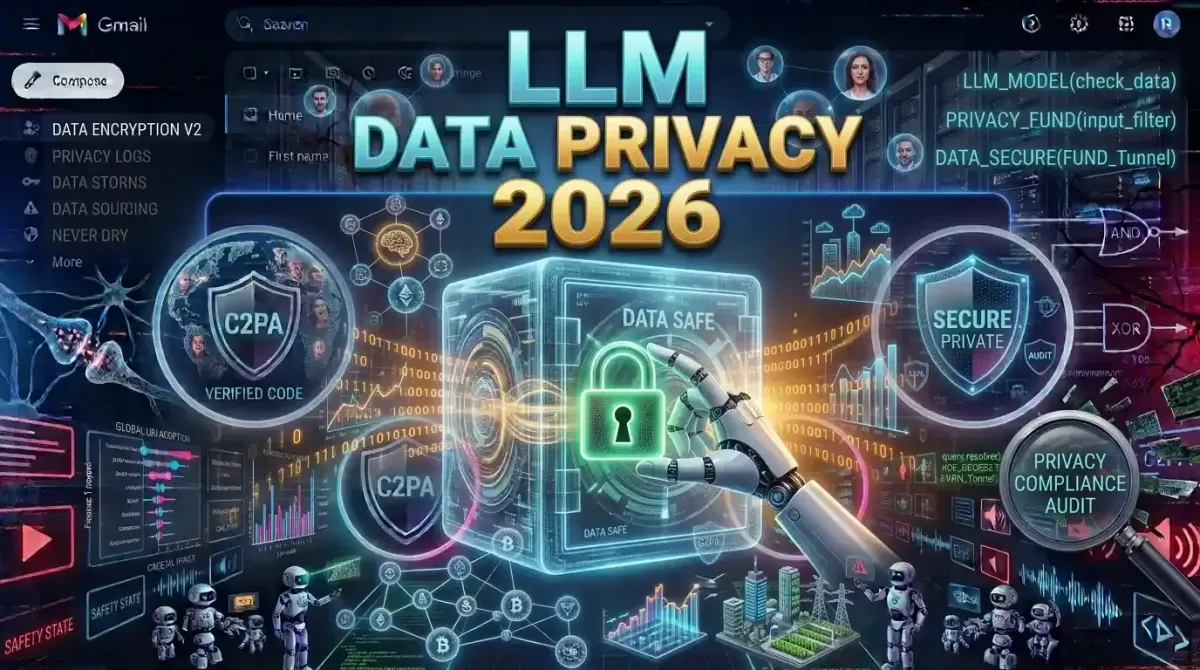
Data privacy in the age of large language models hinges on strict data retention policies, advanced cryptographic safeguards, and controlled deployment architectures. To determine if your information is truly secure, you must evaluate whether the AI provider employs zero data retention for inference, utilizes differential privacy during training, and offers self-hosted or private cloud deployment options. By implementing robust data classification frameworks, enforcing zero-trust access controls, and leveraging privacy-preserving machine learning techniques like federated learning, organizations can safely harness the power of artificial intelligence without exposing sensitive intellectual property or personally identifiable information to unauthorized model training or extraction attacks.
The Mechanics of LLM Data Processing and Privacy Risks
Direct Answer: Your information is only secure in an LLM if the provider explicitly guarantees zero data retention for your prompts and outputs, does not use your data to train foundational models, and employs end-to-end encryption. Without these contractual and technical guarantees, any data submitted to a public LLM interface is at risk of being logged, analyzed, and potentially memorized by the model.
Large language models operate by predicting the next token in a sequence based on patterns learned from massive datasets. When you interact with an LLM, your input is tokenized, processed through multiple transformer layers, and generates an output. The critical privacy question is what happens to that input and output after the generation is complete. In many consumer-grade and even some enterprise SaaS offerings, this interaction data is temporarily or permanently stored to improve model performance, debug errors, or train future iterations.
Understanding how your data is used to train AI models and how to protect it is the foundational step in assessing your risk exposure. If a model memorizes a specific sequence of tokens during training, it becomes susceptible to extraction attacks, where a malicious actor can craft specific prompts to force the model to regurgitate sensitive training data, such as API keys, personal health information, or proprietary source code.
Primary Vectors of Data Leakage
- Training Data Memorization: Models trained on uncurated web scrapes or internal corporate documents without proper sanitization can inadvertently memorize and reproduce exact strings of sensitive text.
- Prompt Injection and Data Exfiltration: Attackers can manipulate an LLM into ignoring its safety guardrails and outputting confidential data it was previously exposed to during a fine-tuning phase.
- Shadow AI Usage: Employees copying and pasting sensitive corporate data into public, unapproved LLM interfaces, bypassing enterprise security controls entirely.
- Third-Party Vendor Risks: LLM providers often rely on third-party cloud infrastructure or annotation services, expanding the attack surface and the number of entities with potential access to your data.
The Regulatory Landscape for AI Data Privacy in 2026
The legal framework governing artificial intelligence has matured significantly, shifting from voluntary guidelines to strict, enforceable mandates. Organizations can no longer treat AI privacy as an afterthought; it is now a core compliance requirement.
GDPR and the Right to Be Forgotten
The General Data Protection Regulation presents a unique challenge for LLMs. Article 17 grants individuals the right to have their personal data erased. However, once personal data is absorbed into the weights of a neural network, it is computationally infeasible to "unlearn" or extract that specific data point without retraining the entire model from scratch. This fundamental conflict between immutable model weights and data subject rights requires organizations to implement strict data minimization and anonymization pipelines before any data ever reaches the training environment. Adhering to the importance of GDPR and modern data privacy laws means proactively filtering datasets and employing techniques that prevent personal data from being ingested in the first place.
The EU AI Act and Transparency Mandates
The European Union has established the most comprehensive regulatory framework for artificial intelligence globally. The EU AI Act categorizes AI systems based on risk levels. Foundation models, particularly those with systemic risk, are subject to stringent transparency requirements. Providers must publish detailed summaries of the copyrighted and personal data used for training. Furthermore, they must implement robust cybersecurity measures and conduct regular conformity assessments. Understanding understanding the EU AI Act and what it means for businesses worldwide is critical for any global technology company, as non-compliance can result in fines reaching up to 35 million USD or seven percent of global annual turnover.
Step by Step Implementation Guide for Enterprise LLM Privacy
Securing data in the age of large language models requires a structured, multi-layered approach. Relying solely on vendor promises is insufficient. Engineering and security teams must implement the following technical workflow.
Phase 1: Comprehensive Data Classification
Before deploying any AI tool, you must know what data you possess. Implement an automated data discovery and classification system that scans your internal repositories, databases, and communication channels. Tag data based on sensitivity levels: Public, Internal, Confidential, and Restricted. Establish strict policies dictating that Restricted data (e.g., personally identifiable information, financial records, unreleased source code) is strictly prohibited from being sent to external, third-party LLM APIs.
Phase 2: Enforcing Zero Data Retention Policies
When selecting an LLM provider, the contractual agreement must explicitly state a zero data retention policy for inference. This means the provider will not log your prompts or outputs, nor will they use this data for model improvement. Technically, this should be verified by ensuring the API endpoint you are calling is specifically designated for enterprise, non-training usage. Many providers offer separate endpoints for this purpose, which are audited to guarantee data is processed in volatile memory and immediately discarded after the response is generated.
Phase 3: Architectural Deployment Choices
For highly sensitive workloads, cloud-based APIs may not be sufficient. Organizations must evaluate self-hosted or private cloud deployment options. By running open-source models on your own infrastructure, you maintain absolute physical and logical control over the data pipeline. When evaluating this path, reviewing SaaS vs self hosted solutions for data privacy and control provides a clear framework for weighing the operational overhead of managing GPU clusters against the absolute data sovereignty gained.
Phase 4: Continuous Monitoring and Data Loss Prevention
Deploy Data Loss Prevention (DLP) tools at the network perimeter and endpoint level. These tools should be configured to inspect outbound traffic for patterns matching sensitive data (like credit card numbers or social security numbers) and block the request from reaching the LLM API. Additionally, implement API gateways that log all LLM interactions (excluding the payload itself, to maintain privacy) to monitor for anomalous usage patterns that might indicate a compromised account or a coordinated extraction attack.
Advanced Privacy Preserving Machine Learning Techniques
Beyond policy and architecture, cutting-edge cryptographic and algorithmic techniques are emerging to allow organizations to utilize LLMs without ever exposing raw data.
Differential Privacy
Differential privacy is a mathematical framework that ensures the output of an algorithm does not reveal whether any specific individual's data was included in the training set. This is achieved by injecting carefully calibrated statistical noise into the data or the model's gradients during training. While this slightly reduces the overall accuracy of the model, it provides a provable, quantifiable guarantee of privacy. If an attacker attempts a membership inference attack, the noise ensures the model's behavior remains statistically indistinguishable regardless of the presence or absence of a specific data point.
Federated Learning
Federated learning decentralizes the training process. Instead of sending raw data to a central server to train a global model, the model is sent to the local devices or private servers where the data resides. The model trains locally, and only the resulting model updates (gradients or weights) are sent back to the central server to be aggregated. This ensures that the raw, sensitive data never leaves the secure local environment. This technique is particularly valuable in healthcare and finance, where data residency laws strictly prohibit the centralization of patient or customer records.
Homomorphic Encryption
Fully homomorphic encryption allows computations to be performed directly on encrypted data without ever decrypting it. In the context of LLMs, a user could encrypt their prompt, send it to the model provider, and the provider's system would process the encrypted tokens and return an encrypted response. The user then decrypts the response locally. While currently computationally expensive and slow for large language models, rapid advancements in hardware acceleration are making practical homomorphic inference a realistic goal for the near future.
Technical Safeguards and Secure Infrastructure
Implementing privacy-preserving algorithms is only effective if the underlying infrastructure is secure. A robust LLM deployment requires hardened systems at every layer.
Secure Enclaves and Confidential Computing
Confidential computing utilizes hardware-based trusted execution environments (TEEs), such as Intel SGX or AMD SEV. These enclaves create an isolated, encrypted region of memory and processing within the CPU or GPU. Even if the host operating system or hypervisor is compromised by a malicious actor or a cloud provider administrator, the data and the model weights being processed inside the enclave remain encrypted and inaccessible. This provides a strong guarantee of data-in-use protection, which is traditionally the most vulnerable state in the data lifecycle.
Local Development and Air-Gapped Environments
For the highest levels of security, organizations should develop and fine-tune their models in air-gapped environments, completely disconnected from the public internet. This eliminates the risk of external network-based attacks. Setting up such an environment requires specialized knowledge. Referencing how to set up a secure Linux distro for local LLM development provides essential guidance on hardening the operating system, disabling unnecessary services, and configuring strict firewall rules to ensure the local environment remains impenetrable.
Identity and Access Management with Zero Knowledge
Controlling who can interact with the LLM is just as important as protecting the data itself. Implement strict role-based access control (RBAC) and require multi-factor authentication for all API keys and user accounts. For advanced use cases, integrating zero knowledge proofs for verifying identity without sharing data allows users to prove they have the necessary clearance to access a specific model or dataset without revealing their underlying identity credentials to the AI system, minimizing the attack surface for identity theft.
Comparing LLM Deployment Models for Privacy
Choosing the right deployment model is the most critical decision an organization makes regarding AI data privacy. The following table compares the primary options available in 2026.
| Deployment Model | Data Sovereignty | Risk of Training Data Leakage | Operational Complexity | Estimated Cost |
|---|---|---|---|---|
| Public SaaS LLM | Low (Data resides on vendor servers) | High (Unless explicit enterprise contract is signed) | Low (Plug and play) | Low (Subscription based, approximately 20 to 50 USD per user monthly) |
| Enterprise Cloud API | Medium (Vendor manages infrastructure, but contractually binds to zero retention) | Low (Contractual and technical safeguards in place) | Medium (Requires API integration and monitoring) | Medium (Pay per token, scales with usage) |
| Private Cloud Hosting | High (Dedicated infrastructure within a compliant cloud region) | Very Low (Complete control over data pipelines) | High (Requires DevOps and MLOps expertise) | High (Dedicated compute instances, approximately 500 to 2000 USD monthly) |
| On Premises Self Hosting | Absolute (Data never leaves corporate network) | Negligible (Air-gapped or strictly firewalled) | Very High (Hardware procurement, maintenance, and cooling) | Very High (Capital expenditure for GPU clusters) |
For organizations leaning towards self-hosting to maximize control, exploring why open source AI models are becoming more popular than closed ones highlights the transparency and auditability benefits of open weights, which allow security teams to verify that no hidden data-exfiltration mechanisms exist within the model architecture.
Real World Scenarios and Threat Modeling
Theoretical risks become tangible when applied to real-world business operations. Understanding how attacks manifest helps in designing effective defenses.
Scenario 1: The Shadow AI Code Leak
A software engineer at a financial technology firm uses a public, free-tier LLM to debug a complex piece of proprietary trading algorithm code. The engineer pastes the code, including hardcoded database credentials, into the chat interface. The LLM provider's terms of service state that all inputs may be used for model training. Six months later, the LLM is queried by an external researcher who asks for examples of Python trading scripts. The model, having memorized the engineer's input, outputs the exact code snippet, including the active database credentials, leading to a severe data breach.
Mitigation: Implement strict endpoint DLP to block code and credential patterns from leaving the corporate network. Mandate the use of an enterprise LLM with a verified zero-data-retention policy for all development tasks.
Scenario 2: The Fine-Tuning Poisoning Attack
A healthcare provider fine-tunes an open-source LLM on a dataset of anonymized patient records to build a medical assistant. However, the dataset was not rigorously scrubbed, and subtle identifiers remained. An attacker gains access to the fine-tuned model and performs a model inversion attack, systematically querying the model to reconstruct the original patient records, violating patient privacy and regulatory compliance.
Mitigation: Apply rigorous differential privacy techniques during the fine-tuning process. Conduct red-teaming exercises specifically designed to test for membership inference and model inversion vulnerabilities before the model is deployed to production.
The Role of Autonomous Agents in Data Privacy
As AI evolves from simple chat interfaces to autonomous agents capable of executing multi-step workflows, the privacy stakes increase exponentially. An autonomous agent may be granted permission to read emails, access databases, and execute API calls on behalf of a user.
If such an agent is compromised or poorly configured, it can inadvertently exfiltrate vast amounts of sensitive data across multiple systems in seconds. The agent's memory vector database becomes a high-value target. Understanding the rise of autonomous AI agents and who is responsible when things go wrong is crucial for establishing clear governance, ensuring that agent actions are strictly bounded by least-privilege access controls and that all agent memory is encrypted and regularly purged of sensitive context.
Future Trends in AI Data Privacy
The landscape of AI privacy is rapidly evolving, driven by both regulatory pressure and technological innovation. Several key trends will define the next generation of secure AI systems.
Synthetic Data Generation
To completely eliminate the risk of exposing real user data during model training, organizations are increasingly turning to synthetic data. Advanced generative models create artificial datasets that statistically mirror the real-world data but contain no actual personal information. This allows for robust model training and testing without any privacy risk. Research into breakthroughs in self supervised learning reducing the need for labeled data complements this trend, as models become better at learning from the underlying structure of data rather than relying on massive, privacy-sensitive, human-labeled datasets.
Machine Unlearning
As regulations like GDPR enforce the right to be forgotten, the field of machine unlearning is gaining significant traction. Researchers are developing algorithms that can efficiently remove the influence of specific data points from a trained model without requiring a full retraining cycle. While still in its early stages, practical machine unlearning will become a mandatory feature for enterprise LLMs to maintain regulatory compliance.
Decentralized AI Networks
Blockchain and decentralized computing networks are being explored as a way to distribute LLM inference and training across a global network of nodes. By using cryptographic proofs, users can verify that their data was processed correctly and immediately deleted, without relying on the trustworthiness of a single, centralized corporate entity. This paradigm shift promises to return data ownership and control directly to the end user.
Conclusion
Data privacy in the age of large language models is not a binary state of being secure or insecure; it is a continuous, active discipline. Your information is only truly secure if you rigorously validate the data retention policies of your AI providers, implement robust data classification and loss prevention controls, and leverage advanced privacy-preserving technologies like differential privacy and confidential computing. As regulatory frameworks like the EU AI Act tighten their grip and the capabilities of AI continue to expand, organizations must treat data privacy as a core architectural requirement, not an optional add-on.
By adopting a zero-trust approach to AI data handling, investing in secure deployment architectures, and staying abreast of emerging privacy technologies, businesses can safely unlock the transformative potential of large language models. The future of AI belongs to those who can innovate rapidly while maintaining the highest standards of data protection and user trust. The time to audit your AI data pipelines and implement these critical safeguards is now.