
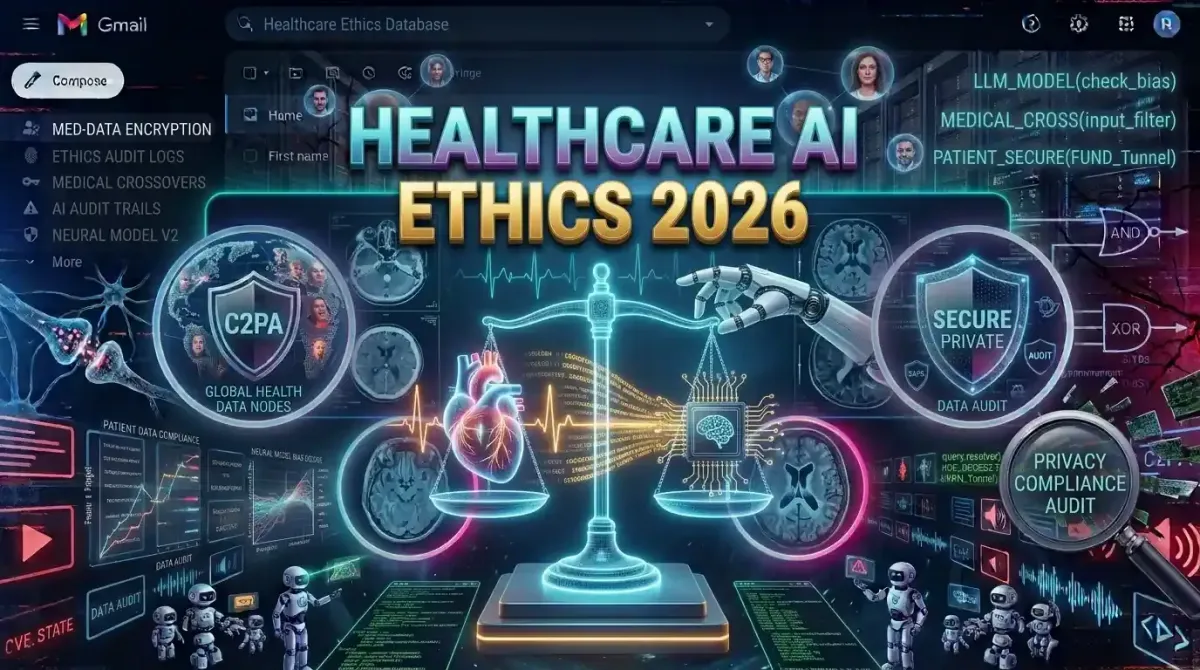
The integration of artificial intelligence into clinical environments represents the most profound technological shift in modern medicine. As multimodal foundation models and autonomous diagnostic agents move from experimental trials to real-time patient care, the medical community faces an unprecedented ethical crucible. We are no longer just asking if these systems can detect anomalies; we are asking if they can be trusted with human lives when they fail, when they hallucinate, or when their training data reflects historical systemic biases. This comprehensive analysis explores the technical, legal, and moral frameworks required to deploy healthcare AI safely, ensuring that the pursuit of computational efficiency never compromises the fundamental tenets of patient autonomy, beneficence, and justice.
The Core Ethical Dilemma of Clinical AI
Direct Answer: Trusting machines with human lives requires shifting from blind reliance to verifiable accountability. We can only trust healthcare AI when it operates under strict explainable AI frameworks, utilizes privacy-preserving federated learning, and maintains a mandatory human-in-the-loop protocol for all critical diagnostic and treatment decisions.
The traditional bioethical framework rests on four pillars: autonomy, beneficence, non-maleficence, and justice. When we introduce algorithmic decision-making into this sacred space, each pillar is fundamentally challenged. Autonomy is threatened when patients do not understand how an algorithm influenced their care plan. Beneficence is complicated when an AI recommends a statistically optimal treatment that conflicts with a patient's personal quality-of-life goals. Non-maleficence is tested by the "black box" nature of deep learning, where a misdiagnosis might occur without any discernible logical trail. Finally, justice is jeopardized when models trained on homogeneous datasets perform poorly on marginalized populations, effectively automating and scaling healthcare disparities.
Understanding the role of machine learning in modern healthcare diagnostics reveals the immense potential of these systems to detect early-stage oncology and rare genetic markers far beyond human visual limits. However, realizing this potential without violating ethical boundaries requires a radical rethinking of how medical software is validated, deployed, and monitored.
Diagnostic Accuracy and the Black Box Problem
In 2026, convolutional neural networks and vision transformers achieve near-perfect accuracy in controlled environments for tasks like identifying diabetic retinopathy or classifying pulmonary nodules in CT scans. Yet, clinical deployment is not a controlled environment. The primary ethical barrier to trusting these models is their opacity. When a deep learning model flags a patient for immediate invasive surgery based on a subtle pattern in an MRI, the attending physician must understand why. If the physician cannot interrogate the model's reasoning, they are forced to choose between blindly trusting a machine and ignoring a potentially life-saving insight.
Explainability as a Clinical Requirement
Explainable AI is no longer a luxury; it is a clinical necessity. Techniques like Grad-CAM for visual models and SHAP for tabular patient data must be integrated directly into the electronic health record interface. When an AI suggests a specific oncology protocol, it must simultaneously output a heatmap highlighting the exact tissue regions that triggered the alert, or a decision tree showing the specific biomarkers that drove the recommendation. Learning how researchers are solving the AI black box problem with explainable AI and XAI provides the technical foundation for building these transparent diagnostic tools.
Without explainability, the physician's role is reduced to a mere rubber stamp, violating the ethical mandate of informed consent. Patients have a right to know the basis of their medical treatment. If the basis is an opaque mathematical function that even the software engineers cannot fully interpret, the moral contract between doctor and patient is broken.
Data Privacy and the Sanctity of Patient Records
Training highly accurate medical AI requires massive datasets comprising millions of patient records, including genomic data, medical histories, and sensitive diagnostic imaging. The ethical obligation to protect this data is paramount. A breach in a healthcare AI training pipeline does not just expose financial information; it exposes the most intimate biological realities of human beings.
Federated Learning and Differential Privacy
To resolve the tension between the need for vast training data and the imperative of patient privacy, the industry has adopted advanced cryptographic and architectural solutions. Federated learning allows models to be trained across multiple hospital networks without the raw data ever leaving the local secure servers. Only the mathematical weight updates are transmitted to the central aggregation server. Furthermore, implementing building privacy first AI techniques for secure data processing ensures that even the aggregated model cannot be reverse-engineered to reveal individual patient records.
Zero Knowledge Proofs in Health Identity
When AI agents need to verify a patient's eligibility for a specific clinical trial or access their cross-institutional medical history, they traditionally require access to raw identity documents. By utilizing zero knowledge proofs the future of verifying identity without sharing data, healthcare systems can cryptographically verify that a patient meets the necessary criteria without ever exposing their underlying personal health information to the AI model or the cloud infrastructure hosting it.
| Privacy Technology | Primary Healthcare Application | Ethical Benefit | Implementation Complexity |
|---|---|---|---|
| Federated Learning | Multi-hospital diagnostic model training | Raw patient data never leaves local servers | High (Requires robust network synchronization) |
| Differential Privacy | Public health trend analysis and research | Mathematical guarantee against individual identification | Medium (Requires tuning the privacy budget epsilon) |
| Zero Knowledge Proofs | Clinical trial eligibility and insurance verification | Verifies conditions without exposing raw health records | High (Requires specialized cryptographic infrastructure) |
| Homomorphic Encryption | Cloud-based AI inference on sensitive records | AI processes data while it remains fully encrypted | Very High (Computationally expensive for large models) |
Algorithmic Bias and the Automation of Health Inequity
Perhaps the most insidious ethical failure in healthcare AI is the amplification of systemic bias. Machine learning models are historical mirrors; they reflect the inequalities present in the data they consume. If a hospital's historical data shows that minority populations receive fewer preventative cardiac screenings, an AI model trained to optimize resource allocation might learn to deprioritize those same populations for future screenings, creating a self-fulfilling prophecy of neglect.
Defining Fairness in Clinical Outcomes
Engineers must move beyond simple accuracy metrics. A model that achieves 95 percent overall accuracy might still be ethically unacceptable if its false negative rate for a specific demographic is three times higher than the baseline. In healthcare, we must apply rigorous fairness constraints. For predictive models estimating patient deterioration, ensuring addressing bias in AI how to build fairer algorithms means enforcing equalized odds, ensuring that the model is equally effective at predicting adverse outcomes across all racial, gender, and socioeconomic groups.
Furthermore, proxy variables must be aggressively audited. An AI might not use race as an input, but it might use zip code or historical healthcare expenditure as a proxy for health needs. Since marginalized groups have historically spent less on healthcare due to lack of access, the model incorrectly learns that they are "healthier" and require less intervention. Eradicating these proxy biases requires continuous, adversarial testing of the model's decision boundaries.
Liability, Malpractice, and the Human in the Loop
When an AI system makes a critical error, who is legally and ethically responsible? The physician who approved the AI's recommendation? The hospital that purchased the software? The developer who trained the model? Or the autonomous agent itself? This ambiguity poses a massive risk to patient safety and institutional trust.
The Myth of Full Autonomy in Medicine
In 2026, the concept of a fully autonomous medical AI making life-or-death decisions without human oversight is ethically and legally untenable. The "human-in-the-loop" paradigm is mandatory. The AI must act as a highly advanced decision-support tool, not an autonomous agent. The physician must retain the final authority and the cognitive responsibility for the care plan. Understanding the rise of autonomous AI agents who is responsible when things go wrong highlights why strict boundaries must be drawn between administrative automation, which can be fully autonomous, and clinical intervention, which requires human accountability.
Automation Bias and Cognitive Deskilling
A secondary ethical concern is "automation bias," where clinicians gradually lose their own diagnostic acumen because they become overly reliant on the AI's suggestions. If a radiologist only reviews the AI's flagged anomalies and ignores the rest of the scan, they may miss novel pathologies that the AI was not trained to recognize. Ethical deployment requires designing interfaces that challenge the physician, forcing them to actively verify the AI's conclusions rather than passively accepting them. Maintaining human cognitive engagement is a vital safeguard against systemic algorithmic failure.
Step by Step Guide to Ethical AI Deployment in Hospitals
Implementing AI in a clinical setting requires a rigorous, multi-phase governance framework that prioritizes patient safety and ethical compliance at every stage.
Phase 1: Clinical Validation and Bias Auditing
Before any AI tool touches a live patient record, it must undergo exhaustive retrospective validation. This involves testing the model against diverse, multi-institutional datasets that represent the exact demographic makeup of the hospital's patient population. Data scientists must calculate fairness metrics, ensuring that the model's positive predictive value does not vary significantly across different patient subgroups. If the model exhibits bias, it must be returned to the development phase for retraining with augmented, balanced datasets.
Phase 2: Regulatory Compliance and Documentation
The tool must be classified according to regional medical device regulations. In the United States, this means navigating the FDA's Software as a Medical Device framework. In Europe, it requires compliance with the stringent requirements of the EU MDR. Furthermore, organizations must adhere to the importance of GDPR and modern data privacy laws if handling any data originating from or pertaining to European citizens, ensuring that the AI's data processing activities are fully documented and legally justified.
Phase 3: Shadow Mode Deployment
The AI is deployed in "shadow mode," where it processes live patient data and generates recommendations, but these recommendations are hidden from the clinical staff. Instead, they are logged and later compared against the actual decisions made by the human physicians. This phase allows the hospital to measure the AI's real-world performance, identify edge cases, and ensure that the system does not generate harmful alerts without disrupting actual patient care.
Phase 4: Active Clinical Integration with Guardrails
Once shadow mode validates the system's safety, it is activated for clinical use. However, strict guardrails are implemented. The AI is restricted from directly altering patient records or prescribing controlled substances. All AI outputs are clearly labeled in the electronic health record, and physicians are required to digitally sign off on their agreement or disagreement with the AI's suggestions, creating a continuous feedback loop for model monitoring.
The Regulatory Landscape and Global Standards
The ethical deployment of healthcare AI is heavily dictated by the regulatory environment. Governments are rapidly moving to classify medical AI based on its potential risk to human life.
The EU AI Act and High-Risk Medical Systems
Under the European Union's comprehensive AI legislation, medical devices and AI systems used in triage, diagnosis, and treatment planning are classified as high-risk. This classification mandates rigorous conformity assessments, continuous post-market monitoring, and absolute transparency regarding the training data. Understanding understanding the EU AI Act and what it means for businesses worldwide is essential for any health-tech company, as failure to comply results in massive fines and the immediate withdrawal of the product from the market.
FDA Pre-Certification and Continuous Monitoring
The FDA has evolved its approach from treating AI software as a static, one-time approved device to recognizing that machine learning models continuously adapt. The focus has shifted toward evaluating the quality of the developer's software engineering practices, their data management protocols, and their continuous monitoring systems. Ethical AI developers must maintain a living dossier of their model's performance, ready for regulatory audit at any moment.
Informed Consent in the Age of Algorithmic Care
The concept of informed consent is undergoing a radical transformation. Patients have the ethical right to know if an algorithm played a significant role in their diagnosis or treatment plan. However, explaining the nuances of a neural network to a patient in distress is practically impossible.
Designing Comprehensible Consent Interfaces
Hospitals must develop new consent workflows that translate complex AI involvement into plain language. Patients should be informed if an AI was used to analyze their scans, what the known accuracy rates of that specific tool are, and crucially, that a human physician has reviewed and validated the AI's findings. Transparency is not just about legal protection; it is about why transparency in AI decision making is crucial for trust. When patients understand the collaborative nature of human and machine intelligence, their anxiety decreases, and their trust in the medical system increases.
Future Horizons: Generative AI and the Doctor-Patient Relationship
As we look toward the late 2020s, the integration of generative AI and large language models into clinical workflows introduces new ethical frontiers. AI scribes that listen to doctor-patient conversations and automatically generate clinical notes are becoming standard. While this reduces physician burnout, it raises severe privacy concerns regarding the continuous audio surveillance of medical consultations.
Empathy vs. Efficiency
There is a profound ethical question regarding the role of empathy in medicine. Can an AI that perfectly simulates empathetic communication provide the same psychological benefit to a patient as a human doctor who genuinely cares? The consensus in medical ethics is that empathy is not merely a communicative tool; it is a moral action rooted in shared human vulnerability. AI can optimize the logistical and analytical burdens of healthcare, freeing up physicians to spend more time engaging in the deeply human aspects of healing. The ethical goal is not to replace the doctor-patient relationship, but to protect and enhance it by removing the administrative friction that currently suffocates it.
Conclusion
The ethics of AI in healthcare cannot be reduced to a simple binary of safe or dangerous. It is a complex, ongoing negotiation between the immense life-saving potential of computational power and the sacred, inviolable rights of the patient. We can trust machines with human lives, but only if we build them with radical transparency, rigorously audit them for bias, and legally bind them to the principle of human oversight. The future of medicine is undeniably algorithmic, but its soul must remain fiercely human. By adhering to strict ethical frameworks, leveraging privacy-preserving cryptography, and maintaining the physician as the ultimate moral arbiter, we can harness the power of artificial intelligence to elevate human health without compromising our fundamental humanity.