
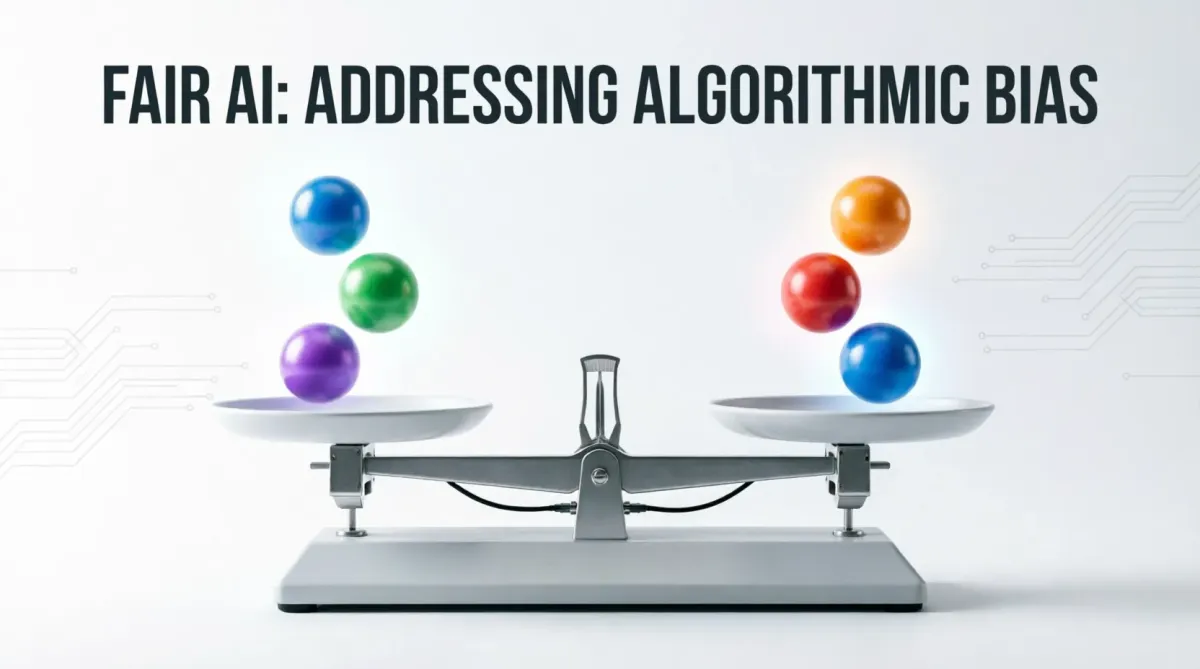
Addressing Bias in AI: How to Build Fairer Algorithms in 2026
In 2026, as Artificial Intelligence takes on a greater role in decision-making—from hiring employees to determining medical treatments—the stakes of Algorithmic Bias have never been higher. An AI is only as fair as the data it is trained on and the people who build it. If we aren't careful, we risk automating the prejudices of the past rather than building a more equitable future. Addressing bias is no longer just an ethical choice; it is a technical and legal necessity. At TipsForAITech, we are exploring the methods and frameworks that developers are using to build fairer, more inclusive AI systems.
This 1500+ word comprehensive guide dives into the mechanics of fairness. Whether you are following new AI regulations or advocating for transparency, eliminating bias is the core mission for 2026.
[Image of the AI Bias Cycle: Showing how biased real-world data leads to biased training sets, resulting in biased model outputs that reinforce societal prejudices]1. Understanding the Sources of AI Bias
Bias doesn't always come from malicious intent. In 2026, we categorize AI bias into three main types:
- Data Bias: When the training data reflects historical inequalities or lacks diversity.
- Algorithmic Bias: When the model's math inadvertently prioritizes certain groups over others.
- Cognitive Bias: When the human developers’ own subconscious prejudices influence the training and labeling process.
2. Diversifying the Training Data
The first step to a fair algorithm in 2026 is ensuring your data represents the real world. This means intentionally seeking out underrepresented groups to ensure the AI doesn't become a "echo chamber" for the majority. This is as critical as managing high-resolution data sets in 3D modeling.
3. The Role of "Fairness Metrics"
In 2026, we don't just "hope" an AI is fair; we measure it. Developers now use standardized metrics like Demographic Parity and Equalized Odds to mathematically prove their model treats different groups equally. These metrics are the benchmarks for responsible and privacy-first AI development.
4. Adversarial Debiasng: Using AI to Fight Bias
One of the most innovative techniques in 2026 is Adversarial Debiasng. This involves training a second AI (the "Adversary") whose only job is to try and guess a protected characteristic (like race or gender) from the main AI’s output. If the Adversary can guess correctly, the main AI is forced to adjust its logic until it becomes truly "blind" to those traits.
5. Human-in-the-Loop: The Ethical Safety Net
In 2026, total automation in sensitive sectors is discouraged. Human-in-the-loop (HITL) systems ensure that a human expert reviews high-stakes AI decisions. This provides a level of human accountability and transparency that machines alone cannot achieve.
[Image showing the "Adversarial Debiasng" process: A main model attempting a task while an adversary model tries to identify bias, forcing the main model to improve its fairness]6. Algorithmic Impact Assessments (AIA)
Before any AI is deployed in 2026, it must undergo an AIA. This is a rigorous audit that evaluates how the AI might impact different communities. This standard is as essential for tech companies as GDPR compliance is for data protection.
7. Open-Source Fairness Toolkits
Bias is a global problem that requires global solutions. In 2026, the most effective tools come from open-source communities. Frameworks like "AI Fairness 360" allow any developer to test their models for hundreds of different types of bias for free.
8. Security: Protecting Fairness Enclaves
Even a fair model can be "poisoned" by attackers who want to re-introduce bias. In 2026, developers use passkey-secured environments to protect the model's weights and training pipelines from unauthorized tampering.
9. Using AI Writing Assistants for Ethical Documentation
Documenting fairness efforts is a major part of 2026's workflow. Developers use advanced writing assistants to draft detailed ethics reports and bias mitigation logs, ensuring maximum professional productivity and clarity.
10. Conclusion: Fairness as the Ultimate Metric
In 2026, the success of an AI model is no longer measured solely by its accuracy, but by its fairness. Building fairer algorithms is an ongoing journey that requires constant monitoring, diverse teams, and a commitment to radical transparency. As AI continues to shape our society, we have a unique opportunity to build systems that are better and more just than the world that created them. Fairness is not a "bug" to be fixed; it is the ultimate feature of the intelligent age. Let’s build a future where AI serves everyone, without exception.
Stay at the forefront of the ethics and AI revolution by following TipsForAITech. Whether you're looking for OS comparisons or development frameworks, we are your partner in the 2026 technology landscape.