
Understanding the Basics of Supervised vs. Unsupervised Learning in 2026
In the rapidly advancing world of 2026, Artificial Intelligence has become so integrated into our lives that we often forget the fundamental mechanics that drive it. At the heart of every Large Language Model (LLM), self-driving car, and diagnostic tool lies a core training methodology. The most fundamental distinction in the field of Machine Learning is between Supervised and Unsupervised Learning. At TipsForAITech, we believe that understanding these concepts is the first step toward true AI literacy.
This 1500+ word deep dive explores the mechanics, use cases, and 2026 trends for both learning styles. Whether you are building AI-powered applications or conducting advanced research, this guide will clarify the foundations of machine intelligence.
1. What is Supervised Learning? The Guided Path
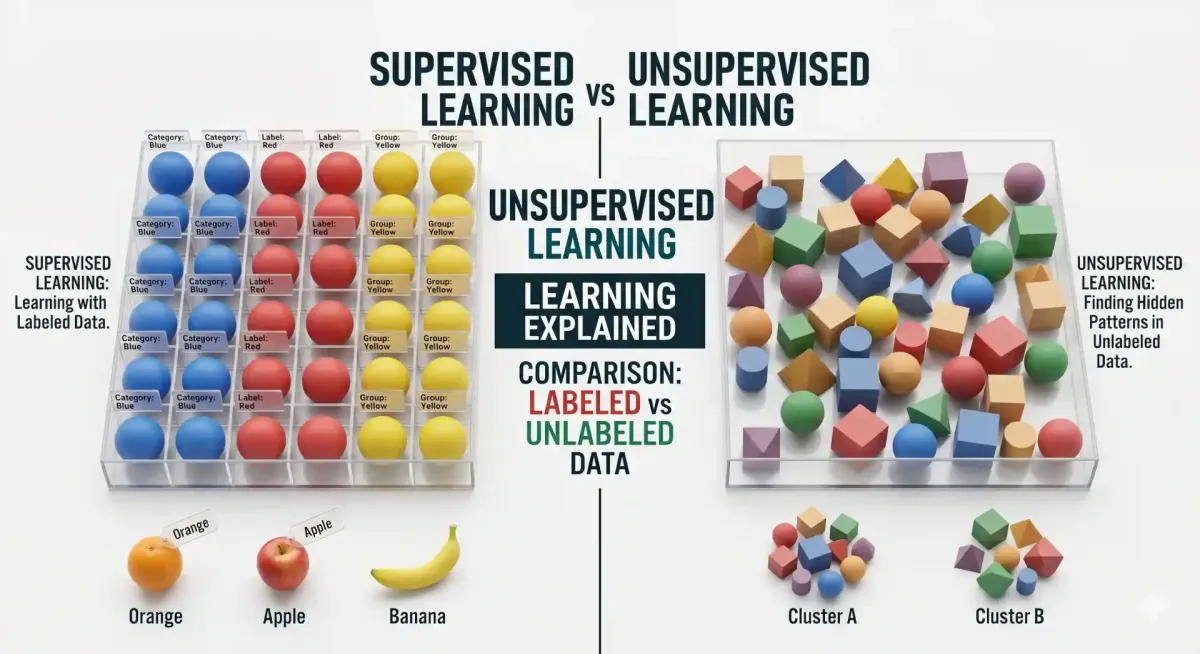
Supervised learning is the most common form of machine learning in 2026. Think of it as a student learning with a teacher. The algorithm is trained on a Labeled Dataset—a collection of input data that has already been tagged with the correct answers.
For example, if you want to teach an AI to identify healthy crops from diseased ones, you provide thousands of images labeled "Healthy" or "Diseased." The model learns to associate specific features (like leaf color or spot patterns) with the labels provided. As we noted in 10 ways AI is transforming technology, this precision is what makes supervised learning the backbone of modern diagnostics.
Types of Supervised Learning:
- Classification: Sorting data into distinct categories (e.g., Spam vs. Not Spam, Cat vs. Dog).
- Regression: Predicting a continuous numerical value based on historical data (e.g., Predicting house prices or stock market trends).
2. What is Unsupervised Learning? The Self-Discovery Path
Unsupervised learning is a journey of discovery. There is no teacher and no labels. The algorithm is given Unlabeled Data and is tasked with finding hidden patterns or structures within that data on its own. It is the "Detective" of the AI world.
This approach is vital for complex data management, where the datasets are too large or too messy for human labeling. The AI looks for similarities and groups the data based on its own findings.
Types of Unsupervised Learning:
- Clustering: Grouping data points that are similar to each other (e.g., Segmenting customers based on purchasing behavior).
- Association: Discovering rules that describe large portions of the data (e.g., "People who buy milk also tend to buy bread").
- Dimensionality Reduction: Simplifying complex data while retaining the most important information.
3. Key Differences: Guidance, Goals, and Complexity
In 2026, the primary difference lies in the Goal. Supervised learning aims to predict an outcome based on new input data. Unsupervised learning aims to gain insights from the structure of the data itself.
While supervised learning requires high-quality, human-labeled data—which can be expensive and time-consuming—unsupervised learning can process vast amounts of raw data instantly. This makes unsupervised learning a key component for the initial training phases of Advanced NLP Voice Assistants, where the model must first learn the structure of language without specific instructions.
4. The 2026 Hybrid: Semi-Supervised Learning
The cutting-edge of 2026 isn't just one or the other; it’s a hybrid. Semi-Supervised Learning uses a small amount of labeled data to guide the processing of a much larger unlabeled dataset. This approach has become the standard for training modern LLMs, allowing for the massive scale of unsupervised learning with the accuracy of supervised guidance.
5. Real-World Applications in 2026
The applications of these technologies are everywhere in 2026:
- Healthcare: Supervised learning classifies medical images, while unsupervised learning discovers new patterns in genetic data that could lead to new drug treatments.
- Finance: Supervised models predict credit scores; unsupervised models detect anomalous behavior that indicates fraud.
- Content Creation: Using generative AI often involves supervised fine-tuning of models that were initially trained through unsupervised methods.
6. Choosing the Right Approach for Your Project
As a developer or researcher, how do you choose? Ask yourself these questions:
- Do you have a clear target? If yes, use Supervised Learning.
- Is your data already labeled? If not, Unsupervised Learning is your starting point.
- Are you looking for a specific prediction or a hidden insight? Predictions favor supervised; insights favor unsupervised.
Using advanced developer prompts can often help you structure your data correctly before you even begin the training process.
7. The Role of Reinforcement Learning
While outside the direct comparison, Reinforcement Learning (RL) is the third pillar in 2026. It involves an agent learning through trial and error, receiving "rewards" for correct actions. This is how we achieve the highly logical reasoning seen in autonomous scheduling assistants and robotics.
8. Ethical Implications and Data Bias
At TipsForAITech, we emphasize that neither method is free from bias. Supervised models can inherit the prejudices of the humans who label the data. Unsupervised models can amplify existing biases within the raw data itself. In 2026, "Fairness Auditing" is a mandatory step in the machine learning lifecycle to ensure ethical AI deployment.
9. Data Management and Sovereignty
Managing the massive datasets required for these learning styles is a logistical feat. In 2026, professionals use seamless AI-driven data tools to maintain data sovereignty and ensure that the training pipelines are efficient and secure.
10. Conclusion: The Foundation of Intelligence
Understanding supervised and unsupervised learning is like understanding the grammar of the future. These are the rules that allow machines to interpret our world. As AI continues to evolve toward "General Intelligence" in 2026, the lines between these methods may blur, but their fundamental roles in shaping machine thought remain unchanged.
Stay at the forefront of the AI education revolution by following TipsForAITech. Whether you are interested in automation tools, writing assistants, or image generation, we provide the expert guides you need for 2026.