Breakthroughs in Self Supervised Learning: Reducing the Need for Labeled Data
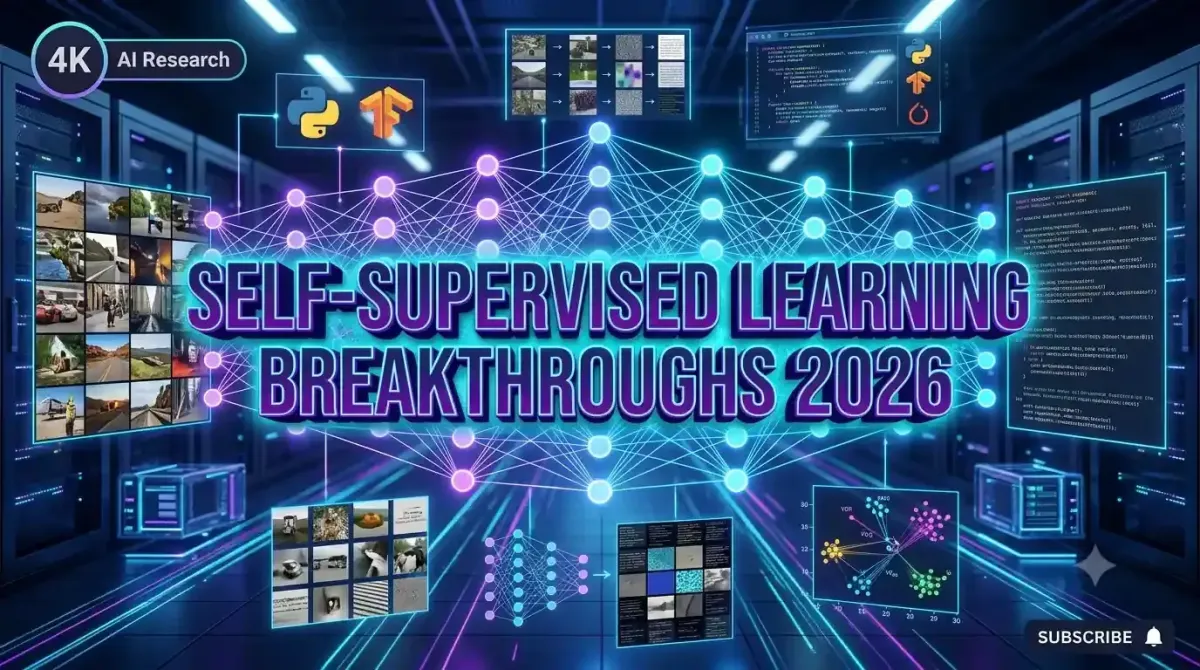
The artificial intelligence industry has long been constrained by a massive, expensive bottleneck: the reliance on human-annotated datasets. Training state-of-the-art models traditionally required millions of manually labeled examples, a process that is not only prohibitively expensive but also slow and prone to human error. In 2026, the paradigm has fundamentally shifted. Self-Supervised Learning (SSL) has emerged as the dominant framework for pre-training foundation models, allowing algorithms to generate their own supervisory signals directly from raw, unlabeled data. By masking portions of an input or contrasting different views of the same data point, SSL models learn rich, generalized representations that can be fine-tuned with minimal labeled examples. This comprehensive technical guide dissects the core architectures driving this revolution, explores the mathematical intuition behind contrastive and masked modeling, and provides a step-by-step engineering workflow for implementing SSL pipelines that drastically reduce annotation costs while maximizing predictive accuracy.
The Economics and Limitations of the Annotation Bottleneck
To understand the magnitude of the SSL breakthrough, we must first examine the traditional supervised learning pipeline. In a standard workflow, engineers must collect raw data and then employ human annotators to draw bounding boxes, transcribe audio, or classify text. For complex domains like medical imaging or autonomous driving sensor fusion, this requires domain experts, driving the cost of dataset creation into the millions of USD. Furthermore, human annotators introduce subjective biases and inconsistencies that limit the theoretical ceiling of model performance.
When researchers began understanding the basics of supervised vs unsupervised learning, the gap between the two was stark. Supervised learning achieved high accuracy but required labels; unsupervised learning could ingest infinite data but struggled to produce actionable, task-specific representations. Self-supervised learning bridges this gap. It is technically a subset of unsupervised learning where the training signal comes from the data itself. By designing a pretext task—such as predicting a masked patch of an image or guessing the next word in a sequence—the model is forced to learn the underlying semantic and structural rules of the environment. This shift has democratized AI development, allowing teams to leverage the exabytes of unlabeled data available on the internet, in enterprise data lakes, and across sensor networks.
Core Architecture One: Contrastive Learning and Instance Discrimination
Contrastive learning revolutionized computer vision by treating every individual image as its own class. The core objective is simple: if you apply two different random augmentations to the same image, the model should recognize them as highly similar (a positive pair). Conversely, if you take two completely different images, the model should push their representations apart in the latent vector space (negative pairs).
The Evolution of Frameworks:
- SimCLR (Simple Framework for Contrastive Learning): SimCLR demonstrated that a non-linear projection head and aggressive data augmentations (like random cropping and color distortion) are critical. It relies on massive batch sizes to provide enough negative pairs within a single forward pass.
- MoCo (Momentum Contrast): To solve the memory limitations of massive batch sizes, MoCo introduced a dynamic dictionary built with a queue and a moving-averaged encoder. This allowed for millions of negative pairs without requiring prohibitive GPU VRAM.
- Barlow Twins and VICReg: These newer architectures moved away from explicit negative pairs, instead focusing on reducing redundancy between embedding dimensions while maintaining variance, effectively preventing the "representation collapse" problem where the model outputs a constant vector for all inputs.
Core Architecture Two: Masked Autoencoders and Generative SSL
While contrastive learning excels at instance discrimination, masked modeling focuses on understanding the internal composition and spatial relationships of data. Popularized in NLP by BERT, this approach was adapted for computer vision through Masked Autoencoders (MAE).
In an MAE pipeline, an image is divided into non-overlapping patches. A high percentage of these patches—often 75 percent or more—are randomly masked and removed. The model, typically a Vision Transformer (ViT), is tasked with reconstructing the missing pixel values using only the visible patches and positional embeddings. Because the masking ratio is so high, the model cannot simply rely on local interpolation; it must understand global semantics, object boundaries, and contextual relationships to accurately hallucinate the missing data.
This approach has proven incredibly data-efficient. Models pre-trained with MAE on unlabeled datasets like ImageNet-1K or massive proprietary web-scrapes consistently outperform supervised counterparts when fine-tuned on downstream tasks with only 1 percent or 10 percent of the labeled data. The latent representations learned through reconstruction are inherently dense and semantically rich, making them ideal for tasks like object detection, segmentation, and medical anomaly detection.
Core Architecture Three: Joint Embedding Predictive Architecture (JEPA)
The latest frontier in SSL, championed by researchers like Yann LeCun, is the Joint Embedding Predictive Architecture (JEPA). Traditional masked autoencoders operate in the pixel space, forcing the model to predict high-frequency, stochastic details like exact texture variations or noise, which is computationally inefficient and often irrelevant to high-level reasoning.
JEPA solves this by operating entirely in the latent space. Instead of predicting raw pixels, the model predicts the abstract representations of the masked regions. An "in-context" encoder processes the visible patches, and a "predictor" network estimates the latent embeddings of the hidden patches. Because the predictor is never exposed to the exact pixel-level ground truth, it is forced to learn the underlying causal structure and semantic meaning of the scene, ignoring irrelevant noise. This architecture is widely considered the most promising pathway toward world models and advanced machine reasoning in 2026.
Step-by-Step Implementation Workflow for SSL Pipelines
Transitioning from supervised fine-tuning to self-supervised pre-training requires a fundamental restructuring of your machine learning pipeline. Below is the technical workflow for deploying a contrastive SSL model using PyTorch.
Step 1: Data Ingestion and Augmentation Strategy
The quality of your SSL model is directly bounded by the quality of your data augmentations. For vision tasks, you must implement a stochastic augmentation pipeline. This includes random resized crops, horizontal flips, Gaussian blur, and solarization. The goal is to ensure that the two views of the same image look vastly different to the human eye, but retain the same core semantic identity.
When handling massive unlabeled datasets, standard data loaders will become a severe bottleneck. Engineers must transition to high-performance data processing. If you are mastering Polars why you should switch from Pandas for large datasets, you can leverage its multi-threaded streaming engine to preprocess and shard image metadata into Parquet formats, ensuring your GPU training loops are never starved for data.
Step 2: Architecting the Backbone and Projection Head
Initialize a ResNet or ViT backbone. Crucially, you must attach a non-linear projection head—a multi-layer perceptron (MLP)—to the output of the backbone. The contrastive loss is computed on the output of this projection head, not the backbone's raw features. This separation allows the backbone to learn invariant, general-purpose features while the projection head absorbs the task-specific variance required for the pretext task.
Step 3: Defining the Loss Function
Implement the InfoNCE (Noise Contrastive Estimation) loss. For a batch of N images, you generate 2N augmented views. The loss function calculates the cosine similarity between all pairs, treating the N positive pairs as the target and the remaining 2N(N-1) pairs as negatives. The temperature parameter (tau) in the softmax function is critical; a lower temperature sharpens the distribution, forcing the model to be more confident in its positive matches.
Step 4: Pre-Training and Linear Probing
Train the model using the Stochastic Gradient Descent (SGD) optimizer with a cosine learning rate decay. Once pre-training is complete, freeze the backbone weights. Attach a simple linear classifier to the frozen backbone and train it on your small, labeled downstream dataset. This "linear probing" phase will yield surprisingly high accuracy, proving the efficacy of the learned representations.
Hardware Requirements and Infrastructure Scaling
Self-supervised learning is notoriously compute-intensive. Because the model must learn from the raw complexity of the data without the shortcut of human labels, it requires massive amounts of matrix multiplications and extended training epochs. The hardware you choose will dictate the scale of your unlabeled dataset.
Understanding the role of GPUs in speeding up AI model training is paramount when designing an SSL cluster. Contrastive methods like SimCLR require batch sizes of 4096 or 8192 to provide enough negative samples. This necessitates multi-node training setups utilizing high-bandwidth interconnects like NVLink or InfiniBand to synchronize gradients across dozens of accelerators without crippling communication overhead.
For research teams and startups building local pre-training infrastructure, investing in a robust workstation is essential. A comprehensive High End Desktop HEDT guide best components for local LLM training outlines the necessity of PCIe lane density, massive ECC RAM capacities, and multi-GPU topologies required to handle the memory-mapped datasets inherent in SSL workflows. Without sufficient VRAM, you are forced to reduce batch sizes, which directly degrades the performance of contrastive negative sampling.
Tooling and the Modern Data Science Stack
The software ecosystem surrounding SSL has matured significantly. Frameworks like lightly, VISSL, and Hugging Face's transformers library provide out-of-the-box implementations of SimCLR, MoCo, and MAE. However, the surrounding data pipeline requires careful engineering.
When selecting your programming environment, you need libraries that can handle high-dimensional tensor operations and efficient data manipulation. Exploring Python for data science essential libraries beyond Pandas and NumPy reveals tools like JAX for hardware-accelerated automatic differentiation, and PyTorch Lightning for abstracting away the complex boilerplate of multi-GPU distributed training loops. These tools allow researchers to focus on the mathematical design of the pretext task rather than debugging distributed memory leaks.
SSL vs Supervised vs Unsupervised: A Technical Comparison
To contextualize the value of self-supervised learning, we must compare it directly against its predecessors across critical engineering metrics.
| Metric | Supervised Learning | Traditional Unsupervised | Self-Supervised Learning |
|---|---|---|---|
| Data Requirement | Massive Labeled Datasets | Unlabeled Data | Unlabeled Data (Pre-training) + Minimal Labels |
| Pretext Task | Final Downstream Task | Clustering / Dimensionality Reduction | Masking / Contrastive Pairs / Generation |
| Compute Cost | High (Per Dataset) | Low to Moderate | Extreme (Pre-training) / Low (Fine-tuning) |
| Representation Quality | Task-Specific (Brittle) | General but Shallow | Dense, Semantic, Highly Transferable |
| Annotation Cost | Extremely High (Millions USD) | Zero | Near Zero (Only for final fine-tuning) |
Real-World Applications and the NLP Revolution
The impact of SSL extends far beyond computer vision. In natural language processing, masked language modeling is the foundational architecture behind every modern foundation model. By masking random tokens in a corpus of text and forcing the model to predict them based on bidirectional context, models learn syntax, semantics, and factual world knowledge.
The sheer scale of these models has fundamentally altered how we interact with information. Analyzing the impact of large language models LLMs on modern research shows that SSL-pre-trained models are now co-authors in scientific discovery, capable of parsing millions of unlabeled academic papers to identify novel protein folding structures or material science anomalies. In the medical field, SSL allows hospitals to train diagnostic models on decades of unlabeled MRI scans, bypassing the need for thousands of hours of radiologist annotation time, which is a critical factor when considering how your data is used to train AI models and how to protect it in highly regulated healthcare environments.
Ethical Considerations and Algorithmic Bias
While SSL removes the bottleneck of human labeling, it does not remove the risk of bias. In fact, by learning directly from the raw internet or massive historical databases, SSL models can ingest and amplify societal prejudices, stereotypes, and historical inequalities present in the unlabeled data. Because the representations are learned implicitly, they are often harder to audit than explicit supervised labels.
Engineers must implement rigorous evaluation protocols during the linear probing phase to test for disparate impact across demographic groups. The ongoing work in addressing bias in AI how to build fairer algorithms is critical here. Techniques like adversarial debiasing and counterfactual data augmentation must be integrated into the SSL pipeline to ensure that the rich representations learned from unlabeled data do not translate into discriminatory downstream applications.
Future Trajectory: Multimodal and Embodied SSL
The next frontier of self-supervised learning is multimodality and embodiment. Models like CLIP and Flamingo have demonstrated that SSL can align the latent spaces of text and images, allowing for zero-shot classification and generative capabilities. Moving forward, SSL is being applied to robotics, where agents learn the physics of the world by interacting with environments and predicting the sensory consequences of their actions, entirely without human demonstration.
As we map out the future trends what to expect from machine learning in the next 5 years, it is clear that the era of manual data annotation is ending. The models that will dominate the next decade are those that can autonomously extract structure from the chaotic, unlabeled reality of the physical and digital world.
Conclusion: Mastering the Unlabeled Frontier
Self-supervised learning is not merely a technique to save money on annotation; it is a fundamental reimagining of how machines acquire knowledge. By forcing algorithms to solve complex pretext tasks—whether reconstructing masked pixels, contrasting augmented views, or predicting latent embeddings—we unlock the ability to learn from the vast, untapped reservoirs of unlabeled data. For engineering teams, mastering SSL requires a deep understanding of contrastive mathematics, robust data augmentation pipelines, and the hardware infrastructure to support massive compute loads. By transitioning to self-supervised workflows, organizations can drastically reduce their reliance on expensive human labels, accelerate their time-to-market, and build foundation models that possess a generalized, robust understanding of the world. The future of AI is unlabeled, and the breakthroughs of 2026 prove that machines are finally ready to teach themselves.