
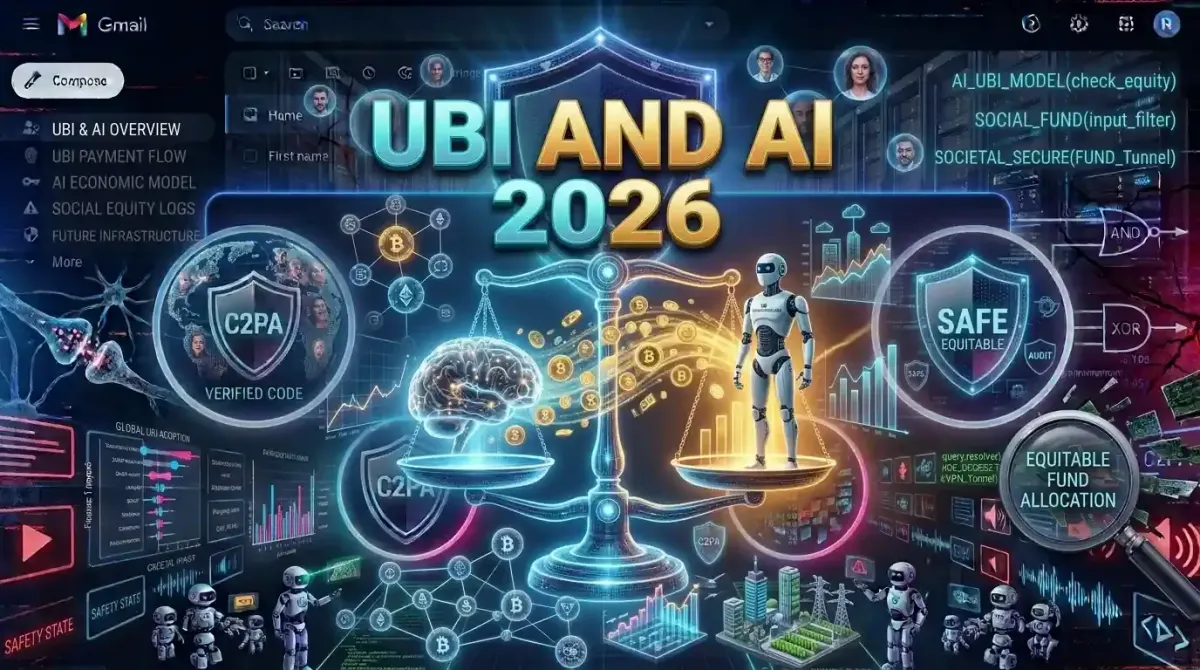
Universal Basic Income combined with advanced artificial intelligence represents the most viable economic framework for navigating the impending post labor economy of 2026. As machine learning algorithms and autonomous systems rapidly displace traditional human labor across manufacturing, logistics, and knowledge work, governments and institutions must transition from wage based survival models to guaranteed income structures. Implementing this requires robust technological infrastructure, including central bank digital currencies, zero knowledge proof identity verification, and automated taxation pipelines, to ensure frictionless, transparent, and fraud resistant distribution. This comprehensive guide details the economic models, technical architectures, and policy frameworks necessary to build a resilient post labor society that prioritizes human dignity and economic stability.
The Mechanics of Labor Displacement in the AI Era
Direct Answer: Labor displacement occurs when artificial intelligence and robotics automate tasks previously performed by humans, reducing the demand for traditional wage labor. Preparing for this requires decoupling basic human survival from employment through guaranteed income structures, funded by automated productivity gains and data taxation.
The trajectory of artificial intelligence has shifted from narrow task automation to broad cognitive and physical replacement. In 2026, large language models manage complex logistical operations, autonomous agents handle customer service and basic software engineering, and advanced robotics perform intricate physical labor. This convergence means that displacement is no longer confined to routine manual jobs; it actively impacts mid level cognitive roles, accelerating the timeline toward a post labor economy.
Historically, technological revolutions created more jobs than they destroyed. However, the current paradigm differs fundamentally. Artificial general intelligence systems are approaching human level adaptability, meaning the new jobs created are increasingly designed to be performed by the AI itself. The economic consequence is a structural decoupling of productivity from human labor. While corporate revenues and gross domestic product may soar due to hyper efficient automation, wage based consumer purchasing power collapses, threatening the foundational cycle of capitalist economies. Understanding the rise of humanoid robots and how they will impact the workforce is critical, as physical automation is now scaling in tandem with cognitive automation, leaving fewer sectors insulated from disruption.
Economic Models for Funding Universal Basic Income
A primary critique of guaranteed income has always been its fiscal feasibility. In a post labor economy, however, the funding mechanisms shift from taxing human income to taxing automated productivity, capital, and data. Several viable models have emerged as frontrunners for sustainable implementation.
The Robot and Automation Tax
This model proposes levying a tax on companies based on the number of human jobs replaced by automated systems or the sheer computational output of their AI infrastructure. By taxing the marginal cost of machine labor, which approaches zero, governments can capture a fraction of the massive productivity gains. This revenue is then redistributed directly to citizens. The challenge lies in defining automation and preventing capital flight to jurisdictions with lax regulations.
Data Dividend and Digital Taxation
Modern AI models are fundamentally trained on human generated data. Every search query, social media post, and digital interaction contributes to the training corpus that makes these systems valuable. A data dividend model treats personal data as a form of labor or property. Companies harvesting this data must pay a licensing fee into a public trust, which is then distributed as a basic income. Recognizing why 2026 is the year of total data sovereignty empowers citizens to demand financial compensation for the digital exhaust that fuels the AI economy.
Value Added Tax on Automated Goods
A broad based consumption tax, specifically adjusted for goods and services produced with high levels of automation, can generate substantial, stable revenue. Because automated production drastically lowers the cost of goods, a modest value added tax can fund a robust income guarantee without significantly inflating consumer prices. This model is highly scalable and difficult for corporations to evade compared to income based taxes.
| Funding Model | Primary Revenue Source | Implementation Complexity | Economic Impact |
|---|---|---|---|
| Automation Tax | Corporate AI and robotics deployment | High (Requires precise tracking of labor substitution) | Slows automation adoption slightly; directly funds distribution |
| Data Dividend | Licensing fees on training data usage | Medium (Requires new data property rights frameworks) | Redistributes wealth from tech monopolies to citizens |
| Automated Value Added Tax | Consumption of AI produced goods and services | Low (Leverages existing tax infrastructure) | Stable revenue; mildly regressive without income offset |
| Sovereign Wealth Fund | Government equity in major AI corporations | Medium (Requires initial capital or regulatory mandates) | Aligns public interest with corporate AI success |
Step by Step Implementation Guide for Pilots
Transitioning to a post labor economy cannot happen overnight. It requires rigorous, data driven pilot programs to test distribution mechanisms, measure economic impact, and refine policy before national rollout. Governments and civic organizations should follow this structured workflow.
Phase 1: Demographic Selection and Baseline Establishment
Select a diverse, representative geographic region or demographic cohort for the pilot. The sample must include varying income levels, employment statuses, and age groups. Before distributing any funds, conduct comprehensive baseline surveys measuring mental health, employment seeking behavior, local business revenue, and community engagement. This baseline is critical for isolating the causal impact of the intervention.
Phase 2: Technological Infrastructure Setup
Establish the digital rails for frictionless distribution. Relying on traditional banking systems excludes unbanked populations and introduces unnecessary friction. Instead, deploy a government backed digital wallet system. To protect user privacy while preventing fraud, integrate zero knowledge proofs for verifying identity without sharing data. This cryptographic method allows the system to verify that a recipient is a unique, eligible citizen without exposing their underlying personal data to the distribution network or potential hackers.
Phase 3: Phased Distribution and Monitoring
Begin distributing the funds at a subsistence level, sufficient to cover basic housing, food, and utilities. Distribute funds monthly via the digital wallet. Simultaneously, deploy real time economic monitoring dashboards. Track metrics such as local inflation rates, small business formation, and healthcare utilization. If localized inflation occurs, the distribution algorithm must be capable of dynamic adjustment or the implementation of targeted price controls on essential goods.
Phase 4: Evaluation and Policy Iteration
After 12 to 24 months, conduct a rigorous econometric analysis comparing the pilot group to a control group. Evaluate whether the program reduced poverty, improved mental health outcomes, and stimulated local economies without causing significant labor market withdrawal. Use these findings to iterate on the distribution amount, funding mechanism, and technological infrastructure before scaling to a regional or national level.
The Role of Reskilling and Human Centric Work
While guaranteed income provides a financial floor, it does not eliminate the human desire for purpose, community, and contribution. A post labor economy must actively cultivate human centric work, roles that emphasize empathy, creativity, complex problem solving, and interpersonal connection, which remain difficult to automate.
Governments must pair income guarantees with robust, freely accessible reskilling programs. These programs should not focus on training people to compete with machines in routine tasks, but rather on elevating uniquely human capabilities. This includes funding for arts, community organizing, advanced caregiving, and environmental restoration. Implementing ethical strategies for reskilling workers ensures that the transition is not merely a passive handout, but an active investment in human capital, allowing individuals to pivot toward roles that provide psychological fulfillment and societal value.
Regulatory Frameworks and Global Policy Alignment
The transition to a post labor economy is inherently global. If one nation implements a robust income guarantee funded by automation taxes, while another subsidizes hyper automation with zero social safety nets, capital and corporate entities will migrate to the latter, undermining the model. Therefore, international regulatory alignment is paramount.
Harmonizing AI and Labor Regulations
International bodies must establish baseline standards for how automation impacts labor rights and social funding. The EU AI Act and what it means for businesses worldwide provides a foundational template, demonstrating how regional regulations can mandate transparency and accountability. Expanding these frameworks to include mandatory contributions to social safety nets based on AI deployment metrics will prevent a race to the bottom in labor standards.
Global Tax Cooperation
To prevent tax avoidance by multinational technology corporations, a global minimum tax on automated productivity is necessary, similar to the recent global minimum corporate tax agreements. The global race for AI regulation comparing US, EU, and Asia highlights the current fragmentation. Bridging these divides through organizations like the OECD is essential to ensure that the wealth generated by global AI infrastructure is equitably shared across borders, funding initiatives worldwide.
Technological Infrastructure for Secure Distribution
The logistical challenge of distributing funds to millions or billions of citizens requires a technological stack that is scalable, secure, and resistant to corruption. Traditional bureaucratic systems are too slow and prone to leakage. The solution lies in decentralized, cryptographically secure financial infrastructure.
Central Bank Digital Currencies
Central bank digital currencies provide the ideal rail for distribution. Unlike decentralized cryptocurrencies, these are issued and regulated by central banks, ensuring stability and legal tender status. They allow for programmable money, meaning funds can be distributed instantly, directly to citizen digital wallets, bypassing commercial bank intermediaries and their associated fees. Furthermore, they can be programmed with specific parameters, such as expiration dates to encourage immediate spending and stimulate local economies, or restrictions preventing the funds from being used for harmful goods.
Automated Accounting and Fraud Detection
Managing a national program generates massive amounts of financial data. To ensure efficiency and prevent fraud, governments must leverage advanced AI for real time auditing. By deploying modern SaaS tools to automate accounting at the governmental level, authorities can track fund flows, detect anomalous patterns indicative of fraud or money laundering, and ensure that the system remains solvent and trustworthy. This automation reduces administrative overhead to a fraction of traditional welfare systems.
Corporate Responsibility and the Evolving Social Contract
The post labor economy demands a fundamental rewrite of the social contract between corporations, the state, and the individual. For decades, the implicit agreement was that corporations provide jobs, and in return, they are granted the license to operate and generate profit. When jobs disappear, this contract breaks.
Corporations benefiting from AI driven margin expansion must recognize their role in sustaining the consumer base that purchases their goods and services. A society with widespread poverty cannot sustain a thriving tech sector. Therefore, embracing the ethics of AI in 2026 and why neutrality is no longer enough requires corporate leaders to actively advocate for and contribute to income guarantee frameworks. This is not merely philanthropy; it is a strategic imperative for long term market stability and brand survival.
Addressing the Data Privacy Trade off
A significant concern with digital distribution, particularly when tied to central bank digital currencies and digital identity systems, is the potential for unprecedented state surveillance. If every transaction is tracked, the financial privacy of citizens is eradicated, creating a tool for potential authoritarian control.
To mitigate this, architectures must be designed with privacy by default. This means utilizing decentralized identity protocols and ensuring that while the government can verify that a unique individual received their allocation, it cannot track how that individual spends it on lawful goods and services. Understanding how your data is used and how to protect it is a parallel concern; the same cryptographic principles that protect training data privacy must be applied to protect citizen financial privacy in this system. The goal is to provide economic security without sacrificing civil liberties.
Future Scenarios: The AGI Horizon
The urgency of implementing these economic safeguards is directly tied to the timeline of Artificial General Intelligence. Narrow AI automates specific tasks, but AGI will possess the ability to learn, reason, and execute any intellectual task that a human can, at a fraction of the cost and speed.
As researchers make leading research breakthroughs expected in late 2026, the window for proactive economic restructuring is closing. If AGI is achieved before a framework is established, the resulting economic shock could lead to severe social unrest, mass unemployment, and political instability. Conversely, if implemented proactively, AGI becomes a tool for unprecedented human flourishing, freeing humanity from menial labor to pursue scientific discovery, artistic expression, and community building.
Managing the Transition: Civic Tech and Community Organization
The transition to a post labor economy will be disruptive. Effective management requires robust civic infrastructure to support communities through the change. Local governments and community organizations will play a vital role in administering localized support, managing retraining programs, and fostering community cohesion.
To coordinate these efforts efficiently, civic organizations must adopt modern operational tools. Utilizing agile project management tools allows community leaders to track the progress of local support initiatives, manage volunteer networks, and ensure that resources are allocated efficiently to those most in need during the transition period. This decentralized, community led approach ensures that the macroeconomic policy is effectively translated into microeconomic stability for individual families.
Conclusion
Universal Basic Income is no longer a utopian fringe theory; it is an economic necessity for the AI driven post labor economy of 2026 and beyond. As artificial intelligence and robotics systematically decouple productivity from human labor, the traditional wage based social contract is becoming obsolete. Preparing for this reality requires bold, proactive action: implementing sustainable funding models like data dividends and automation taxes, building secure and privacy preserving digital distribution infrastructure, and fostering a cultural shift that values human well being over mere employment metrics.
The transition will be complex, requiring unprecedented global cooperation, technological innovation, and a redefinition of corporate responsibility. However, the alternative, a society characterized by extreme wealth concentration, mass technological unemployment, and social instability, is untenable. By embracing these economic frameworks and the technological tools required to administer them, humanity can harness the immense productive power of artificial intelligence to create a future of widespread prosperity, freedom, and human flourishing. The time to build the foundations of the post labor economy is now.