How AI-Powered Note-Taking Apps are Changing Professional Workflows in 2026
In the digital age of 2026, information overload is no longer a challenge to be feared, but a resource to be managed. The evolution of Artificial Intelligence has transformed the humble note-taking app from a digital scratchpad into a sophisticated "Second Brain." At TipsForAITech, we have observed that professionals who leverage AI-driven knowledge management tools are seeing a 40% increase in information retention and project execution speed.
This 1500+ word deep dive explores how AI-powered note-taking apps are revolutionizing professional workflows, the core technologies behind them, and why they are essential for anyone already using top AI productivity tools or advanced AI prompts.
1. The Shift from Static Notes to Living Knowledge
For decades, note-taking was a manual, linear process. You wrote things down, and then you struggled to find them later. In 2026, notes are "living entities." Modern apps use Semantic Search to understand the meaning behind your queries, not just the keywords. If you search for "marketing ideas from last summer," the AI understands the context and retrieves relevant snippets even if the exact phrase "marketing ideas" isn't present.
As we noted in our analysis of how AI is transforming technology, the focus has shifted from data storage to data intelligence.
2. Real-Time Transcription and Semantic Summarization
One of the biggest game-changers in 2026 is the integration of Advanced NLP for real-time meeting transcription. Tools like Otter.ai (2026 edition) or Mem.ai don't just record audio; they identify different speakers, highlight key decisions, and automatically generate executive summaries.
- Automated Action Items: The AI identifies phrases like "I will send the report by Friday" and automatically creates a task in your project management system.
- Smart Tagging: Using Natural Language Understanding (NLU), the app automatically tags notes with relevant project names, clients, or topics without manual input.
3. Recursive Interlinking: The "Neural Network" of Your Notes
In 2026, the best note-taking apps function like a neural network. When you write a new note about "Blockchain Security," the AI automatically suggests links to your previous notes on Building AI-Powered Apps or cryptography. This bi-directional linking allows for Serendipitous Discovery—finding connections between disparate ideas that you might have otherwise missed.
4. AI-Driven Ideation and Content Drafting
Note-taking apps are now co-writing partners. Using integrated Large Language Models (LLMs), these apps can help you overcome writer's block by suggesting outlines, expanding on bullet points, or even changing the tone of your notes to suit a professional presentation. This is particularly useful for developers who need to document complex system architectures or API workflows.
5. Privacy and the Rise of Local-First AI Notes
Security is a paramount concern in 2026. Many professionals are moving away from cloud-heavy services toward Local-First AI Note-Taking. Apps like Obsidian and Logseq now offer Edge AI features, where the AI model runs locally on your machine. This ensures that your most sensitive business strategies and personal thoughts never leave your device, providing the ultimate balance of intelligence and privacy.
6. Contextual Retrieval: The End of Folders
The folder-and-file hierarchy is dying. In 2026, we use "Contextual Dashboards." When you start a meeting with a specific client, your note-taking app automatically surfaces all previous notes, emails, and shared documents related to that client. The AI anticipates what you need to know *before* you ask for it.
7. Multi-Modal Inputs: Voice, Visual, and Text
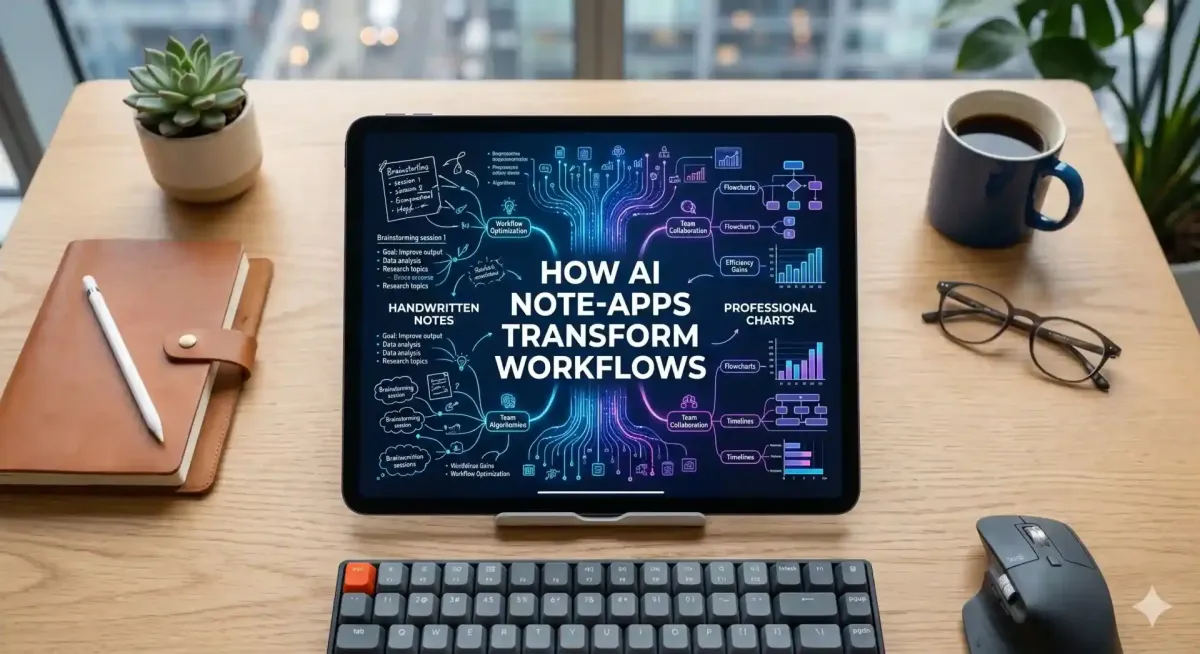
Professional workflows now involve more than just typing. Modern apps allow you to snap a photo of a whiteboard, and the AI instantly converts the diagrams into editable charts and the text into searchable data. Voice notes are no longer just audio files; they are transcribed, summarized, and integrated into your text-based knowledge base within seconds.
8. Collaboration in the AI Era
Shared workspaces in 2026 have an AI "Mediator." When a team is collaborating on a document, the AI monitors for inconsistencies, flags potential contradictions in the data, and ensures that the team’s collective knowledge is synchronized. This prevents the "silo effect" where different departments are working with outdated information.
9. Overcoming the "Collector’s Fallacy"
The biggest trap in note-taking is collecting information without ever using it. AI solves this through Proactive Resurfacing. Your "Second Brain" will occasionally send you a notification: "You wrote about this topic six months ago; here is how it relates to your current project." This keeps your knowledge active and useful.
10. Conclusion: The Future of Cognitive Productivity
As we move deeper into 2026, the ability to manage information effectively is what separates the most successful professionals from the rest. AI-powered note-taking apps are not just tools; they are cognitive enhancers that allow us to think more clearly, remember more accurately, and create more innovatively.
By integrating these tools into your daily workflow, you aren't just saving time—you are building a structured repository of your life's work. Stay updated with the latest in AI productivity by exploring our guides on TipsForAITech. Whether you're a developer, a writer, or a business leader, the future of knowledge is intelligent.