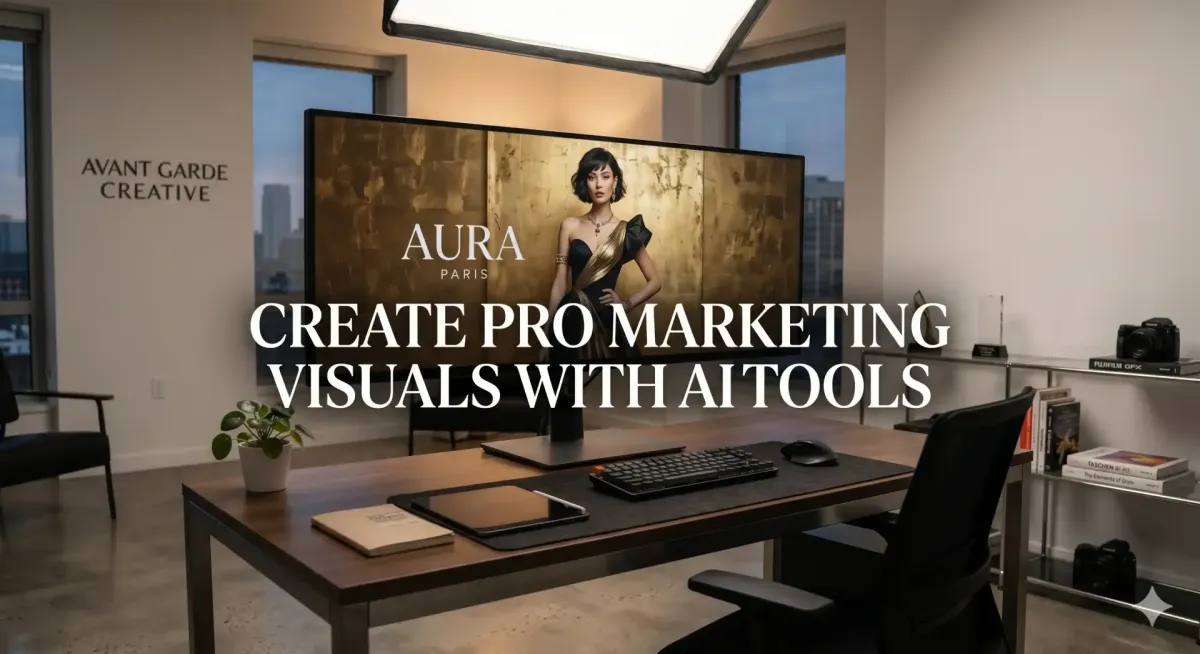
How to Create High-Quality Marketing Visuals Using AI Image Tools in 2026
In 2026, the visual demands of the digital market are relentless. To capture attention in a world of infinite content, a brand needs more than just "good" images—it needs high-fidelity, emotionally resonant, and brand-consistent visuals. Generative AI has transformed from an experimental toy into a professional workstation for marketers. At TipsForAITech, we are seeing a 70% reduction in production time for brands that successfully integrate AI into their visual workflows.
This 1500+ word comprehensive guide will teach you how to create high-quality marketing visuals using the leading AI tools of 2026. Whether you are choosing between Midjourney and DALL-E 3 or mastering the perfect prompt, these strategies will elevate your brand's aesthetic.
1. Defining Your AI Visual Identity
Before you generate a single pixel, you must define your AI Style Guide. In 2026, the most successful brands don't just use "generic AI"; they use custom-tuned styles. You need to define your color palette, lighting style (e.g., "golden hour," "soft studio lighting"), and composition rules. This ensures that every image, whether it's a product shot or a lifestyle graphic, feels like it belongs to the same brand family.
As we discussed in 10 ways AI is transforming technology, consistency is the key to building trust in an automated world.
2. Mastering "Product-First" Prompting
Marketing visuals usually center around a product. In 2026, tools like Midjourney v7 allow for "Character and Style References." By uploading a photo of your actual product, you can use AI to generate that product in diverse environments. For example: "A high-end sustainable water bottle [Reference Image] placed on a minimalist marble kitchen counter, hyper-realistic, 8k, soft morning light."
This "Consistent Object Generation" is vital for fast-paced social media marketing, where you need to show your product in new contexts every single day.
3. Leveraging DALL-E 3 for Graphic Design and Layout
While Midjourney excels at photorealism, DALL-E 3 (integrated with GPT-5) is the master of Semantic Layouts. In 2026, DALL-E 3 can generate error-free typography and specific graphic elements like icons and logos. If you need a promotional banner with specific text like "SUMMER SALE - 50% OFF," DALL-E 3 will render it perfectly within the artistic context of the image.
4. Advanced Post-Processing with Generative In-Painting
Sometimes an AI image is 90% perfect but has one small flaw. In 2026, professional marketers use Generative In-Painting (available in Adobe Firefly and Runway). This allows you to select a specific area—like a model’s expression or a background object—and tell the AI to "change the blue shirt to a red linen shirt" or "add a laptop on the table." This level of surgical control ensures your visuals meet specific campaign requirements.
5. Scaling Visuals with AI Upscaling and Enhancement
Raw AI outputs are often not high enough resolution for large-scale billboards or high-definition displays. In 2026, using tools like Magnific AI is standard. These tools don't just increase pixels; they add texture and detail, making an AI-generated image look like it was shot on a $50,000 Phase One camera. This is crucial for maintaining a premium brand perception.
6. Creating Immersive AR and 3D Marketing Assets
Marketing in 2026 often happens in 3D. By combining 2D generative tools with Luma Dream Machine, you can turn a 2D marketing visual into a 3D asset for virtual offices or AR shopping experiences. This allows customers to "place" your product in their room using their AR glasses, increasing engagement and conversion rates.
7. The Ethical Imperative: Transparency and Disclosure
As we emphasize at TipsForAITech, transparency is a marketing superpower. In 2026, savvy consumers appreciate honesty. Using Content Credentials to disclose the use of AI in your visuals builds a reputation for ethical innovation. It also protects your brand from "Deepfake" accusations, ensuring your audience knows your brand's official content is verified.
8. Syncing Visuals with AI-Driven Data Management
By integrating your visual production with AI-driven data management, you can perform real-time A/B testing on your visuals. The AI can track which image styles (e.g., "vibrant" vs. "muted") are performing better in specific regions and automatically suggest or generate more content in that high-performing style.
9. Using AI for Rapid Prototyping and Moodboards
Even if you still use traditional photography for final assets, AI is a game-changer for Concept Development. Instead of spending days scouring stock photo sites for a moodboard, you can use advanced prompts to generate a dozen specific visual concepts in minutes, aligning your creative team instantly.
10. Conclusion: The New Era of Visual Storytelling
The ability to create high-quality marketing visuals with AI is not about replacing photographers or designers; it is about giving them a "Superpower." In 2026, the brands that win are those that combine human creative direction with the infinite speed and scalability of AI. Your vision is the limit; the tools are now ready to catch up.
Stay ahead of the visual revolution by following our technical guides and reviews at TipsForAITech. Whether you are looking for automation productivity or advanced AI insights, we are your partner in the 2026 technology landscape.