
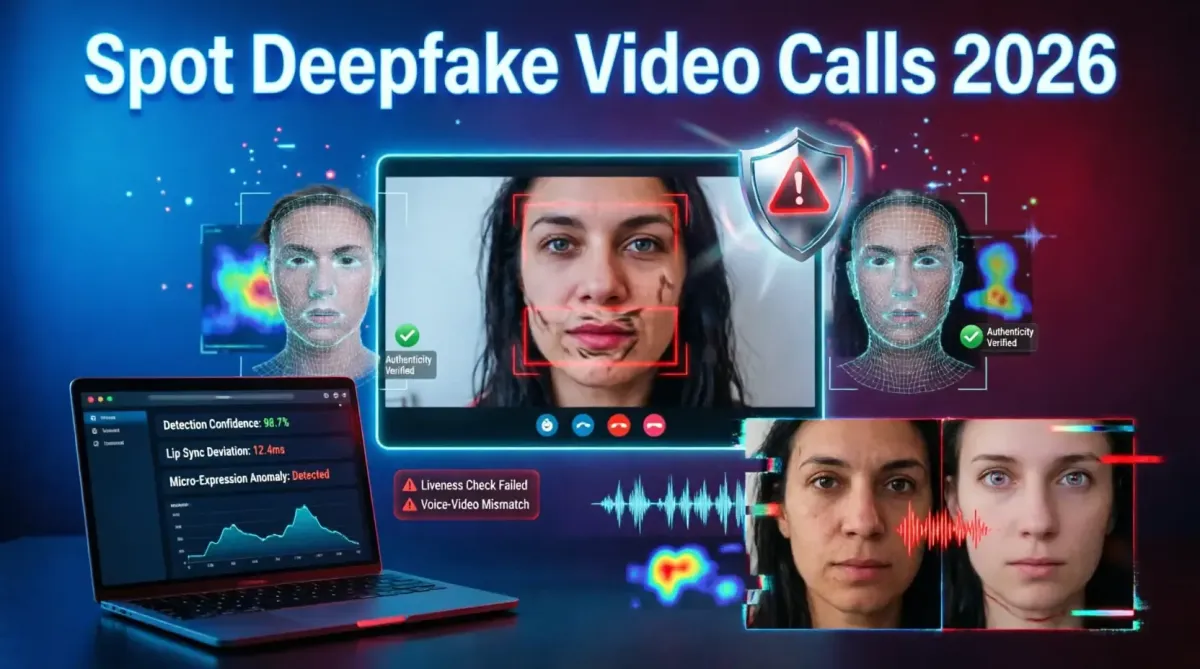
How to Spot a Deepfake Video Call New Tactics Used by Cybercriminals
Deepfake video calls represent one of the most sophisticated cyber threats in 2026, where cybercriminals use AI to impersonate executives, family members, or trusted contacts in real time video conversations. Unlike pre recorded deepfake videos, these live impersonation attacks leverage advanced generative adversarial networks and neural rendering to create convincing real time video forgeries that can bypass traditional security measures. This comprehensive technical guide examines the latest tactics used by cybercriminals, provides step by step detection methodologies for identifying synthetic video in real time, outlines verification protocols for suspicious video calls, and details preventive measures for individuals and organizations. By understanding these emerging threats and implementing layered security practices, you can protect yourself from financial fraud, data breaches, and social engineering attacks that exploit the trust we place in face to face video communication.
Understanding Real Time Deepfake Video Technology in 2026
Real time deepfake video technology has evolved from pre rendered forgeries to live synthesis capable of impersonating individuals during video calls with minimal latency. Modern systems use advanced neural networks, particularly generative adversarial networks and diffusion models, to analyze target individuals from publicly available videos and photos, then generate convincing real time video streams that mimic their facial expressions, voice, and mannerisms.
The technology operates through several key components. First, a face encoder extracts facial features and expressions from the target person using reference videos. Second, a generator network creates synthetic frames that match the attacker's movements while displaying the target's face. Third, a discriminator network refines the output to eliminate artifacts and improve realism. Advanced systems can now process video in real time with latencies under 200 milliseconds, making detection during live calls extremely challenging.
For individuals concerned about digital privacy, understanding how your data is used to train AI models and how to protect it provides essential context for how publicly shared videos on social media, professional platforms, or video conferencing recordings can become training data for unauthorized deepfake generation.
New Tactics Used by Cybercriminals in 2026
Cybercriminals have developed sophisticated tactics that exploit the trust and urgency inherent in video communication. Understanding these patterns helps victims recognize attacks before irreversible damage occurs.
Executive Impersonation for Financial Fraud:
- Scenario: Attackers impersonate CEOs, CFOs, or senior executives during urgent video calls to authorize fraudulent wire transfers, disclose sensitive financial information, or approve suspicious transactions
- Tactics: Use deepfake video combined with voice cloning to create convincing executive presence, exploit after hours timing when verification is difficult, create artificial urgency to bypass normal approval workflows
- Red Flags: Unusual payment instructions, requests to bypass standard procedures, communication outside normal channels, pressure to act immediately without documentation
Family Emergency Scams via Video:
- Scenario: Criminals impersonate family members claiming to be in distress, arrested, hospitalized, or stranded, requesting immediate money transfers or personal information
- Tactics: Combine deepfake video with emotional manipulation, claim phone or camera issues to avoid extended conversation, provide plausible but unverifiable details about emergencies
- Red Flags: Refusal to answer personal questions, pressure for immediate payment via untraceable methods, inability to verify through known contact information
Technical Support and IT Impersonation:
- Scenario: Attackers pose as IT support staff or security personnel during video calls to extract credentials, install malware, or gain remote access to systems
- Tactics: Use professional appearance and technical jargon to establish credibility, create false security alerts to trigger panic, request screen sharing or remote desktop access
- Red Flags: Unsolicited contact, requests for sensitive credentials, pressure to install software immediately, refusal to let you initiate callback through official channels
Recruitment and Job Offer Scams:
- Scenario: Fraudsters impersonate recruiters or hiring managers during video interviews to extract personal information, banking details, or payment for fake training materials
- Tactics: Use deepfake video to appear as legitimate company representatives, offer positions with minimal interview process, request personal documents or payment for equipment
- Red Flags: Offers that seem too good to be true, requests for payment or sensitive information before employment, unprofessional communication or rushed timeline
For comprehensive fraud prevention, reviewing how to spot and avoid AI generated phishing scams provides complementary techniques for identifying synthetic communications across email, text, voice, and video channels.
Technical Indicators of Deepfake Video Calls
While advanced deepfakes can fool human observers, technical analysis and careful observation can reveal telltale artifacts. Understanding these indicators enables more reliable detection during live video calls.
| Indicator | What to Look For | Detection Difficulty | Verification Method |
|---|---|---|---|
| Unnatural Facial Movements | Asymmetric expressions, delayed reactions, or robotic movements | Moderate | Ask person to make specific facial expressions or gestures |
| Inconsistent Lighting | Facial lighting that does not match background or changes unnaturally | Moderate | Request person move closer to or away from light source |
| Audio Visual Desynchronization | Lip movements that do not match speech timing | Easy | Listen carefully while watching mouth movements |
| Unusual Blinking Patterns | Infrequent blinking, unnatural timing, or asymmetrical eye movements | Easy | Observe eye movements during extended conversation |
| Background Artifacts | Blurred edges around face, inconsistent background details, or digital distortion | Moderate | Request person change background or move camera angle |
| Resolution Inconsistencies | Face appears sharper or blurrier than background unexpectedly | Difficult | Compare face quality to background quality |
| Unnatural Head Movements | Jerky, delayed, or mechanically smooth head rotations | Moderate | Ask person to turn head side to side |
| Response Latency | Unusual delays before answering complex or unexpected questions | Easy | Ask spontaneous questions requiring real time thought |
Advanced Detection Techniques:
- Challenge Questions: Ask about shared memories, recent events, or inside knowledge that only the real person would know. Deepfake operators lack contextual knowledge and may provide generic or incorrect answers.
- Secondary Verification: Hang up and call the person back through a known, trusted number or platform. Legitimate contacts will understand security precautions during suspicious circumstances.
- Technical Verification: Request the person perform specific actions like holding up fingers, turning their head, or showing a specific object. Real time deepfakes may struggle with complex spatial movements.
- Environmental Questions: Ask about their current surroundings, what they are wearing, or what they are doing. Deepfake operators may not have prepared answers for spontaneous environmental questions.
For organizations implementing video conferencing security, understanding why you should switch to passkeys for better online security demonstrates how multi factor authentication can complement video verification to prevent unauthorized access even if deepfake impersonation succeeds.
Step by Step Verification Protocol for Suspicious Video Calls
When receiving a video call that may involve deepfake impersonation, follow this structured protocol to verify authenticity before taking any action or sharing sensitive information.
Step One: Pause and Assess
- Do not act on urgent requests immediately, regardless of emotional pressure or apparent authority
- Note the caller's claimed identity, relationship to you, and requested action
- Observe video quality, facial movements, and audio synchronization for technical indicators
- Trust your instincts if something feels unusual or out of character
Step Two: Challenge the Caller
- Ask a specific question only the real person could answer, such as a shared memory, recent activity, or personal preference
- Request the caller to describe their current location or surroundings in detail
- Ask them to perform a specific action like holding up three fingers, turning their head, or showing a specific object
- Propose switching to a different communication channel you know is legitimate
Step Three: Technical Verification
- Request the person move closer to or away from the camera to observe facial rendering quality
- Ask them to change lighting conditions or move to a different location
- Request they turn their head side to side or make specific facial expressions
- Observe whether video quality changes or artifacts appear during movement
Step Four: Independent Verification
- Hang up and contact the person through a known, trusted channel (their personal phone, email, or verified social media)
- If the caller claims to represent an organization, hang up and call the official number listed on the organization's verified website
- Consult with other colleagues, family members, or IT security teams who may have recent contact with the claimed individual
- Use out of band verification methods like texting or calling a different number
Step Five: Secure Actions
- Never provide payment, credentials, or sensitive information based solely on a video call without independent verification
- Verify any financial or administrative request through official channels, documented procedures, or in person confirmation
- Enable transaction alerts and spending limits on accounts to detect unauthorized activity
- Document the call details including time, platform, requested actions, and any suspicious indicators
Step Six: Report and Document
- Report suspected deepfake video calls to relevant authorities (FBI IC3, local law enforcement, organizational security teams)
- Document call details including platform used, phone number if available, time, requested actions, and observed anomalies
- Share the experience with colleagues, family, and community networks to raise awareness
- Preserve any recordings or screenshots if legally permissible for investigation purposes
For small business owners targeted by deepfake video scams, reviewing how to protect your small business from ransomware attacks provides complementary security practices that strengthen overall organizational resilience against social engineering and fraud.
Preventive Measures for Individuals and Families
Proactive security practices reduce vulnerability to deepfake video call scams before attacks occur. Implement these measures to protect yourself and loved ones.
Establish Family Verification Protocols:
- Create a unique family code word or phrase known only to trusted members, to be used in emergency verification scenarios
- Agree on secondary communication channels for urgent situations, such as a specific messaging app or email address
- Establish a protocol where family members verify identity through a pre agreed question or action during suspicious calls
- Educate all family members, especially elderly relatives and children, about deepfake risks and verification procedures
Limit Public Video Exposure:
- Review social media privacy settings to restrict access to videos, live streams, or video posts that could be harvested for deepfake training
- Avoid posting high quality videos that clearly show your face from multiple angles
- Be cautious when participating in public video calls, webinars, or online events that may be recorded without consent
- Request that organizations blur or remove your video from publicly accessible recordings
Strengthen Account Security:
- Enable multi factor authentication on all video conferencing platforms, email, and sensitive accounts
- Use unique, complex passwords managed through a reputable password manager to prevent credential stuffing attacks
- Enable login notifications and review account activity regularly for unauthorized access
- Implement device recognition and location based authentication where available
Stay Informed and Adaptive:
- Follow cybersecurity news and consumer protection resources to learn about emerging deepfake tactics and countermeasures
- Periodically review and update family security protocols as technology and threat landscapes evolve
- Participate in community awareness programs that share scam prevention knowledge across demographic groups
- Practice verification protocols regularly so they become automatic during high stress situations
For comprehensive digital privacy management, understanding how to manage your digital footprint in the age of AI tracking provides strategies for minimizing publicly available personal data that could be exploited for deepfake generation or other impersonation attacks.
Organizational Defenses Against Deepfake Video Attacks
Businesses and institutions face heightened risks from deepfake video attacks targeting financial transactions, sensitive data, and operational integrity. Implementing layered defenses reduces exposure and enables rapid incident response.
Authentication Hardening:
- Implement multi factor authentication for all financial transactions and sensitive operations, requiring approval through separate authenticated channels
- Establish verification protocols that require in person or documented approval for high value transactions
- Use hardware security keys or biometric authentication for critical system access
- Implement behavioral biometrics that analyze typing patterns, mouse movements, or device interaction to detect anomalous access attempts
Employee Training and Awareness:
- Conduct regular security awareness training that includes deepfake video scam scenarios and verification protocols
- Simulate deepfake attacks in controlled exercises to test organizational response and identify process gaps
- Establish clear escalation procedures for employees who receive suspicious video calls, ensuring rapid consultation with security teams
- Create quick reference guides for verification procedures that employees can access during suspicious calls
Technical Monitoring and Detection:
- Deploy AI powered deepfake detection tools that analyze video streams in real time for synthetic artifacts
- Integrate video conferencing platforms with security information and event management systems to detect unusual patterns
- Maintain threat intelligence feeds that provide early warnings about emerging deepfake campaigns targeting your industry
- Implement call recording and analysis systems that flag suspicious video characteristics for human review
Policy and Procedure Development:
- Establish clear policies requiring secondary verification for all financial transactions, regardless of apparent authority
- Document approved communication channels for sensitive requests and ensure all employees are trained on these protocols
- Implement approval workflows that require multiple authorized individuals for high value transactions
- Create incident response playbooks specific to deepfake video attacks, including containment, investigation, and recovery steps
For organizations navigating regulatory requirements around data protection and fraud prevention, understanding understanding the EU AI Act what it means for businesses worldwide helps align video security measures with emerging compliance obligations for AI system transparency and user protection.
Emerging Detection Technologies and Tools
As deepfake technology advances, so do detection capabilities. Understanding emerging tools helps individuals and organizations stay ahead of threats.
Real Time Deepfake Detection Software:
- AI powered tools that analyze video streams in real time for synthetic artifacts, facial inconsistencies, and rendering anomalies
- Browser extensions and video conferencing plugins that flag suspicious video characteristics during live calls
- Mobile applications that can analyze video calls on smartphones for deepfake indicators
- Enterprise solutions that integrate with video conferencing platforms to provide automated deepfake detection
Blockchain Based Video Authentication:
- Systems that cryptographically sign video streams at the source to verify authenticity
- Digital watermarks embedded in legitimate video streams that can be verified in real time
- Decentralized identity verification systems that use blockchain to confirm participant identity
Behavioral Analysis Tools:
- AI systems that analyze speech patterns, facial micro expressions, and behavioral consistency to detect anomalies
- Tools that compare current video calls to historical patterns for the same individual
- Systems that detect unusual response times, speech patterns, or behavioral inconsistencies
Collaborative Threat Intelligence:
- Industry sharing networks that distribute deepfake signatures and detection patterns
- Centralized databases of known deepfake attacks and tactics
- Real time alerting systems that warn organizations about active deepfake campaigns
For organizations planning long term technology strategy, understanding the future of SaaS top trends to watch this year provides context for how cloud based security services may integrate deepfake detection into broader threat protection platforms.
Legal and Regulatory Considerations
The rise of deepfake video calls raises profound legal and regulatory questions that societies must address to balance innovation with protection.
Legal Frameworks for Deepfake Prevention:
- Criminal Penalties: Many jurisdictions are enacting laws that criminalize malicious deepfake creation and use, with penalties ranging from fines to imprisonment
- Civil Liability: Victims of deepfake fraud may pursue civil remedies for financial losses, emotional distress, and reputational damage
- Platform Responsibility: Video conferencing platforms face increasing pressure to implement deepfake detection and prevent misuse of their services
Regulatory Approaches:
- Disclosure Requirements: Mandating clear labeling of synthetic video content in commercial, political, or public communications
- Access Controls: Restricting deepfake creation tools to verified users with legitimate purposes
- Victim Remediation: Establishing legal pathways for individuals harmed by unauthorized deepfakes to seek redress and removal of synthetic content
Global Coordination Challenges:
- Deepfake attacks cross national boundaries, requiring international cooperation on standards, enforcement, and threat intelligence sharing
- Divergent regulatory approaches across jurisdictions create compliance complexity for global technology providers
- Balancing innovation incentives with protective measures requires ongoing dialogue among technologists, policymakers, and civil society
For stakeholders engaged in shaping responsible AI development, reviewing balancing innovation and ethics regulating AI development provides frameworks for advancing video technology while mitigating risks of misuse and harm.
Future Trajectory and Strategic Preparation
Deepfake video technology and defensive countermeasures will continue evolving in tandem. Understanding emerging trends helps individuals and organizations prepare for future challenges.
Advancing Deepfake Capabilities:
- Real time full body synthesis that can impersonate individuals in complete video calls including gestures and body language
- Multi person deepfakes that can impersonate multiple participants in group video calls simultaneously
- Context aware deepfakes that adapt to conversation topics and environmental changes in real time
- Lower latency synthesis that reduces detection opportunities through faster processing
Emerging Countermeasures:
- On device AI classifiers that analyze video in real time to flag deepfakes with minimal latency
- Hardware based video authentication that cryptographically signs video at the camera sensor level
- Collaborative threat intelligence networks that share deepfake signatures across organizations for faster detection
- Quantum resistant authentication methods that remain secure even as computing power increases
Strategic Preparation Recommendations:
- Invest in security awareness training that evolves with emerging deepfake tactics and countermeasures
- Design authentication systems with flexibility to incorporate new verification methods as technology advances
- Participate in industry working groups and standards bodies shaping responsible video technology development
- Maintain adaptive security postures that anticipate rather than merely react to evolving threats
- Build relationships with law enforcement and cybersecurity partners for coordinated response during active attacks
For organizations implementing comprehensive data protection frameworks, exploring building privacy first AI techniques for secure data processing reveals how privacy enhancing technologies complement deepfake defenses by minimizing data exposure and enforcing strict access controls.
Conclusion: Preserving Trust in Video Communication
The rise of deepfake video calls represents a profound challenge to the trust we place in face to face digital communication. As synthetic video becomes increasingly indistinguishable from reality, individuals and organizations must adopt layered security practices that combine technical safeguards, behavioral awareness, and procedural verification. The strategies outlined in this guide—establishing verification protocols, limiting public video exposure, strengthening authentication, implementing organizational defenses, and staying informed about evolving threats—provide a foundation for resilience against deepfake impersonation attacks.
Success requires treating video call security as an ongoing discipline rather than a one time configuration. Regularly review and update verification protocols, educate family members and employees about emerging risks, and maintain healthy skepticism toward urgent requests that bypass normal verification channels. The compound effect of consistent security practices will transform your ability to navigate an increasingly complex communication landscape.
Begin by implementing one preventive measure from this guide, such as establishing a family code word or enabling multi factor authentication on video conferencing platforms. Measure its effectiveness, gather feedback from loved ones or colleagues, and expand your security posture systematically. The future of trustworthy video communication belongs to those who combine technological awareness with human judgment to verify before trusting, protect before reacting, and adapt before being exploited.
Your video call security journey starts now. Verify suspicious calls. Protect your video data. Educate your network. Stay informed. The tools and knowledge are available. The threat is real. Build defenses that preserve trust, protect assets, and maintain peace of mind in an era where synthetic video challenges our most fundamental assumptions about face to face communication.