The Best AI Powered CRM Tools for Small Businesses A Comparison
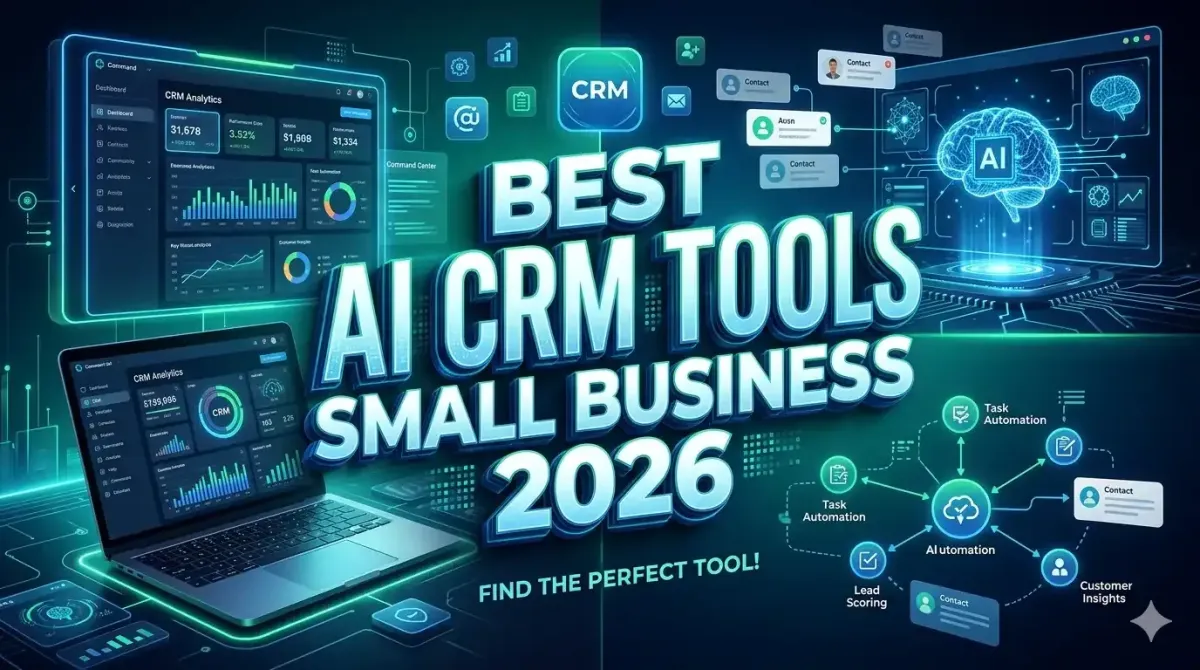
Small businesses in 2026 need customer relationship management tools that combine affordability, ease of use, and intelligent automation to compete effectively. AI powered CRM platforms now deliver predictive lead scoring, automated email sequencing, conversational intelligence, and real time sales forecasting without requiring enterprise level budgets or technical expertise. This comprehensive comparison evaluates the top AI CRM tools for small businesses including HubSpot CRM, Zoho CRM Plus, Salesforce Essentials, Pipedrive, and Freshsales, analyzing pricing structures, AI capabilities, integration ecosystems, and implementation complexity. By understanding these distinctions, small business owners can select CRM solutions that reduce administrative overhead by 40 to 60 percent while improving conversion rates, customer retention, and revenue predictability. Each platform review includes feature breakdowns, real world use cases, and strategic recommendations aligned with specific business models and growth stages.
Why Small Businesses Need AI Powered CRM in 2026
Customer expectations have evolved dramatically, with buyers demanding personalized experiences, rapid response times, and seamless omnichannel interactions. Traditional CRM systems required manual data entry, static reporting, and reactive engagement strategies. AI powered CRMs transform these limitations by automating routine tasks, surfacing actionable insights from customer data, and enabling proactive relationship management at scale.
For small businesses with limited staff and resources, AI CRM capabilities deliver disproportionate value. Predictive lead scoring identifies high intent prospects before competitors, automated email sequences nurture contacts without daily manual effort, and conversational AI handles initial inquiries freeing human teams for complex negotiations. These efficiencies allow small teams to operate with the sophistication of larger organizations while maintaining agility and personal touch.
Understanding why every modern business needs an AI driven CRM provides essential context for how intelligent customer management systems create competitive advantages through data driven decision making and automated relationship building.
Evaluation Framework for AI CRM Selection
Selecting the right AI CRM requires systematic assessment across multiple dimensions beyond feature checklists. This framework ensures alignment with business objectives, technical capabilities, and growth trajectories.
| Evaluation Dimension | Key Questions | Small Business Priority |
|---|---|---|
| AI Capabilities | Does it offer predictive scoring, automation, or conversational AI? | High - Drives efficiency gains |
| Pricing Structure | Is pricing per user, per feature, or usage based? | Critical - Budget constraints matter |
| Implementation Complexity | Can non technical staff configure and maintain the system? | High - Limited IT resources |
| Integration Ecosystem | Does it connect with existing tools like email, calendar, accounting? | Medium to High - Workflow continuity |
| Scalability | Can the platform grow with increasing contacts and users? | Medium - Future proofing investment |
| Support and Training | Are onboarding resources and responsive support available? | High - Minimizes adoption friction |
For financial operations integration, connecting your chosen CRM to how to automate your accounting using modern SaaS tools ensures seamless revenue tracking, invoice generation, and financial reporting without duplicate data entry.
HubSpot CRM: All in One AI Marketing and Sales Platform
HubSpot CRM stands out for small businesses seeking an integrated platform combining contact management, marketing automation, sales pipeline tracking, and customer service tools. Its AI capabilities include predictive lead scoring, content optimization suggestions, email send time optimization, and conversational bots for website engagement.
Key AI Features:
- Predictive Lead Scoring: Analyzes historical conversion data to rank prospects by likelihood to close, enabling sales teams to prioritize high value opportunities
- Content Assistant: Generates email subject lines, body copy, and social media posts using generative AI trained on high performing marketing content
- Send Time Optimization: Determines optimal email delivery windows for each contact based on historical engagement patterns
- Conversational Bots: Qualifies website visitors through AI powered chat workflows, capturing lead information and routing to appropriate team members
Pricing and Limitations: HubSpot offers a free tier with core CRM functionality, while AI features require Starter plans starting at 20 USD monthly per user. Advanced predictive analytics and custom bot building need Professional tiers at 800 USD monthly. Small businesses should evaluate whether AI feature costs justify expected efficiency gains.
Best For: Marketing focused small businesses, content driven lead generation, teams seeking unified marketing and sales workflows, organizations prioritizing ease of use over deep customization.
For teams managing distributed operations, integrating HubSpot with top 5 SaaS platforms for managing global remote teams ensures CRM data remains accessible and actionable across time zones without sacrificing collaboration quality.
Zoho CRM Plus: Customizable AI Workflows for Growing Teams
Zoho CRM Plus delivers enterprise grade AI capabilities with small business friendly pricing and configuration flexibility. Its Zia AI assistant provides predictive sales forecasting, anomaly detection in pipeline metrics, automated workflow suggestions, and natural language query processing for report generation.
Key AI Features:
- Zia AI Assistant: Answers natural language questions about pipeline health, contact activity, and performance trends without requiring report building expertise
- Predictive Forecasting: Projects quarterly revenue based on historical close rates, deal stage progression, and seasonal patterns
- Anomaly Detection: Alerts teams to unusual pipeline changes, contact behavior shifts, or performance deviations requiring investigation
- Workflow Automation: Suggests and auto configures routine task sequences based on observed team patterns and successful deal workflows
Pricing and Limitations: Zoho CRM Plus starts at 57 USD monthly per user for the Standard tier with core AI features. Advanced Zia capabilities require Enterprise tiers at 100 USD monthly. The platform offers extensive customization but requires 2 to 4 weeks for initial configuration and team training.
Best For: Small businesses with technical configuration resources, teams requiring deep workflow customization, organizations planning significant growth within 12 to 24 months, companies already using Zoho ecosystem products.
For content teams leveraging CRM data, understanding the future of content creation how generative AI is changing the game reveals opportunities to integrate AI powered content generation into CRM driven marketing campaigns.
Salesforce Essentials: Enterprise Grade AI for Small Business Budgets
Salesforce Essentials brings the power of the world's leading CRM platform to small businesses through simplified configuration, guided setup wizards, and bundled AI features. Einstein AI capabilities include opportunity insights, email activity capture, automated data entry, and next best action recommendations.
Key AI Features:
- Einstein Opportunity Insights: Analyzes won and lost deals to identify success patterns and risk factors for active opportunities
- Email Intelligence: Automatically logs email interactions, extracts key details, and suggests follow up tasks based on message content
- Automated Data Entry: Captures contact information from email signatures, business cards, and calendar invites without manual input
- Next Best Action: Recommends optimal next steps for each contact based on engagement history, deal stage, and similar successful outcomes
Pricing and Limitations: Salesforce Essentials costs 25 USD monthly per user with core Einstein features included. Advanced AI capabilities require upgrading to Sales Cloud Professional at 75 USD monthly. The platform offers robust functionality but has a steeper learning curve than competitors.
Best For: Small businesses anticipating rapid growth, teams already familiar with Salesforce ecosystem, organizations requiring robust reporting and compliance features, companies prioritizing long term platform stability over initial simplicity.
For security conscious deployments, implementing why you should switch to passkeys for better online security ensures CRM access remains protected against credential theft while maintaining frictionless user experience for distributed teams.
Pipedrive: Visual Pipeline Management with AI Sales Assistance
Pipedrive excels at visual sales pipeline management with AI enhancements focused on deal progression, activity optimization, and revenue forecasting. Its AI features prioritize simplicity and actionable insights over complex predictive modeling, making it ideal for sales focused small businesses.
Key AI Features:
- Deal Prediction: Estimates close probability and expected revenue for each opportunity based on stage duration, activity patterns, and historical outcomes
- Activity Recommendations: Suggests optimal next actions for stalled deals based on successful patterns from similar opportunities
- Revenue Forecasting: Projects monthly and quarterly revenue with confidence intervals based on pipeline health and conversion trends
- Email Integration AI: Analyzes email sentiment and engagement to prioritize follow ups and suggest response templates
Pricing and Limitations: Pipedrive Essential starts at 14 USD monthly per user with basic AI features. Advanced forecasting and custom reporting require Advanced tiers at 49 USD monthly. The platform focuses on sales workflows with limited marketing automation capabilities.
Best For: Sales focused small businesses, teams prioritizing visual pipeline management, organizations with straightforward sales processes, companies seeking rapid implementation with minimal training overhead.
For protecting CRM data from cyber threats, understanding how to protect your small business from ransomware attacks provides essential security practices for safeguarding customer information and business continuity.
Freshsales: Conversational AI and Built in Phone Integration
Freshsales combines CRM functionality with built in phone, email, and chat capabilities enhanced by Freddy AI for conversational intelligence, lead scoring, and workflow automation. Its unified communication approach reduces tool switching overhead for small sales teams.
Key AI Features:
- Freddy AI Lead Scoring: Ranks contacts by engagement level, demographic fit, and behavioral signals to prioritize outreach efforts
- Conversational Intelligence: Analyzes call and email content to identify buying signals, objections, and next best actions
- Automated Workflow Triggers: Executes task sequences based on contact behavior, deal stage changes, or time based conditions
- Sentiment Analysis: Evaluates communication tone to alert teams to at risk relationships or escalation opportunities
Pricing and Limitations: Freshsales Growth tier starts at 29 USD monthly per user with core Freddy AI features. Advanced conversation analytics and custom AI models require Pro tiers at 59 USD monthly. The platform's strength in communication tools may be unnecessary for teams using separate phone systems.
Best For: Small businesses with inside sales teams, organizations prioritizing phone and email integration, teams seeking built in communication tools, companies valuing conversational AI over complex predictive analytics.
For teams implementing AI driven communication strategies, reviewing how to spot and avoid AI generated phishing scams ensures security awareness remains high as AI powered communication tools become more prevalent in sales workflows.
Comparison Matrix: Features, Pricing, and Ideal Use Cases
This consolidated comparison enables rapid evaluation across key decision criteria for small business CRM selection.
| Platform | Starting Price | Core AI Features | Best For | Implementation Time |
|---|---|---|---|---|
| HubSpot CRM | Free tier, AI at 20 USD/user | Lead scoring, content assistant, send time optimization | Marketing focused teams, content driven growth | 1 to 2 weeks |
| Zoho CRM Plus | 57 USD/user monthly | Zia assistant, predictive forecasting, anomaly detection | Customizable workflows, technical teams | 2 to 4 weeks |
| Salesforce Essentials | 25 USD/user monthly | Einstein insights, email intelligence, next best action | Rapid growth, enterprise features at small scale | 3 to 5 weeks |
| Pipedrive | 14 USD/user monthly | Deal prediction, activity recommendations, revenue forecasting | Visual pipeline management, sales focused teams | 1 week |
| Freshsales | 29 USD/user monthly | Freddy AI scoring, conversational intelligence, sentiment analysis | Inside sales, built in communication tools | 1 to 2 weeks |
For organizations evaluating broader SaaS ecosystems, understanding the future of SaaS top trends to watch this year helps anticipate platform evolution and integration opportunities that may influence long term CRM selection.
Implementation Best Practices for Small Business Success
Successful CRM adoption requires strategic planning beyond feature selection. Follow these implementation guidelines to maximize ROI and minimize disruption.
Phase 1: Discovery and Planning (Week 1)
- Document current sales and marketing workflows to identify automation opportunities
- Define success metrics including time saved, conversion rate improvement, and revenue impact
- Assign implementation owner and establish weekly check in cadence
- Prepare contact data for migration including deduplication and field mapping
Phase 2: Configuration and Testing (Weeks 2-3)
- Configure core pipelines, stages, and custom fields aligned with business processes
- Enable AI features incrementally starting with lead scoring or email automation
- Test workflows with sample data before migrating live contacts
- Train core team members on daily usage patterns and troubleshooting
Phase 3: Launch and Optimization (Weeks 4-6)
- Migrate historical data with validation checks for accuracy and completeness
- Monitor adoption metrics and address user friction through targeted coaching
- Review AI recommendations weekly to refine scoring models and automation rules
- Establish quarterly review cadence for feature evaluation and process improvement
For data privacy compliance during implementation, reviewing the importance of GDPR and modern data privacy laws ensures CRM configuration meets regulatory requirements for customer data handling and consent management.
Measuring CRM ROI and Continuous Improvement
Quantifying CRM value enables data driven optimization and justifies ongoing investment. Track these metrics to evaluate performance and guide refinement.
Efficiency Metrics:
- Time saved on data entry and administrative tasks (target: 5 to 10 hours weekly per user)
- Reduction in manual follow up reminders through automation (target: 30 to 50 percent decrease)
- Increased contact engagement through personalized AI driven outreach (target: 20 to 40 percent improvement)
Revenue Metrics:
- Lead to opportunity conversion rate improvement from predictive scoring (target: 15 to 30 percent increase)
- Shortened sales cycle duration through activity optimization (target: 10 to 25 percent reduction)
- Higher average deal size from next best action recommendations (target: 5 to 15 percent growth)
Adoption Metrics:
- Daily active user percentage indicating team engagement with the platform
- Feature utilization rates identifying underused capabilities requiring training or configuration adjustment
- User satisfaction scores capturing qualitative feedback on usability and value perception
For building fair and effective AI scoring models, understanding addressing bias in AI how to build fairer algorithms ensures lead scoring and predictive analytics do not inadvertently disadvantage specific customer segments.
Future Trends in AI CRM for Small Businesses
The AI CRM landscape continues evolving with emerging capabilities that will shape small business tools through 2026 and beyond.
Emerging Capabilities:
- Voice and Video Intelligence: AI analysis of sales calls and video meetings to extract insights, sentiment, and action items automatically
- Generative Content Creation: Automated generation of personalized proposals, case studies, and marketing materials based on CRM data
- Predictive Churn Prevention: Early identification of at risk customers with automated retention workflows and intervention recommendations
- Cross Platform Data Unification: AI powered consolidation of customer interactions across email, social, chat, and phone into unified profiles
Strategic Preparation:
- Select CRM platforms with active AI development roadmaps and regular feature releases
- Maintain clean, structured data to enable future AI capabilities without extensive reconfiguration
- Invest in team training on AI interpretation and ethical usage to maximize emerging feature value
- Establish data governance policies that balance innovation with privacy and compliance requirements
For organizations prioritizing responsible AI deployment, reviewing building privacy first AI techniques for secure data processing provides frameworks for implementing AI CRM capabilities while maintaining customer trust and regulatory compliance.
Conclusion: Selecting the Right AI CRM for Your Small Business
Choosing the best AI powered CRM for your small business requires balancing immediate needs with long term growth potential, budget constraints with feature requirements, and simplicity with sophistication. HubSpot CRM excels for marketing focused teams seeking integrated automation. Zoho CRM Plus offers deep customization for technically capable organizations. Salesforce Essentials delivers enterprise grade AI at accessible pricing for rapidly scaling businesses. Pipedrive provides visual pipeline clarity for sales focused teams. Freshsales combines conversational AI with built in communication tools for inside sales operations.
Success depends not only on platform selection but on thoughtful implementation, continuous optimization, and team adoption. Start with clear success metrics, configure AI features incrementally, and measure outcomes rigorously. The small businesses that thrive in 2026 will be those that leverage AI CRM capabilities to deepen customer relationships, accelerate revenue growth, and operate with strategic clarity despite limited resources.
Begin your CRM evaluation by documenting current workflows, defining success criteria, and trialing top contenders with real business data. Engage your team in the selection process to ensure adoption. Implement systematically with training and support. Measure, learn, and refine continuously. The right AI powered CRM becomes not just a tool but a strategic asset that amplifies your team's capabilities and drives sustainable growth.