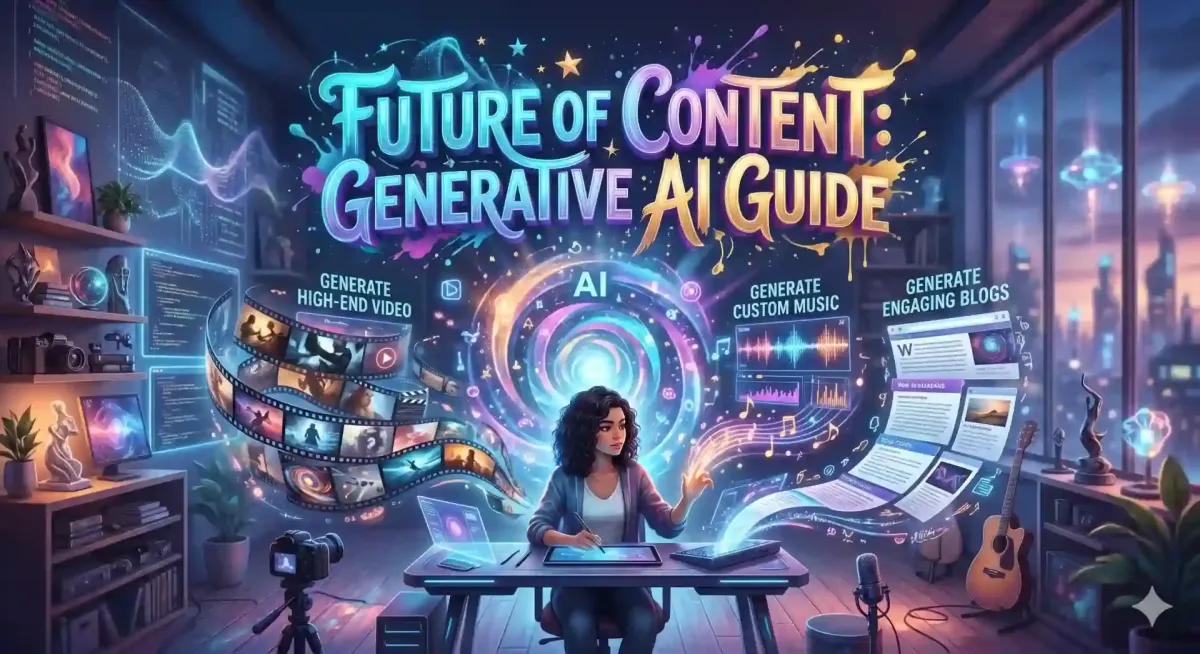
The Future of Content Creation: How Generative AI is Changing the Game in 2026
By 2026, the digital landscape has transformed into an "Intelligence-First" era. The traditional barriers between an idea and its execution have been dismantled by Generative AI. We are no longer just using AI to fix sentences; we are using it to orchestrate entire media universes. At TipsForAITech, we are observing how 2026’s models have evolved from simple generators into creative collaborators that understand nuance, culture, and context.
This 1500+ word deep dive explores the future of content creation. Whether you are mastering your schedule with AI or building intelligent applications, understanding how generative models are "changing the game" is essential for every modern creator.
1. The Dawn of Native Multi-Modality
In 2026, we have moved past the "siloed" AI era. Early models could only do text or images; 2026's Multi-Modal AI (like GPT-5 and Gemini 2.5) processes text, audio, video, and code simultaneously. A creator can now upload a rough sketch and a voice memo, and the AI will generate a high-fidelity 3D model, a promotional blog post, and a 15-second teaser video—all perfectly aligned with the original vision.
As we discussed in 10 ways AI is transforming technology, this native understanding is what makes 2026 a turning point in human creativity.
2. Cinematic AI: Hollywood-Grade Production for Everyone
Video generation has reached its "iPhone moment" in 2026. Tools like Sora 3 and Runway Gen-4 can now generate photorealistic 8K video with consistent physical properties. This means creators can produce cinematic sequences where characters and environments remain stable across different shots.
- World Consistency: AI now understands "lighting logic" and "object permanence," making AI-generated films look professional rather than distorted.
- Virtual Sets: Using advanced developer prompts, creators can "code" their cinematography, directing virtual cameras with precise commands.
3. Hyper-Personalized and Dynamic Storytelling
In 2026, content is no longer a static file; it’s a living experience. Imagine a documentary that adjusts its depth of technical detail based on the viewer’s background, or a brand story that features local landmarks from the viewer’s actual city. Generative AI allows for Real-Time Adaptation, ensuring that every piece of content feels personally curated for the individual.
4. Neural Audio and the Voice Revolution
Audio content has seen a massive upgrade through Neural TTS (Text-to-Speech). As highlighted in our guide on Advanced NLP Voice Assistants, AI voices in 2026 possess perfect emotional cadence. They can laugh, whisper, or show excitement, making AI-narrated audiobooks and podcasts indistinguishable from human performances.
5. AI-Augmented Professional Writing
Writing in 2026 is about "Curated Originality." Professional writers use top-tier AI writing assistants to handle structural drafting and research, freeing themselves to focus on the "Soul" of the story—the unique perspective and human emotion that AI cannot yet fully replicate. This has led to a renaissance in high-quality long-form journalism and technical storytelling.
6. 3D Asset Generation for Spatial Computing
With the rise of AI-driven virtual offices and AR glasses, the demand for 3D objects is infinite. Generative AI can now turn a 2D description into a fully rigged, textured 3D model in seconds. This is a game-changer for indie game developers and architects who can now prototype entire cities with a few sentences of text.
7. The Ethical Framework: Provenance and Transparency
As AI content becomes ubiquitous, "Truth" is a premium commodity. In 2026, we use Content Credentials (C2PA) to track whether a piece of content was human-made, AI-generated, or a hybrid. At TipsForAITech, we advocate for "Explainable Creativity," where creators are transparent about the AI tools they use to maintain trust with their audience.
8. Data-Driven Ideation: Predicting Trends Before They Happen
Creators now use AI-driven data management to identify "cultural gaps." Instead of guessing what might go viral, AI analyzes global sentiment and suggests content topics that have a high probability of resonance. This "Predictive Creativity" helps brands stay ahead of the cultural curve with surgical precision.
9. New Monetization: The "Prompt-to-Product" Economy
In 2026, your "Prompt Engineering" skills are a direct source of income. Creators are selling "AI Workflows" and "Fine-Tuned Models" on decentralized marketplaces. This allows creators to monetize their *process* and *style*, not just their final product, creating a new recurring revenue stream for the creative class.
10. Conclusion: The Human-AI Symbiosis
Generative AI hasn't replaced the creator; it has liberated them. In 2026, the most successful content is a result of a Human-AI Symbiosis—where human vision provides the spark, and AI provides the limitless fuel. The "Game" has indeed changed, and for those who embrace these tools, the stadium is bigger than ever.
Stay updated with the latest shifts in the creative economy by following TipsForAITech. Whether you're interested in productivity tools or deep technical guides, we are your partner in the 2026 AI revolution.