
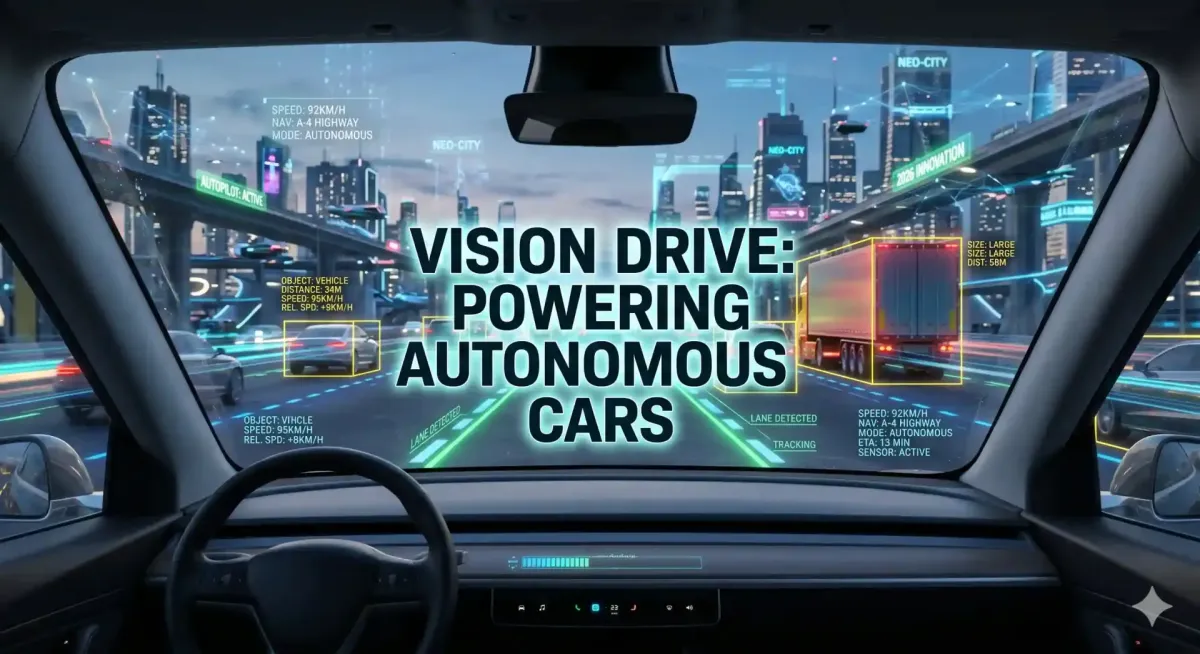
How Computer Vision is Powering Autonomous Vehicles in 2026
By 2026, the dream of the "Self-Driving Car" has transitioned from a science fiction concept to a common sight on the streets of major global hubs. At the heart of this mobility revolution is Computer Vision—the ability of a machine to "see," interpret, and react to the physical world in real-time. At TipsForAITech, we are observing how 2026’s neural networks have achieved a level of visual perception that challenges human capability.
This 1500+ word deep dive explores the technical mechanics of how vision-based AI is driving the future of transportation. Whether you are tracking how AI transforms technology or learning the fundamentals of ML, understanding computer vision in automotive tech is essential for 2026.
1. The "Eyes" of the Vehicle: Object Detection and Classification
The primary task of computer vision in 2026 is Real-Time Object Detection. Autonomous vehicles utilize high-definition cameras placed around the body to identify pedestrians, other vehicles, traffic signs, and obstacles. Using Deep Learning, the vehicle doesn't just see a "shape"; it classifies it instantly. It knows the difference between a child running toward the street and a plastic bag blowing in the wind, allowing for precise, millisecond-level braking decisions.
2. Semantic Segmentation: Understanding the Road Landscape
Beyond identifying objects, 2026’s computer vision performs Semantic Segmentation. This involves the AI labeling every single pixel it sees. It distinguishes the drivable road from the sidewalk, identifies lane markings (even when faded), and recognizes the state of traffic lights blocks away. As we noted in our guide on healthcare diagnostics, this pixel-level precision is what makes AI reliable in high-stakes environments.
3. The Debate of 2026: LiDAR vs. Vision-Only Systems
The industry remains divided between "Sensor Fusion" (using LiDAR, Radar, and Cameras) and "Vision-Only" systems (relying entirely on cameras). In 2026, vision-only systems—pioneered by companies like Tesla and perfected by open-source researchers—have made massive leaps. By using Pseudo-LiDAR algorithms, cameras can now estimate depth and distance with incredible accuracy, reducing the need for expensive hardware.
4. 3D Scene Reconstruction and Spatial Mapping
Modern autonomous vehicles use SLAM (Simultaneous Localization and Mapping) driven by computer vision. As the car moves, the AI creates a real-time 3D reconstruction of its surroundings. This is similar to the technology used in virtual offices, where spatial awareness is critical for interaction. This mapping allows the car to know exactly where it is in space, even when GPS signals are weak or unavailable.
5. Predictive Behavior Modeling
The most advanced computer vision systems of 2026 don't just react; they predict. By analyzing the trajectory and body language of a pedestrian or the erratic movement of a nearby car, the AI can predict a potential collision seconds before it happens. This "Intent Recognition" is powered by Advanced NLP-inspired Transformer models applied to visual data, allowing the car to "read" the social cues of the road.
6. Low-Light and Extreme Weather Performance
One of the triumphs of 2026 is the performance of AI vision in fog, heavy rain, or total darkness. Using Infrared Sensory Fusion and Generative Image Enhancement, the vehicle can "see" through visual noise that would blind a human driver. This is a practical application of the same technology we see in AI photo enhancement and upscaling.
7. Edge AI: Processing at the Speed of Life
Safety in autonomous driving requires near-zero latency. In 2026, the vision processing is handled by On-Board Edge AI Chips. The car does not wait for a cloud connection to decide whether to stop. Everything is processed locally, ensuring total autonomy and security. This mirrors the move toward local data sovereignty we see in professional data management.
8. Ethical AI and the Trolley Problem
At TipsForAITech, we emphasize the ethical responsibility of AI. In 2026, autonomous vehicles are governed by strict "Ethical Logic Kernels." These ensure that the AI prioritizes human life above all else, following global safety standards. Transparency in how these visual decisions are made is crucial for public trust and is a major topic in modern academic AI research.
9. Connectivity: The V2X (Vehicle-to-Everything) Network
Computer vision in 2026 is augmented by V2X communication. While the car "sees" with its cameras, it also receives data from smart traffic lights and other vehicles. This "Collective Vision" allows a car to know what’s around a blind corner by "seeing" through the cameras of the vehicle ahead of it, creating a seamless and safe transport grid.
10. Conclusion: The Road Ahead
Computer vision has turned the automobile into a sentient navigator. In 2026, we are not just passengers in a machine; we are participants in an intelligent network. As vision models continue to improve, the road will become safer, more efficient, and more accessible for everyone. The future of mobility is clear—and it is powered by AI.
Stay ahead of the AI and automotive revolution by following TipsForAITech. Whether you're interested in automation productivity or building AI applications, we are your partner in the 2026 technology landscape.