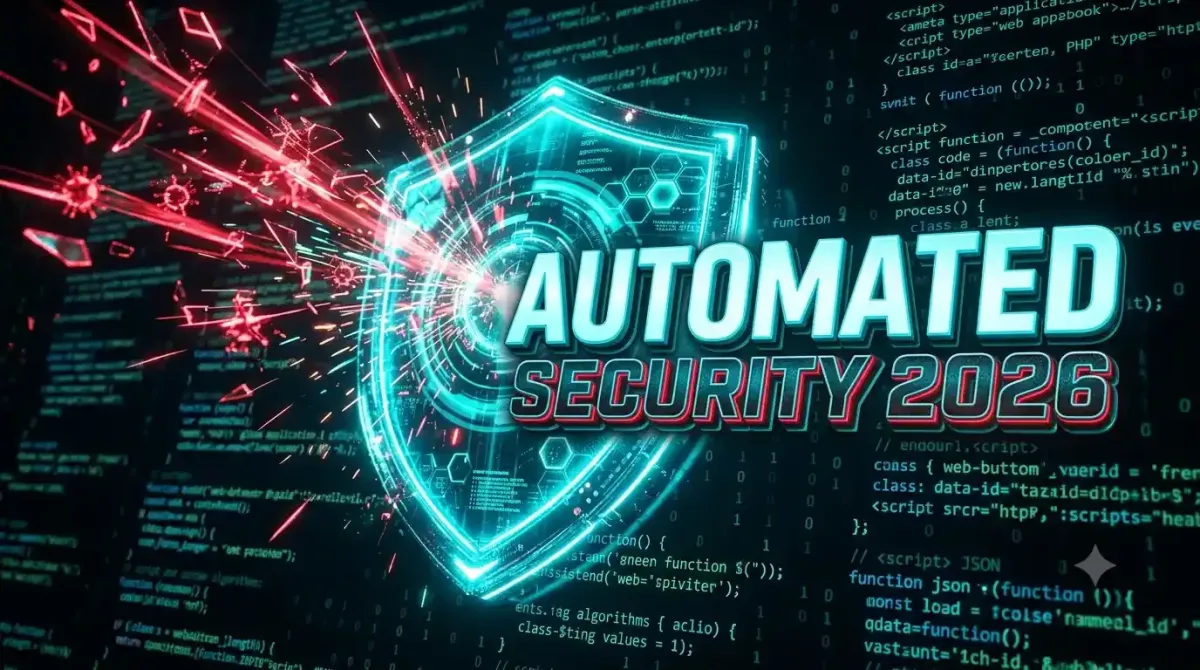
Automated security scanning integrates Static Application Security Testing (SAST), Dynamic Application Security Testing (DAST), and Software Composition Analysis (SCA) directly into your continuous integration and continuous deployment pipeline. By configuring tools like Semgrep, OWASP ZAP, and Snyk within GitHub Actions or GitLab CI, developers can automatically detect vulnerabilities, outdated dependencies, and misconfigurations on every single commit. This shift-left approach ensures that security flaws are identified and remediated before code reaches production, drastically reducing the attack surface of modern web applications while maintaining rapid deployment velocities. Implementing these automated gates transforms security from a bottleneck into a seamless, continuous engineering practice.
The Core Components of Automated Web Security
Building a resilient automated security posture requires understanding the distinct layers of application testing. Relying on a single scanning method leaves critical blind spots. A comprehensive DevSecOps strategy combines multiple analysis techniques to cover the entire software development lifecycle.
Static Application Security Testing (SAST)
Static Application Security Testing analyzes source code without executing it. It identifies vulnerabilities like SQL injection and cross-site scripting by parsing the abstract syntax tree. Developers use SAST to catch security flaws early in the development cycle, ensuring code meets security standards before compilation or deployment.
Dynamic Application Security Testing (DAST)
Dynamic Application Security Testing evaluates running web applications from the outside in. It simulates malicious attacks by sending crafted payloads to endpoints and analyzing the HTTP responses. DAST identifies runtime vulnerabilities such as authentication bypasses and server misconfigurations that static analysis cannot detect.
Software Composition Analysis (SCA)
Software Composition Analysis scans third-party libraries and open-source dependencies for known vulnerabilities. It cross-references project manifests against databases like the National Vulnerability Database. SCA prevents supply chain attacks by blocking builds that include compromised or outdated external packages.
Infrastructure as Code (IaC) Scanning
Modern web applications rely heavily on cloud infrastructure defined in code. IaC scanning tools analyze Terraform, Kubernetes manifests, and Dockerfiles to detect misconfigurations, overly permissive IAM roles, and exposed ports before the infrastructure is even provisioned. This prevents cloud-native vulnerabilities from entering your environment.
Selecting the Right Security Scanning Tools for 2026
The security tooling landscape has matured significantly. In 2026, the focus is on speed, accuracy, and developer experience. Tools must integrate seamlessly into existing workflows without causing alert fatigue. When evaluating your stack, it is highly beneficial to review the top 10 open source security tools to ensure you are leveraging community-vetted solutions that offer transparency and flexibility.
| Tool Category | Top Open Source Option | Top Commercial Option | Primary Function |
|---|---|---|---|
| SAST | Semgrep | SonarQube Enterprise | Source code vulnerability detection |
| DAST | OWASP ZAP | Invicti (Netsparker) | Runtime application probing |
| SCA | Dependency-Track | Snyk Open Source | Third-party dependency analysis |
| IaC Scanning | Checkov | Wiz | Cloud configuration validation |
| Container Scanning | Trivy | Aqua Security | Image vulnerability assessment |
Step by Step Implementation Guide for CI/CD Integration
Integrating these tools into your pipeline requires careful orchestration. The goal is to fail the build only on critical, exploitable vulnerabilities while allowing developers to address low-severity issues asynchronously. Before diving into pipeline configuration, ensure your local development environment is secure. If you are containerizing your applications, mastering Docker Desktop setup is crucial for replicating production security boundaries locally. Similarly, if your security scanning infrastructure runs on dedicated hardware, knowing how to set up a secure Linux distro ensures your scanning servers are not themselves compromised.
Phase 1: Configuring SAST with Semgrep
Semgrep has become the industry standard for fast, customizable static analysis. Unlike older tools that suffer from high false-positive rates, Semgrep uses pattern-matching that feels like writing standard code.
Implementation Steps:
- Create a
.semgrep.ymlconfiguration file in your repository root. - Define custom rules for your specific framework, such as detecting unsafe database queries in your ORM.
- Add the Semgrep action to your GitHub Actions workflow.
name: SAST Security Scan
on:
  pull_request:
    branches: [main, develop]
jobs:
  semgrep:
    runs-on: ubuntu-latest
    steps:
      - name: Checkout code
        uses: actions/checkout@v4
      - name: Run Semgrep
        uses: returntocorp/semgrep-action@v1
        with:
          config: >-
            p/security-audit
            p/owasp-top-ten
            .semgrep/rules
          generateSarif: 1
      - name: Upload SARIF file
        uses: github/codeql-action/upload-sarif@v3
        with:
          sarif_file: semgrep.sarif
Phase 2: Implementing SCA for Dependency Management
Supply chain attacks are the most prevalent vector in 2026. Your application is only as secure as its weakest third-party library. Automated SCA must run on every pull request to catch newly introduced vulnerable dependencies.
Implementation Steps:
- Install an SCA tool like Trivy or Snyk CLI in your build environment.
- Configure the tool to fail the build only on vulnerabilities with a CVSS score of 7.0 or higher.
- Enable automatic pull request generation for dependency updates to remediate existing flaws.
name: Software Composition Analysis
on: [push, pull_request]
jobs:
  dependency-scan:
    runs-on: ubuntu-latest
    steps:
      - name: Checkout code
        uses: actions/checkout@v4
      - name: Run Trivy vulnerability scanner
        uses: aquasecurity/trivy-action@master
        with:
          scan-type: 'fs'
          scan-ref: '.'
          format: 'sarif'
          output: 'trivy-results.sarif'
          severity: 'CRITICAL,HIGH'
          exit-code: '1'
Phase 3: Setting up DAST in the Pipeline
DAST requires a running application to test against. In a CI/CD pipeline, this means spinning up a temporary staging environment, running the scan, and tearing it down.
Implementation Steps:
- Deploy the application to a temporary ephemeral environment using Docker Compose or Kubernetes.
- Configure OWASP ZAP to run in baseline mode, targeting the ephemeral URL.
- Parse the ZAP report and fail the pipeline if active threats are detected.
- Destroy the ephemeral environment to save compute costs.
Advanced AI Powered Vulnerability Detection
Traditional rule-based scanners are being augmented by machine learning models capable of understanding business logic. In 2026, AI-driven security tools can analyze the context of your code to identify complex flaws like insecure direct object references (IDOR) that lack traditional signatures. While AI is revolutionizing security, it is also being used by attackers; understanding how to spot AI generated phishing scams is critical for security teams managing the alerts generated by these automated systems. Furthermore, as identity verification becomes more complex, integrating concepts like zero knowledge proofs into your application architecture ensures that automated scanners do not accidentally expose sensitive user data during the authentication testing phase.
Securing the Scanning Infrastructure Itself
The tools you use to secure your applications become high-value targets for attackers. If a malicious actor compromises your CI/CD pipeline or your scanning server, they can silently disable security checks or inject backdoors into your software.
Protecting Pipeline Credentials
Security scanners require access to your source code, cloud environments, and vulnerability databases. The credentials used to authenticate these tools must be managed with extreme care. Use hardware-backed secret management solutions and ensure that pipeline tokens have the minimum necessary permissions. To prevent unauthorized access to your scanning dashboards and CI/CD interfaces, strictly enforce two-factor authentication safely for all engineering and security personnel. Additionally, ensure that the servers hosting your scanning infrastructure are hardened against lateral movement, as a compromised scanner could be used to deploy ransomware attacks across your internal network.
Ensuring Data Privacy During Scans
When DAST tools interact with your application, they might inadvertently extract sensitive data from databases or user profiles. Configure your scanning tools to use dedicated test accounts with restricted permissions. Ensure that end-to-end encryption is enforced for all data in transit between the scanner and the application, preventing man-in-the-middle attacks from intercepting the vulnerability payloads.
Managing False Positives and Developer Friction
The fastest way to get developers to bypass security scans is to flood them with false positives. A well-tuned automated security pipeline must prioritize accuracy and provide actionable remediation advice.
Tuning SAST Rules
Out-of-the-box SAST rules often flag secure code patterns as vulnerable. For example, a generic SQL injection rule might flag a parameterized query if the ORM syntax is slightly non-standard. Security engineers must regularly review flagged items and suppress false positives using inline comments or baseline files. When a genuine vulnerability is found, the remediation process must be swift. If your team relies on specific frameworks, having a standardized process, much like patching zero day vulnerabilities in Laravel, ensures that critical fixes are applied uniformly across all microservices.
Implementing Risk-Based Thresholds
Do not block deployments for low-severity issues. Configure your pipeline to fail only on Critical and High severity findings. Medium and Low severity issues should be automatically converted into tickets in your project management system, allowing developers to address them during regular sprint planning without halting the release train.
Automating Security Alerts and Remediation Workflows
Detecting a vulnerability is only half the battle; ensuring it gets fixed is the real challenge. Automated alerting routes the right information to the right people at the right time.
Integrating with Communication Platforms
Configure your scanning tools to send rich notifications to Slack or Microsoft Teams when a critical vulnerability is detected in the main branch. These notifications should include the exact file path, the line of code, the CVSS score, and a link to the remediation documentation.
Automating Ticket Creation
Use automation platforms to bridge the gap between security findings and development tasks. By setting up Zapier workflows for automation, you can automatically create a Jira or Linear ticket whenever a new high-severity vulnerability is confirmed. The ticket should be automatically assigned to the developer who authored the commit that introduced the flaw, ensuring immediate accountability and rapid remediation.
Compliance and Reporting Automation
Regulatory frameworks like SOC 2, ISO 27001, and the EU AI Act require continuous evidence of security testing. Manual reporting is unsustainable in a continuous deployment environment.
Generating Audit Trails
Configure your CI/CD pipeline to archive the SARIF (Static Analysis Results Interchange Format) reports and DAST scan logs in an immutable, write-once storage bucket. This creates a tamper-proof audit trail that auditors can review to verify that every production release underwent rigorous security testing.
Automated Compliance Dashboards
Aggregate the results from your SAST, DAST, and SCA tools into a centralized security dashboard. Tools like DefectDojo can ingest findings from multiple scanners, deduplicate them, and track the mean time to remediation (MTTR). This provides engineering leadership with real-time visibility into the security posture of the entire application portfolio.
Real World Technical Workflows for Microservices
Monolithic applications are straightforward to scan, but modern microservices architectures require a distributed scanning strategy. Each service must be scanned independently, and the results must be aggregated.
Centralized Policy Management
Instead of configuring security rules in every individual repository, use a centralized policy repository. Tools like Open Policy Agent (OPA) or enterprise SAST platforms allow you to define security standards in a single location. When a developer creates a new microservice, the CI/CD pipeline automatically pulls the latest security policies, ensuring uniform enforcement across hundreds of services.
Service Mesh Security Scanning
In a Kubernetes environment, leverage your service mesh (like Istio or Linkerd) to perform continuous DAST. The service mesh can mirror production traffic to a secure testing environment, allowing DAST tools to analyze real-world payloads without impacting actual users or requiring dedicated synthetic test scripts.
Future Trends in Automated Security
The automation of web application security is evolving rapidly. As we move through 2026 and beyond, several key trends are reshaping the DevSecOps landscape.
- Autonomous Remediation: AI agents are moving beyond detection to autonomous remediation. When a vulnerability is found, the AI will automatically generate a pull request with the exact code changes required to fix the flaw, requiring only a human click to approve and merge.
- Continuous Cloud Posture Management (CSPM): Security scanning is expanding beyond the application code to the entire cloud environment. CSPM tools continuously monitor cloud configurations, automatically revoking overly permissive IAM roles and closing exposed storage buckets in real time.
- Supply Chain Attestation: Following the SLSA (Supply-chain Levels for Software Artifacts) framework, automated pipelines will cryptographically sign every build artifact and dependency, providing mathematical proof that the software has not been tampered with during the build process.
Conclusion
Setting up automated security scans for your web applications is no longer an optional enhancement; it is a fundamental requirement for surviving the modern threat landscape. By integrating SAST, DAST, and SCA directly into your CI/CD pipeline, you shift security left, catching vulnerabilities at the source before they can cause damage. The key to success lies in careful tool selection, rigorous tuning to minimize false positives, and seamless integration with developer workflows. As AI and automation technologies continue to advance, the security pipelines of today will evolve into fully autonomous defense systems. Start by implementing basic dependency scanning and static analysis, then progressively add dynamic testing and infrastructure scanning. By treating security as code, you ensure that your web applications remain resilient, compliant, and secure in an increasingly hostile digital world.