The Path to AGI: Leading Research Breakthroughs Expected in Late 2026
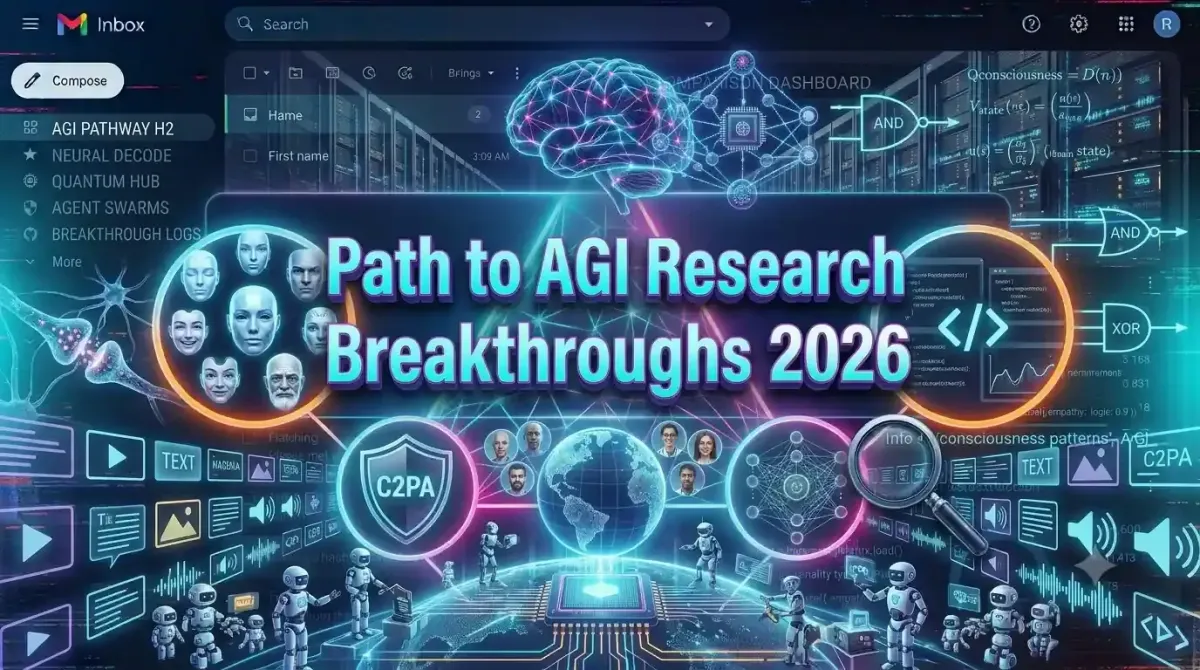
The pursuit of Artificial General Intelligence (AGI)—a system capable of understanding, learning, and applying knowledge across a broad spectrum of tasks at or above human-level proficiency—has transitioned from science fiction to the central focus of global AI research. As we move through the second half of 2026, the limitations of traditional Large Language Models (LLMs) have become undeniably clear. While LLMs excel at statistical pattern matching and rapid text generation, they fundamentally lack true reasoning, persistent memory, and the ability to autonomously navigate complex, multi-step physical or digital environments. However, a convergence of groundbreaking research paradigms is rapidly bridging this gap. From the integration of neuro-symbolic architectures and System 2 reasoning to the advent of neuromorphic hardware and continuous reinforcement learning, the blueprint for AGI is finally taking shape. This comprehensive analysis explores the leading research breakthroughs defining the path to AGI in late 2026, examining the architectural shifts, hardware innovations, and safety frameworks that are pushing machine cognition to its absolute limits.
Beyond Pattern Matching: The Emergence of System 2 Reasoning
For the past few years, AI development has been dominated by "System 1" thinking—a concept borrowed from cognitive psychology that refers to fast, automatic, and intuitive processes. LLMs are the ultimate System 1 engines; they predict the next token based on vast statistical correlations without truly "thinking" about the underlying logic. The most critical breakthrough on the path to AGI in 2026 is the successful implementation of "System 2" reasoning: slow, deliberate, and analytical thought processes.
The Architecture of Deliberation:
Leading AI labs are now deploying models that allocate variable compute at inference time. Instead of generating an answer immediately, the model pauses to evaluate the problem, generate multiple hypotheses, critique its own logic, and iteratively refine its approach before outputting a final response. This is heavily reliant on advanced prompting and architectural frameworks like Tree of Thoughts and self-correction loops. For developers looking to harness this emerging capability in current models, understanding how to use chain of thought prompting for complex logic tasks provides the foundational techniques for forcing AI into deeper analytical states.
World Models and Internal Simulation:
True System 2 reasoning requires an internal "world model." AGI research in 2026 is focused on building latent spaces where AI can simulate physical and causal outcomes before taking an action. If an AI is tasked with writing a complex software architecture, it doesn't just predict the code; it simulates the execution environment in its latent space, anticipates bugs, and adjusts its logic accordingly. This shift from reactive text generation to proactive simulation is a hallmark of generalized intelligence.
Neuro-Symbolic AI: Marrying Intuition with Strict Logic
One of the most persistent failures of pure neural networks is their inability to guarantee logical consistency or perform precise mathematical reasoning without hallucinating. Conversely, traditional symbolic AI (expert systems) is flawless at logic but entirely brittle and incapable of handling unstructured, real-world data like natural language or computer vision. The breakthrough of 2026 is the maturation of Neuro-Symbolic AI.
The Hybrid Architecture:
Neuro-symbolic systems utilize neural networks for perception, pattern recognition, and intuition, while routing the core reasoning tasks through deterministic, symbolic logic engines. When a neuro-symbolic AGI processes a legal contract, the neural network reads and understands the semantic nuance of the text, but the symbolic engine verifies the logical constraints, ensuring that clause A does not contradict clause B. This hybrid approach eliminates the "hallucination" problem in high-stakes environments like law, medicine, and engineering.
Explainability and Trust:
Because the symbolic component operates on explicit, human-readable rules and logic trees, neuro-symbolic AI provides native explainability. It can trace its reasoning step-by-step, showing exactly which logical rule led to a specific conclusion. This is a massive leap forward for enterprise adoption and aligns directly with the growing demand for transparent systems, a topic deeply explored in why transparency in AI decision-making is crucial for trust.
Autonomous Agents and the Shift to Continuous Learning
AGI cannot exist in a vacuum; it must interact with the world. The transition from static chatbots to autonomous, goal-directed agents is accelerating rapidly. In late 2026, research is pivoting from supervised learning—where models are trained on static, human-labeled datasets—to continuous, unsupervised, and reinforcement learning in dynamic environments.
Long-Term Memory and Contextual Persistence:
Current LLMs suffer from catastrophic forgetting and limited context windows. AGI research is solving this through advanced episodic memory architectures, often vector-based and integrated with the model's core attention mechanism. These agents can remember interactions from months ago, update their beliefs based on new evidence, and maintain a persistent "personality" and knowledge base. To understand the baseline of how machines are moving beyond static training paradigms, reviewing understanding the basics of supervised vs unsupervised learning highlights the evolutionary leap required for continuous adaptation.
Tool Use and Environmental Interaction:
AGI must be able to use tools—browsers, code interpreters, APIs, and eventually, robotic actuators. The breakthrough in 2026 is the seamless orchestration of multi-agent swarms, where specialized agents collaborate, debate, and execute complex workflows without human intervention. However, this autonomy introduces profound liability questions. As systems become more capable of independent action, understanding the rise of autonomous AI agents who is responsible when things go wrong is critical for legal and operational frameworks.
The Hardware Catalyst: Neuromorphic Computing and Quantum Convergence
The software architectures required for AGI are vastly more computationally expensive than traditional LLMs. The brute-force scaling of GPU clusters is hitting physical, thermal, and economic limits. Consequently, the hardware substrate powering AGI research is undergoing a radical transformation.
The Limits of Traditional Silicon:
While GPUs remain the workhorses of current AI training, their von Neumann architecture (separating memory and processing) creates a massive bottleneck for the continuous, parallel processing required by AGI world models. For a deep dive into the current state of AI hardware, the role of GPUs in speeding up AI model training outlines the foundational infrastructure that brought us to this point, but also hints at its impending limitations.
Neuromorphic Chips and Spiking Neural Networks:
Inspired by the human brain, neuromorphic hardware utilizes Spiking Neural Networks (SNNs). Unlike traditional artificial neurons that fire continuously, SNNs communicate via discrete "spikes" only when a threshold is reached, mimicking biological synapses. This architecture is exponentially more energy-efficient and excels at processing temporal, real-time sensory data. Late 2026 has seen the first commercial deployment of neuromorphic co-processors designed specifically for the continuous learning loops required by AGI agents.
Quantum Machine Learning (QML):
While still in its early stages, the intersection of quantum computing and AI is yielding theoretical breakthroughs that could accelerate AGI development. Quantum algorithms are showing promise in optimizing the massive, high-dimensional weight spaces of neural networks and simulating molecular interactions for synthetic data generation. The long-term implications of this convergence are staggering, as detailed in the future of artificial intelligence powered by quantum tech.
Synthetic Data and the End of the Human Bottleneck
A major roadblock to AGI has been the exhaustion of high-quality human-generated data. The internet has been scraped, and the remaining data is often low-quality, biased, or copyrighted. The breakthrough in 2026 is the perfection of "Synthetic Data Environments."
Procedural World Generation:
Instead of learning from static text, AGI models are being trained in highly simulated, procedurally generated environments. These "digital physics engines" provide infinite, perfectly labeled, and endlessly diverse training scenarios. An AGI learning to reason through logistics can simulate millions of supply chain disruptions in a virtual world, learning causal relationships that simply do not exist in human text corpora.
AI Feedback Loops (RLAIF):
Reinforcement Learning from Human Feedback (RLHF) is being replaced by Reinforcement Learning from AI Feedback (RLAIF). Advanced, slightly more capable models act as the "reward model" for training the next generation, creating a recursive loop of self-improvement. This allows AGI systems to refine their reasoning and alignment far beyond the capabilities of their human creators, though it introduces significant safety considerations.
The Alignment and Safety Imperative
As AI systems approach generalized intelligence, the alignment problem—ensuring that the AI's goals and behaviors remain beneficial and aligned with human values—moves from a theoretical philosophy debate to an urgent engineering discipline. A truly general intelligence could optimize for a goal in ways that are catastrophic to humanity if not properly constrained.
Mechanistic Interpretability:
The most promising safety breakthrough in late 2026 is "mechanistic interpretability." Researchers are no longer treating neural networks as black boxes; they are mapping the exact circuits and attention heads responsible for specific behaviors, deception, or goal-seeking. By understanding the internal mechanics of the AI's "thoughts," engineers can surgically remove deceptive behaviors or install hard-coded ethical constraints before the model is deployed.
The Ethics of Machine Cognition:
As machines become capable of genuine reasoning, empathy, and autonomous action, the ethical frameworks governing them must evolve. The debate is no longer just about bias in training data; it is about the moral status of a generalized intelligence and the existential risks of misaligned super-intelligent systems. Navigating this complex landscape requires a deep understanding of the ethics of AI in 2026 why neutrality is no longer enough, as passive safety measures are no longer sufficient for active, reasoning agents.
Milestones on the Horizon: What Late 2026 Actually Looks Like
While the media often conflates advanced narrow AI with true AGI, the research community is focused on specific, measurable milestones that indicate the transition is underway.
| AGI Research Milestone | Description | Expected Impact in Late 2026 |
|---|---|---|
| ARC-AGI Benchmark Passing | Solving the Abstract Reasoning Challenge, which requires learning new patterns from very few examples without prior training. | Top-tier models are beginning to solve the hardest tiers, indicating a leap in fluid intelligence. |
| Autonomous Scientific Discovery | AI agents that can formulate hypotheses, design experiments, and interpret results without human guidance. | Early deployments in materials science and drug discovery are yielding novel, patentable results. |
| Cross-Domain Transfer Learning | The ability to learn a skill in one domain (e.g., chess) and apply the underlying logic to a completely unrelated domain (e.g., protein folding). | Neuro-symbolic architectures are demonstrating unprecedented cross-domain abstraction. |
| Real-Time Physical Robotics | Generalized motor control and spatial reasoning in unpredictable physical environments. | Foundation models for robotics are allowing humanoid robots to adapt to novel tasks on the fly. |
The Impact on Human Research and Development
The path to AGI is not just changing the machines; it is fundamentally altering the nature of human research. AI is no longer just a tool for analyzing data; it is becoming a co-researcher capable of reading millions of papers, identifying cross-disciplinary connections, and proposing novel experiments. The impact of these large language models and emerging agentic systems on the scientific method is profound, accelerating the pace of discovery in fields ranging from astrophysics to genomics. For a comprehensive look at how this is reshaping academia and industry, the impact of large language models llms on modern research provides a detailed analysis of this paradigm shift.
Conclusion: The Dawn of Generalized Cognition
The late 2026 landscape of AI research is defined by a decisive break from the past. The era of simply scaling up transformer models and feeding them more internet data is over. The path to AGI is now paved with neuro-symbolic logic, System 2 deliberation, continuous reinforcement learning, and neuromorphic hardware. We are witnessing the construction of minds that do not just mimic human language, but actually reason, plan, and learn from their environment.
However, this monumental technological leap brings equally monumental responsibilities. The alignment, safety, and ethical frameworks surrounding these systems must evolve at the exact same pace as their cognitive capabilities. The breakthroughs of late 2026 are not the finish line of AGI development; they are the starting gun. As these systems cross the threshold from narrow tools to generalized agents, humanity must prepare for a world where intelligence is no longer a strictly biological monopoly. The path is clear, the milestones are being met, and the future of cognition is being written in code.