
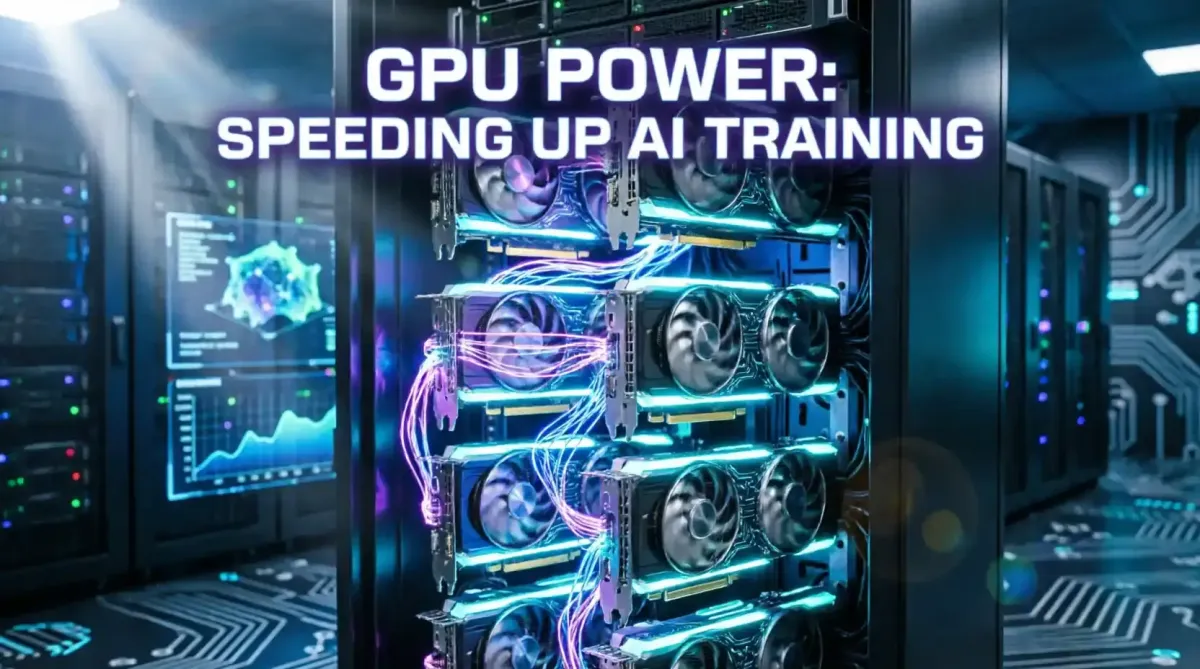
The Role of GPUs in Speeding Up AI Model Training in 2026
In 2026, the meteoric rise of Artificial Intelligence would be impossible without a single, powerful piece of hardware: the Graphics Processing Unit (GPU). Originally designed to render pixels in video games, the GPU has been repurposed as the "Engine of AI." While a CPU is like a high-speed train carrying a few passengers, a GPU is like a massive fleet of thousands of small vehicles moving in perfect unison. At TipsForAITech, we are examining why the GPU is the unsung hero of the AI revolution and how it accelerates the training of the world's most advanced models.
This 1500+ word comprehensive guide dives into the architecture of AI acceleration. Whether you are learning about processor speed or exploring quantum-powered AI, the GPU remains the industry's workhorse in 2026.
1. Parallel Processing: The GPU’s Secret Weapon
The fundamental difference between a CPU and a GPU in 2026 is Parallelism. AI model training involves millions of matrix multiplications—simple but repetitive math problems. A CPU handles tasks one by one (Serial Processing), whereas a GPU can handle thousands of these tasks simultaneously. This is a level of efficiency that mirrors autonomous industrial systems where multiple actions happen at once.
2. Tensor Cores: Specialized for Deep Learning
In 2026, high-end GPUs from NVIDIA and AMD feature dedicated Tensor Cores. These are hardware components specifically tuned to perform the "Multiply-Accumulate" operations used in deep learning neural networks. By using Tensor Cores, a GPU can train a Large Language Model (LLM) up to 100x faster than a traditional processor, a breakthrough essential for rapid software debugging and optimization.
3. Managing Massive Datasets: VRAM and High-Bandwidth Memory
AI models require massive amounts of data to learn. In 2026, GPUs are equipped with HBM3e (High-Bandwidth Memory), allowing them to load entire datasets into video memory for instant access. This eliminates "Data Bottlenecks," ensuring seamless data management for models with trillions of parameters.
4. The Impact of NVIDIA Blackwell and Beyond
The year 2026 marks the dominance of the Blackwell (B200) and its successors. These GPUs are not just chips; they are "AI Platforms." By connecting thousands of GPUs via high-speed NVLink, companies can create a "Super-GPU" that acts as a single brain. This infrastructure is what allows global SaaS companies to provide real-time AI services to millions of users.
5. Reducing Training Time: From Months to Days
In the early days of AI, training a state-of-the-art model took months of compute time. In 2026, a cluster of modern GPUs can accomplish the same task in a few days. This rapid iteration allows for faster deployment of specialized AI apps and ensures that AI models are always up-to-date with current events.
[Image showing a comparison chart: Training Time for a 175B Parameter Model—CPU Only vs. 2020 GPU vs. 2026 Blackwell Cluster]6. Energy Efficiency and Sustainable AI
Training AI is energy-intensive. However, because GPUs are so much faster than CPUs at AI tasks, they are actually more energy-efficient per calculation. In 2026, "Green AI" initiatives prioritize GPU clusters to reduce the carbon footprint of data centers, a trend we also see in sustainable home automation.
7. The Rise of "Edge GPUs" in Mobile Devices
AI isn't just in the cloud. In 2026, our smartphones and laptops feature "Mobile GPUs" that allow for local AI inference. This ensures that your writing assistant or chatbot works instantly, even without an internet connection, while maintaining total data privacy through local processing.
8. Security: Protecting the AI Model Weights
The "Weights" of an AI model are its most valuable secret. In 2026, GPUs use Confidential Computing to encrypt data while it is being processed. Using open-source security monitoring alongside hardware encryption prevents "Model Stealing" and ensures small business AI assets remain secure.
9. Using AI Writing Assistants for Hardware Optimization
Data scientists use advanced writing assistants to document their GPU cluster configurations and share optimization tips with the community, ensuring maximum professional productivity in the tech sector.
10. Conclusion: The Silicon Heart of Intelligence
The role of GPUs in 2026 has expanded far beyond simple graphics. They are the silicon heart of the intelligence revolution. By providing the parallel power needed to digest the world's data, GPUs have unlocked the full potential of artificial intelligence. As we look toward the future of quantum-powered neural networks, the foundation will always be built on the lessons we learned from the humble graphics chip. In 2026, if AI is the mind, the GPU is the muscle—and together, they are changing everything.
Stay at the forefront of the hardware and AI revolution by following TipsForAITech. Whether you're looking for OS comparisons or development frameworks, we are your partner in the 2026 technology landscape.