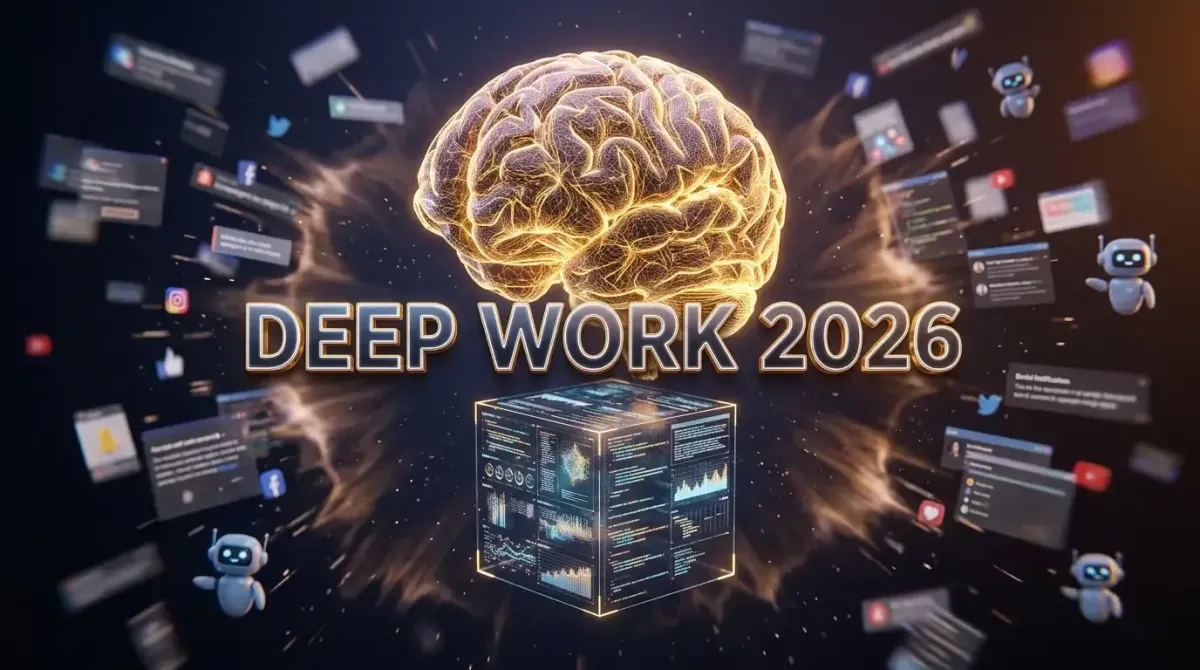
In an era where artificial intelligence can instantly generate code, draft marketing copy, and analyze massive datasets in seconds, the modern professional is facing a profound paradigm shift. The ability to perform shallow, repetitive tasks is no longer a competitive advantage; it is a commodity entirely subsumed by machine learning algorithms. Consequently, the capacity for Deep Work, defined as the ability to focus without distraction on a cognitively demanding task, has emerged as the single most valuable and稀缺 skill in the 2026 economy. While AI handles the superficial layers of information processing, human beings must retreat into the deep, complex, and creative realms of problem solving to remain indispensable. This comprehensive guide explores the neuroscience of deep focus, the psychological toll of the AI distraction economy, and the exact technical workflows required to cultivate unbreakable concentration in a world designed to fracture your attention.
The Neuroscience of Deep Work in an AI Driven World
To understand why deep focus is so critical, we must first examine the biological mechanics of learning and complex problem solving. When you engage in deep work, you are not merely processing information; you are physically altering the structure of your brain. The process of mastering a complex skill or solving a novel architectural problem triggers the production of myelin, a fatty tissue that wraps around your neurons. This myelination increases the speed and strength of electrical signals traveling between brain cells, effectively upgrading your brain's internal bandwidth.
Artificial intelligence, for all its computational power, does not possess this biological mechanism. AI models operate on static weights and probabilistic token generation. They do not learn in real time through focused biological immersion. Therefore, the human ability to myelinate new neural pathways through intense, uninterrupted focus is a biological superpower that machines cannot replicate. When you succumb to distractions, checking notifications or context switching between AI prompts and your own thoughts, you interrupt the myelination process. The cognitive load is fractured, and the deep structural changes required for true mastery fail to occur.
This biological reality means that professionals who can sustain deep focus will literally build superior cognitive hardware in their brains compared to their distracted peers. They will be capable of holding larger, more complex mental models in their working memory, allowing them to direct AI systems with a level of nuance and strategic vision that a fragmented mind simply cannot achieve. Understanding the how to choose a monitor for deep work is a critical first step in optimizing your physical environment to support this intense neurological process, ensuring that visual fatigue does not prematurely terminate your focus sessions.
The Paradox of AI and the Attention Economy
We are living through a profound paradox. On one hand, AI tools have the potential to eliminate the shallow work that plagues modern knowledge workers. Automated scheduling, AI driven email sorting, and intelligent data entry can theoretically free up hours of our day. On the other hand, the same technology ecosystem has created an attention economy that is more aggressive and sophisticated than ever before. AI algorithms power the recommendation engines of social media, the infinite scroll of news feeds, and the gamified notification systems of enterprise software, all engineered to hijack your dopamine receptors and shatter your concentration.
The result is a workforce that is technically capable of doing less busywork, but psychologically conditioned to be unable to focus for more than fifteen minutes at a time. When a professional sits down to engage in deep work, their brain is constantly anticipating the next micro reward from a digital interruption. This chronic state of continuous partial attention destroys the ability to perform the deep, linear thinking required for high level strategy, complex system design, and creative breakthroughs.
To reclaim your cognitive sovereignty, you must treat your attention as a finite, highly protected resource. This requires a fundamental shift in how you interact with your digital environment. It is not enough to simply turn off your phone; you must architect a frictionless workflow that actively prevents shallow work from bleeding into your deep work blocks. Learning how to build a frictionless workflow using Arc Browser and Raycast allows you to create strict digital boundaries, ensuring that your communication tools are completely siloed away from your primary creative and analytical environments.
Core Philosophies of Deep Work for the AI Era
Implementing deep work in 2026 requires adapting classic productivity philosophies to a world where AI agents are constantly vying for your input. There are four primary frameworks for scheduling deep work, and choosing the right one depends on your specific role and the nature of your cognitive tasks.
The Monastic Philosophy
This approach involves maximizing deep efforts by eliminating shallow obligations entirely. In the context of modern tech, this might mean a senior architect or a lead researcher who completely delegates all email, scheduling, and administrative coordination to AI agents and human assistants. They operate in a state of near total isolation, emerging only to deliver high level strategic outputs. This is highly effective but difficult to maintain in collaborative corporate environments.
The Bimodal Philosophy
The bimodal approach divides your time clearly between deep stretches and shallow periods. You might dedicate three to four consecutive days a week to pure, uninterrupted deep work, during which you are virtually unreachable. The remaining days are dedicated to open collaboration, AI management, and administrative tasks. This philosophy is ideal for academics, lead developers, and founders who need to balance deep strategic thinking with team leadership.
The Rhythmic Philosophy
This is the most practical approach for the majority of knowledge workers. It involves creating a daily habit, such as working deeply from 6:00 AM to 9:00 AM every single day before the rest of the world wakes up and the AI notification queues begin to fill. By chaining these sessions together, you build a rhythmic habit that bypasses the need for willpower. To support this early morning routine, exploring mastering macOS Sequoia 10 hidden productivity hacks for power users can help you automate your morning system boot up, instantly launching your deep work environment without wasting cognitive energy on manual setup.
The Journalistic Philosophy
This advanced approach involves squeezing deep work into any available gap in your schedule. While it sounds chaotic, it requires an exceptionally high level of cognitive flexibility and rapid context switching. It is generally not recommended for beginners, as the mental cost of transitioning into a deep state in just thirty minutes is incredibly high. However, for experienced practitioners, it allows for massive output in highly unpredictable environments.
Building the Ultimate Deep Work Environment
Your physical and digital environment dictates the quality of your cognitive output. In 2026, the tools you use must be specifically selected to minimize friction and maximize focus. The modern deep work setup is a carefully calibrated machine designed to protect your attention.
Hardware Optimization for Cognitive Load
The hardware you use should never be a bottleneck that forces you to break your focus. When selecting a primary machine, the integration of dedicated neural processing units is now mandatory for handling local AI tasks without relying on cloud latency. Reading the ultimate laptop buying guide 2026 choosing between NPU powered AI PCs will help you select a machine that can run local language models and background automation seamlessly, ensuring that your primary CPU and GPU remain entirely dedicated to your core analytical tasks.
Furthermore, the tactile feedback of your input devices plays a massive role in sustaining flow states. The physical act of typing should be rhythmic and satisfying, providing a sensory anchor that keeps your mind engaged with the present task. Understanding how to select the perfect mechanical keyboard for long coding sessions is essential for developers and writers who need to type for hours without experiencing fatigue or losing their mental momentum. A high quality mechanical switch reduces the physical friction of typing, allowing your thoughts to flow directly onto the screen.
Software Boundaries and Digital Siloing
Software must be configured to enforce your deep work boundaries. This means utilizing operating system level focus modes that not only silence notifications but actively block access to distracting applications and websites. You should establish distinct digital profiles for different modes of thinking. Your "Deep Work" profile should have no email clients, no messaging apps, and no web browsers open. Only the specific tools required for your current cognitive task should be accessible.
Implementing 10 productivity frameworks that actually work for tech founders can provide the structural methodology needed to enforce these software boundaries consistently. Frameworks like time blocking and task batching ensure that your deep work sessions are protected on your calendar, treating them with the same immovable respect as a meeting with a major client.
Integrating AI Without Losing Your Focus
The goal is not to reject AI, but to use it as a shield that protects your deep work, rather than a sword that fractures it. AI should be deployed to handle the shallow work that surrounds your deep work, creating a protective moat around your most valuable cognitive hours.
Using AI to Automate the Shallow
Before you begin a deep work session, you must clear the mental RAM of all pending shallow tasks. This is where AI excels. You can use AI scheduling assistants to negotiate meeting times, AI email drafters to summarize and respond to routine communications, and AI data processors to organize your research materials. By offloading these tasks to automated systems, you enter your deep work block with a completely clear mind. Mastering mastering time management with AI scheduling assistants ensures that your calendar is optimized for long, uninterrupted blocks of focus, automatically declining or rescheduling low priority interruptions.
AI as a Deep Work Partner
When you are in the depths of a complex problem, AI can act as a high level sounding board, provided you interact with it deliberately. Instead of using AI to generate entire solutions, use it to stress test your own logic. This requires advanced interaction techniques. Learning the art of prompt engineering how to talk to AI in 2026 allows you to extract precise, targeted feedback from your models without falling into the trap of letting the AI do the thinking for you.
For highly complex logical problems, you can force the AI to slow down and match your cognitive pace. By utilizing how to use chain of thought prompting for complex logic tasks, you can require the AI to output its step by step reasoning process. This not only improves the accuracy of the AI's response but also forces you, the human, to critically evaluate each logical step, keeping your own mind deeply engaged in the problem solving process rather than passively accepting a generated answer.
Deep Work vs Shallow Work in the Age of Automation
To fully grasp the value of deep work, it is necessary to contrast it directly with the shallow work that AI is rapidly automating. The following table outlines the fundamental differences between these two modes of operation and their respective values in the 2026 economy.
| Characteristic | Deep Work | Shallow Work |
|---|---|---|
| Cognitive Demand | Extremely high, requires sustained concentration and complex problem solving | Low, logistical style tasks that can be performed while distracted |
| AI Vulnerability | Low, requires human nuance, strategic vision, and novel synthesis | Extremely high, easily automated by current and emerging AI agents |
| Economic Value | Exponentially increasing, commands premium compensation and leadership roles | Rapidly depreciating, facing wage stagnation and outsourcing to machines |
| Biological Impact | Builds myelin, enhances neuroplasticity, and improves long term cognitive capacity | Fragments attention, increases cognitive fatigue, and degrades focus stamina |
| Execution Style | Uninterrupted blocks of 90 to 120 minutes, strict environmental controls | Constant context switching, reactive responses to notifications and emails |
As the table illustrates, the economic and cognitive trajectories of these two work styles are diverging rapidly. Professionals who spend the majority of their day in shallow work are actively training their brains to be replaced by AI. Conversely, those who prioritize deep work are building the exact cognitive capabilities that AI lacks.
Overcoming the Attention Deficit Crisis
The greatest barrier to deep work in 2026 is not a lack of time; it is a severe deficit in attention span. The constant barrage of hyper stimulating digital content has rewired the modern brain to expect a novel dopamine hit every few seconds. Reversing this conditioning requires a deliberate and often uncomfortable process of cognitive rehabilitation.
Digital Minimalism and Dopamine Detoxification
To rebuild your attention span, you must ruthlessly eliminate low quality digital distractions from your life. This goes beyond simply putting your phone away during work hours; it requires a fundamental restructuring of your relationship with technology. You must audit every application on your devices and ask whether it genuinely supports your deep goals or merely provides cheap, algorithmic entertainment.
Implementing strict screen time limits and utilizing software blockers is essential. Exploring managing digital wellbeing best apps to control screen time provides the exact tools needed to enforce these boundaries at the operating system level. By starving the brain of constant, low effort dopamine, you gradually reset your baseline stimulation threshold. Over time, the deep, slow burn of focused work becomes not only tolerable, but deeply satisfying.
Embracing Productive Meditation and Boredom
In the absence of digital stimulation, the modern mind often panics. We have lost the ability to simply be bored. However, boredom is the crucible in which deep creativity is forged. When you allow your mind to wander without immediately reaching for a screen, you engage the brain's default mode network. This network is responsible for connecting disparate ideas, generating novel insights, and consolidating complex information.
You must practice being bored. Take walks without listening to podcasts or music. Wait in line without pulling out your phone. Sit in silence for ten minutes before starting your work day. By reclaiming these moments of mental emptiness, you create the necessary space for deep, original thought to emerge. You transition from being a passive consumer of AI generated content to an active creator of original human insight.
Future Trends: Cognitive Enhancement and the Evolution of Focus
As we look toward the latter half of the decade, the tools and techniques surrounding deep work will continue to evolve. The integration of hardware and software will become even more seamless, creating environments that actively monitor and support your cognitive state.
Biometric Feedback and Adaptive Environments
Wearable technology is advancing beyond simple step counting. Future deep work setups will utilize non invasive biometric sensors to monitor your cognitive load, heart rate variability, and eye tracking data in real time. When the system detects that your attention is fracturing or your cognitive fatigue is peaking, it will automatically adjust your environment. It might dim the lights, alter the ambient soundscape, or automatically pause incoming communications until your biometric markers indicate you are ready to resume.
The Rise of the Cognitive Athlete
In the AI economy, deep work will be treated with the same rigor and scientific approach as elite physical training. Professionals will hire cognitive coaches, utilize specialized nootropic supplements, and follow strict periodization schedules for their mental efforts. The ability to sustain deep focus will be recognized not just as a soft skill, but as a hard, measurable performance metric that directly correlates with professional success and personal fulfillment.
Conclusion
The rise of artificial intelligence has not diminished the value of human cognition; it has distilled it. By automating the shallow, repetitive tasks that once consumed our days, AI has forced us to confront the true nature of human work. The ability to engage in Deep Work, to focus with unbroken intensity on complex, meaningful problems, is now the ultimate competitive advantage. It is the skill that allows us to direct the machines, rather than being replaced by them.
Cultivating this skill requires more than just good intentions. It demands a ruthless commitment to protecting your attention, a deliberate restructuring of your digital and physical environments, and a willingness to endure the discomfort of boredom and cognitive strain. By mastering the art of deep focus, you secure your place in the 2026 economy, ensuring that your mind remains a powerful, irreplaceable engine of innovation and strategy in a world increasingly run by algorithms.