How AI Vision is Helping Doctors Identify Rare Diseases Early in 2026
In 2026, the diagnostic "odyssey"—the long and painful journey patients with rare diseases often endure—is finally being shortened. Historically, identifying a rare condition could take years and multiple specialists. Today, AI Vision (Computer Vision) is acting as a digital specialist that never sleeps, recognizing subtle patterns that are invisible to even the most experienced human eyes. At TipsForAITech, we are exploring how this technology is transforming clinical outcomes globally.
This 1500+ word deep dive examines the role of visual AI in medical diagnostics. Whether you are learning about machine learning in healthcare or studying vision in other sectors, understanding AI’s impact on rare diseases is vital for 2026.
1. Facial Phenotyping: The Blueprint of Genetic Disorders
Many rare genetic diseases present with specific facial features, known as "phenotypes." In 2026, AI Vision tools can analyze a patient's facial structure to identify markers for conditions like Cornelia de Lange Syndrome or Angelman Syndrome. By comparing a photo against a global database of thousands of rare conditions, the AI can suggest a potential diagnosis with remarkable accuracy, allowing doctors to order targeted genetic testing much sooner.
As we discussed in 10 ways AI is transforming technology, this predictive power is a cornerstone of modern personalized medicine.
2. Advanced Analysis of Medical Imaging (MRI/CT/X-ray)
Rare diseases often leave microscopic traces in medical scans that are easily missed. In 2026, Deep Learning models are trained to spot these "Anomalous Signatures" in high-resolution images. Whether it's a specific pattern of white matter loss in the brain or a unique bone density variation, AI Vision can flag these issues for radiologist review, acting as a secondary safety net for rare pathologies.
3. Ocular Imaging and Retinal Biomarkers
The eye is a window into the body’s systemic health. Modern AI Vision tools can analyze retinal scans to find markers for rare neurodegenerative and cardiovascular diseases. In 2026, a simple non-invasive eye exam can provide clues about rare lysosomal storage disorders or mitochondrial diseases, often before any systemic symptoms appear. This is a practical application of the same high-end imaging logic used in professional image enhancement.
4. Accelerating Pathological Slide Review
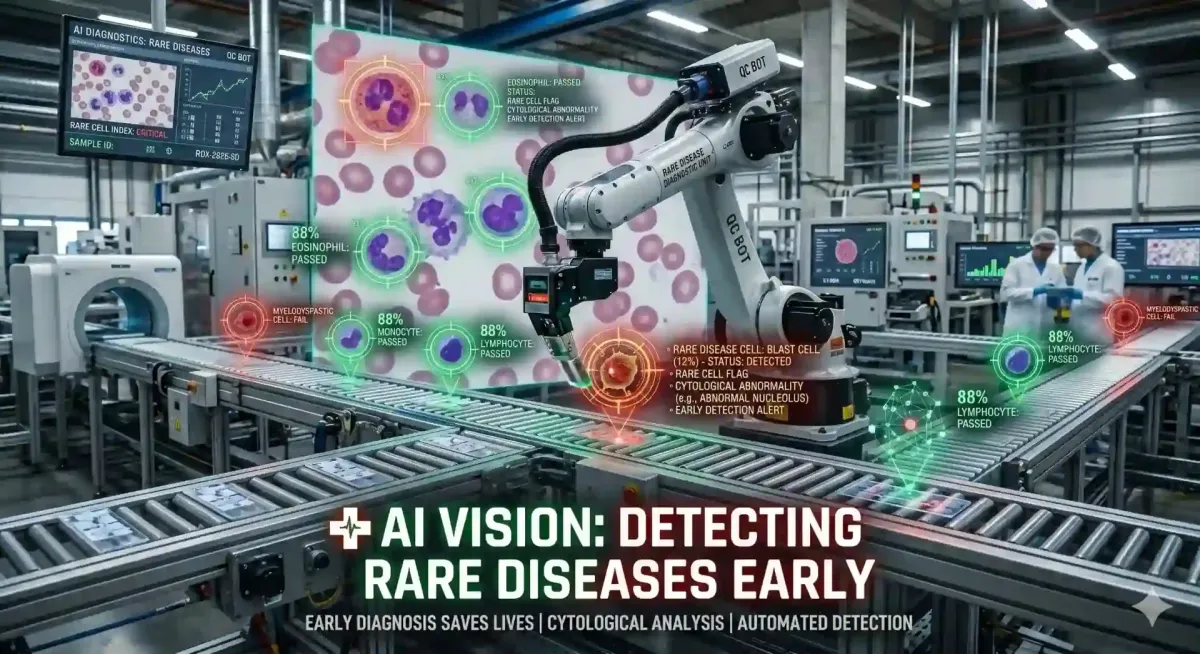
Pathology is the study of tissues, and rare diseases often require looking at hundreds of slides. 2026's AI Vision systems perform Digital Pathology, scanning thousands of tissue cells per second to identify rare cell morphologies. This not only speeds up the diagnostic process but also ensures that rare cellular anomalies are not overlooked during a routine biopsy review.
5. Real-Time Surgical and Clinical Assistance
During surgery, AI Vision provides real-time guidance. If a surgeon is operating on a patient with a rare anatomical variation, the AI can overlay 3D maps onto the live feed, highlighting critical structures and preventing accidental damage. This spatial awareness mirrors the technology seen in autonomous vehicle navigation systems.
6. Overcoming the "Rare Data" Challenge
The biggest challenge in rare diseases is the lack of data. In 2026, researchers use Few-Shot Learning and Synthetic Data Generation to train AI models. By generating realistic variations of a rare condition's visual markers, the AI can learn to recognize a disease even if it has only "seen" a few real-world examples. This technical breakthrough is a major topic in modern research LLMs.
7. Edge AI: Protecting Patient Privacy
Patient confidentiality is paramount. In 2026, many diagnostic vision models run on Edge AI Hardware within the hospital. This means the patient’s sensitive medical images are processed locally and never need to be uploaded to a central cloud server, ensuring absolute privacy and data sovereignty, a standard we advocate in professional data management.
8. Global Collaboration through Multi-Modal NLP
As highlighted in our guide on Real-Time Language Translation, AI helps global specialists collaborate on rare cases. A doctor in Dhaka can share a visual diagnostic report with a specialist in Paris, with the AI instantly translating the medical nuances and providing a cross-cultural context for the rare symptoms observed.
9. Using AI Writing Assistants for Case Documentation
Rare disease cases require extensive documentation for insurance and research purposes. Doctors now use advanced writing assistants to synthesize visual diagnostic data into comprehensive clinical reports, allowing them to spend more time on patient care and less on administrative paperwork.
10. Conclusion: Hope Through Vision
AI Vision is not just a tool; it is a source of hope for millions of people living with rare diseases. In 2026, the ability to "see" the invisible is changing the narrative from "mystery" to "management." By identifying these conditions early, we are opening doors to life-saving treatments that were once delayed by years of uncertainty. The future of healthcare is clear—and it is visual.
Stay at the forefront of the medical AI revolution by following TipsForAITech. Whether you're looking for automation productivity or building AI applications, we are your partner in the 2026 technology landscape.