The Science Behind Real-Time Language Translation Using NLP in 2026
By 2026, the biblical "Tower of Babel" has finally been conquered by silicon. We are living in an era where a person in Dhaka can have a high-stakes business negotiation with someone in Tokyo, each speaking their native tongue, with zero perceived delay. This is not magic; it is the pinnacle of Natural Language Processing (NLP). At TipsForAITech, we are diving deep into the neural architecture that makes this global conversation possible.
This 1500+ word deep dive explores the technical "under-the-hood" mechanics of 2026 translation technology. Whether you are learning about human-like chatbots or building your own AI-powered tools, understanding the science of translation is fundamental.
1. The Foundation: Neural Machine Translation (NMT)
In 2026, traditional rule-based translation is obsolete. We now rely exclusively on Neural Machine Translation (NMT). Unlike old tools that translated word-for-word, NMT uses massive neural networks to translate entire sentences or paragraphs at once, maintaining the "Contextual Flow." This ensures that idioms, cultural nuances, and technical jargon are preserved perfectly across languages.
As we noted in 10 ways AI is transforming technology, NMT is the engine that has turned the world into a global village.
2. Transformers and the Attention Mechanism
The "Science" of real-time translation was revolutionized by the Transformer Model. Specifically, the "Attention Mechanism" allows the AI to focus on specific words in a sentence that determine the meaning of other words. For example, in the sentence "The bank was closed," the AI looks at the surrounding words to determine if "bank" refers to a financial institution or a riverbank. In 2026, these models have become so efficient that they can process these relationships in milliseconds.
3. Zero-Latency and Streaming Inference
The biggest challenge in 2026 was achieving Zero-Latency. To solve this, NLP researchers developed Streaming Inference. Instead of waiting for you to finish a sentence, the AI begins translating the *beginning* of your sentence while you are still speaking the *end*. It uses "Predictive Linguistics" to guess the most likely conclusion of your thought, adjusting in real-time if you change direction. This is a critical component of Advanced NLP Voice Assistants.
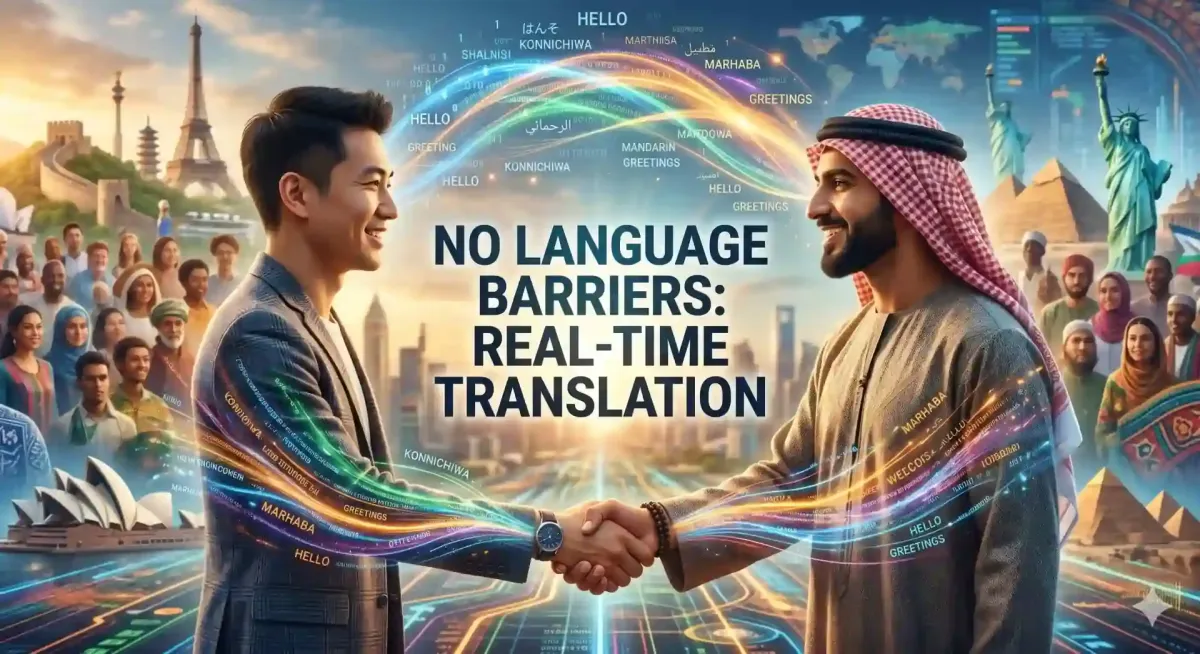
[Image showing the process of real-time speech-to-speech translation with sub-second latency]4. Cross-Lingual Embeddings: The Universal Language of Numbers
How does a machine know that "বন্ধু" in Bengali means the same as "Friend" in English? It uses Cross-Lingual Word Embeddings. In 2026, every word in every language is mapped to a multi-dimensional mathematical space. Words with similar meanings are placed close to each other in this space, regardless of the language. This mathematical "map" is what allows for the near-perfect translation we see today.
5. Mastering Low-Resource Languages
One of the triumphs of 2026 is the inclusion of "Low-Resource" languages—languages that don't have millions of books or websites to learn from. Using Few-Shot Learning and Transfer Learning, AI models can now learn a new language by comparing its structure to a similar, better-documented language. This is fostering inclusion in the AI-driven virtual offices of the world.
6. Contextual and Cultural Adaptation
Translation in 2026 is not just about words; it’s about Cultural Etiquette. If you are translating English into Japanese, the NLP model automatically adjusts the level of formality based on the relationship between the speakers. It understands honorifics and social hierarchy, ensuring that your translation is not just accurate, but also respectful. This level of nuance is also a major focus for modern academic research in LLMs.
7. The Role of Edge AI and Hardware Acceleration
To achieve real-time speeds, the translation logic has moved to Edge AI. Instead of sending your voice to a distant server, the translation is processed on local AI chips inside your earbuds or smartphone. This provides total privacy and ensures the translation works even when you are offline—a vital feature for global travelers and data-sensitive spreadsheet and data management.
8. Multimodal Translation: Lip-Syncing and Visuals
In 2026, translation is also visual. Modern video conferencing tools use Generative AI to adjust the speaker's lip movements in real-time to match the translated audio. This reduces the "cognitive dissonance" of watching someone speak a different language, making the interaction feel 100% natural. This is a prime example of generative AI changing the game.
9. Using AI Writing Assistants for Post-Translation Polish
For written translation, professionals often use advanced writing assistants to ensure the translated text matches the intended brand voice. The AI translates the core message, and the writing assistant ensures the style is consistent with the rest of the company’s documentation.
10. Conclusion: A World Without Borders
The science behind real-time language translation is ultimately the science of human connection. By stripping away the barriers of language through NLP, we are creating a world where ideas can flow freely between cultures. In 2026, your voice is no longer limited by the language you were born with—it is limited only by the strength of your ideas.
Stay at the cutting edge of the language revolution by following TipsForAITech. Whether you're looking for automation productivity or scheduling mastery, we are your partner in the 2026 technology landscape.