
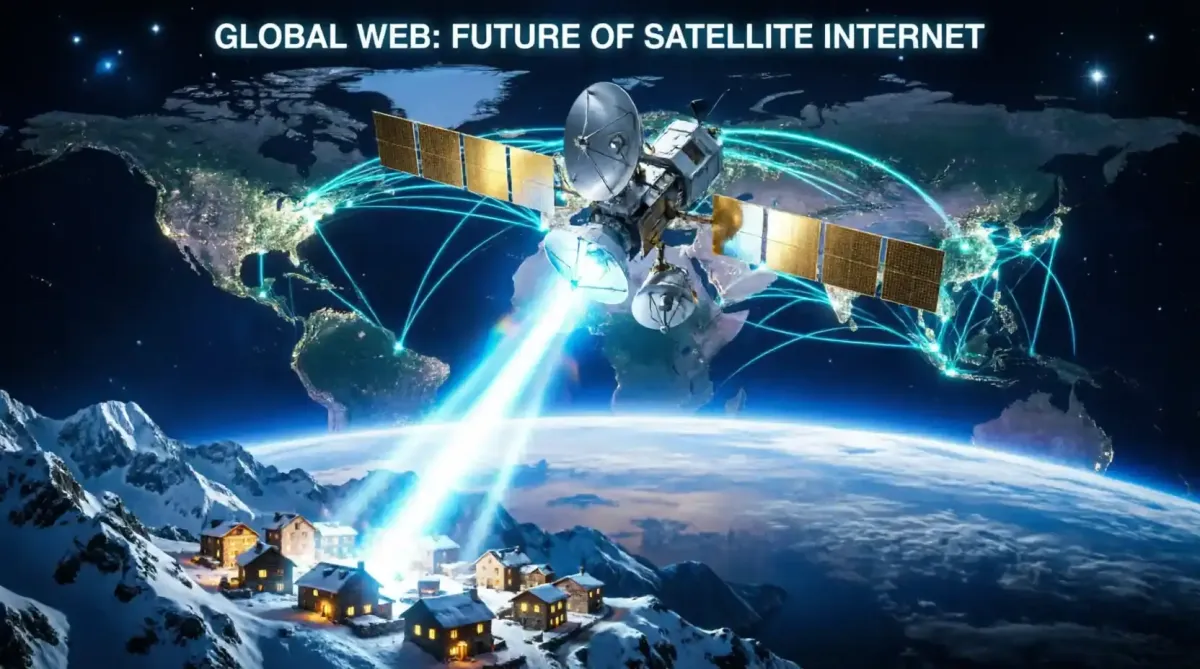
The Future of Satellite Internet: Connecting the Remotest Parts of Earth in 2026
In 2026, the digital divide is finally closing. For decades, living in a remote village, a dense jungle, or the middle of the ocean meant being cut off from the global high-speed network. Traditional fiber and 5G infrastructure simply couldn't reach these areas. However, the rise of Low Earth Orbit (LEO) Satellite Constellations has changed the game. Today, high-speed, low-latency internet is available from the North Pole to the Amazon rainforest. At TipsForAITech, we are exploring how satellite internet is becoming the ultimate equalizer for global communication.
This 1500+ word comprehensive guide dives into the satellite revolution. Whether you are tracking the cost of rocket launches or managing a remote team, satellite internet is the backbone of your 2026 connectivity.
1. The LEO Advantage: Low Latency for the Real World
Unlike old satellite internet that sat 35,000 km away in geostationary orbit, 2026’s LEO satellites (like Starlink and Amazon’s Project Kuiper) orbit at just 550 km.
The Result: Latency has dropped from 600ms to under 25ms. This makes it possible to engage in Real-time Video Calls, online gaming, and remote software development from anywhere on the planet.
2. Closing the Education and Healthcare Gap
In 2026, satellite internet is a lifeline for remote communities. Schools in rural areas now have access to the same digital resources as urban centers. Furthermore, Telemedicine has been revolutionized; doctors can now perform remote robotic surgeries and diagnostics via stable satellite links, saving lives in previously unreachable zones.
3. The "Cellular-to-Satellite" Revolution
A major breakthrough in 2026 is Direct-to-Cell technology. Your standard smartphone can now connect directly to a satellite in areas with zero cell towers. This ensures that "Dead Zones" no longer exist, a vital safety feature for explorers and field researchers.
4. Impact on Global Logistics and Maritime Safety
Ships, planes, and long-haul trucks in 2026 are always connected. This allows for real-time tracking of massive logistics data. Satellite internet ensures that vessels in the middle of the Pacific can maintain End-to-End Encrypted communications with their home ports, enhancing maritime security.
5. The Competition: Starlink, Kuiper, and OneWeb
The "Space Internet Race" is in full swing. In 2026, SpaceX's Starlink remains the leader, but Amazon’s Kuiper has achieved global coverage, and OneWeb is serving the enterprise sector. This competition is driving down subscription costs, a trend we also see in the SaaS and cloud industry.
[Image showing a comparison chart: Internet Speeds and Latency—Fiber vs. 5G vs. 2026 LEO Satellite]6. Solving the Space Debris and Light Pollution Issues
With thousands of satellites in orbit, 2026 has introduced strict Space Traffic Management. Satellites now use AI-driven collision avoidance systems and "dark coatings" to reduce light pollution for astronomers, fulfilling the government's mandate for safe and ethical space use.
7. Satellite Internet for Disaster Resilience
When hurricanes or earthquakes destroy ground-based towers, satellite internet remains active. In 2026, emergency responders use portable satellite terminals to coordinate rescue missions and robotic deployments, ensuring communication never fails during a crisis.
8. Security: Protecting the Orbital Network
Since satellite data travels through space, it must be protected. In 2026, Quantum-Resistant Encryption is being integrated into satellite beams. Users are encouraged to use open-source security tools and passkeys to secure their local satellite routers.
9. Using AI Writing Assistants for Global Coordination
Global teams connected via satellite use advanced writing assistants to overcome language barriers and coordinate projects across time zones, maintaining maximum professional productivity in a borderless world.
10. Conclusion: One Planet, One Network
The future of satellite internet in 2026 is about more than just fast downloads; it is about human connection. By removing the geographical barriers to information, we are creating a truly global society. Whether it’s an entrepreneur in a remote village or a researcher in Antarctica, everyone now has the same opportunity to contribute to the digital economy. The sky is no longer the limit; it is the infrastructure. One planet, one network, and infinite possibilities.
Stay at the forefront of the space and tech revolution by following TipsForAITech. Whether you're looking for OS comparisons or self-hosting guides, we are your partner in the 2026 technology landscape.