
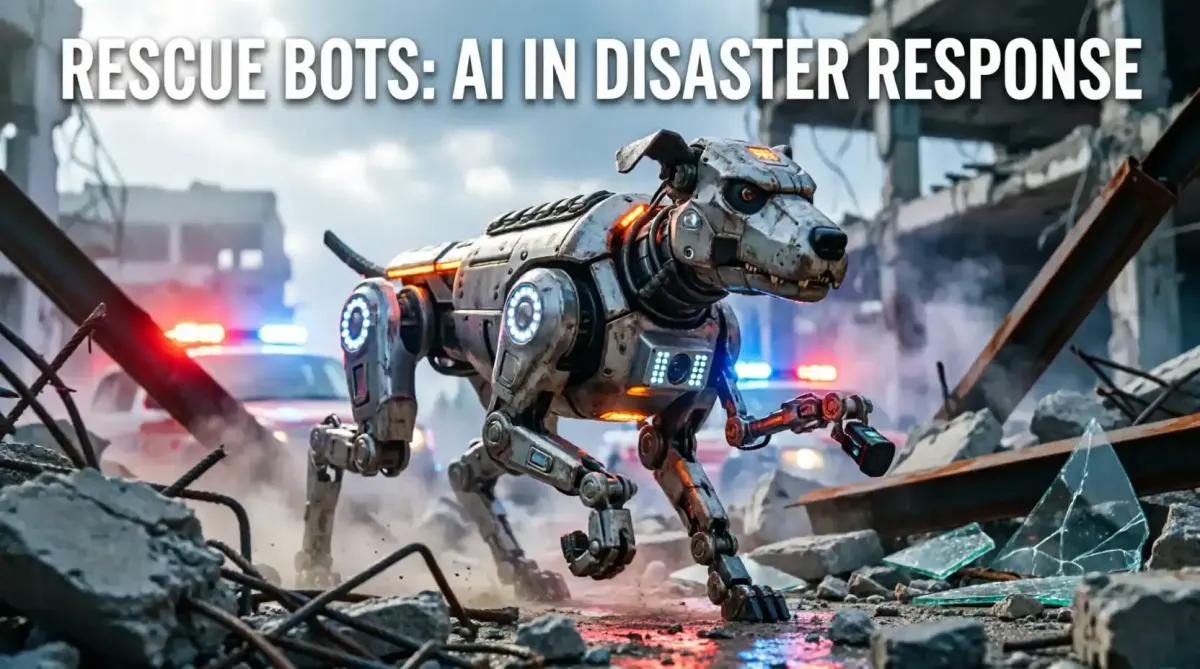
The Role of Robotics in Disaster Response and Rescue Missions in 2026
In 2026, when disaster strikes, the first "boots on the ground" are often not boots at all, but tracks, rotors, and sensors. Whether it is an earthquake-damaged building or a massive forest fire, Disaster Response Robots are now the frontline heroes of rescue missions. These machines are designed to go where it is too dangerous, too tight, or too toxic for human rescuers. At TipsForAITech, we are examining how the marriage of AI and robotics is saving lives during humanity's darkest hours.
This 1500+ word deep dive explores the critical role of robotics in emergency management. From collaborative workplace robots to humanoid assistants, the technology we build today is the shield that protects us tomorrow.
1. Urban Search and Rescue (USAR) and Structural Collapse
In the aftermath of an earthquake or explosion, time is the enemy. In 2026, Snake Robots and small Crawl-Bots are deployed into the crevices of collapsed structures. Equipped with high-fidelity microphones and CO2 sensors, they can detect the heartbeat and breath of a survivor buried deep under concrete. This is a life-saving application of the advanced sensor technology we see in autonomous systems.
2. Search and Rescue Drones: The Eye in the Sky
Aerial robotics has reached a peak in 2026. Rescue drones now use Multi-Spectral Thermal Imaging to find lost hikers in dense forests or survivors in flood zones at night. Furthermore, "Delivery Drones" are used to drop critical medical supplies, water, and radios to people in isolated areas, a logistical feat mirroring autonomous agricultural monitoring.
3. Robotic Swarms for Rapid Mapping
In 2026, rescuers use Swarm Intelligence. Instead of one large robot, dozens of small, palm-sized drones are released into a disaster zone. They work together to create a real-time 3D map of the area using SLAM (Simultaneous Localization and Mapping). This map is then transmitted to human teams, allowing for seamless data-driven decision making.
4. Firefighting Robots: Tackling the Heat
Humanoid and tracked firefighting robots in 2026 can withstand temperatures that would be fatal to a human. They can enter burning chemical plants or tunnels to extinguish fires with high-pressure foam cannons. By using AI Vision, they can identify the source of the fire through thick smoke, a proactive safety measure we also see in intelligent home security.
5. Underwater Search and ROVs
Disasters don't just happen on land. In 2026, Remotely Operated Vehicles (ROVs) are used for maritime rescue and recovery. These robots can dive to depths that are impossible for human divers, using sonar to locate submerged vehicles or structures. This technology is vital for maintaining global logistics and supply chain safety during floods or hurricanes.
6. Humanoid Robots for Heavy Lifting and Extraction
In 2026, humanoid robots like the Atlas Rescue Variant are used for "Heavy Extraction." These robots have the strength to lift debris and the dexterity to move injured people without causing further harm. Their bipedal movement allows them to climb stairs and cross uneven terrain, much like the workforce humanoids in industrial sectors.
7. Tele-Presence and Expert Remote Assistance
Medical emergencies in disaster zones require experts who might be thousands of miles away. In 2026, Tele-Presence Robots allow surgeons and trauma specialists to "see" through the robot's eyes and guide on-site responders through complex procedures, a feature supported by virtual office and remote collaboration tech.
8. Security: Protecting Rescue Data and Infrastructure
Communication in a disaster zone must be secure. In 2026, rescue robots use Encrypted Mesh Networks to ensure that their data feeds are not intercepted. Protecting this infrastructure with open-source security tools and passkey authentication is essential to prevent cyber-interference during critical missions.
9. Using AI Writing Assistants for Emergency Coordination
In the chaos of a rescue mission, clear communication is everything. Rescuers use advanced writing assistants to rapidly draft situation reports and coordinate between different international NGOs, ensuring maximum operational productivity.
10. Conclusion: A Brave New World of Resilience
The role of robotics in disaster response in 2026 is a testament to human ingenuity. We are building machines not to replace our compassion, but to extend our reach and protect our most vulnerable. By combining the precision of AI with the resilience of robotics, we are creating a world where no person is left behind, and no environment is too dangerous for a rescue mission. Technology, in its truest form, has become our greatest lifesaver.
Stay at the forefront of the robotics and AI revolution by following TipsForAITech. Whether you're looking for development frameworks or security tips, we are your partner in the 2026 technology landscape.