Using AI to Generate Consistent Brand Assets and Logos in 2026
In the hyper-competitive market of 2026, a brand’s visual identity is its digital handshake. However, maintaining Brand Consistency across thousands of touchpoints—from social media to virtual reality—has become a challenge that manual design can no longer solve alone. Artificial Intelligence has stepped in as the guardian of brand integrity. At TipsForAITech, we are exploring how AI tools are now capable of generating not just logos, but entire consistent asset ecosystems.
This 1500+ word comprehensive guide explores the mechanics of AI-driven branding in 2026. Whether you are using professional creative AI tools or creating marketing visuals, mastering consistency is the key to long-term brand equity.
1. The Problem of "AI Drift" in Branding
The biggest challenge for creators in 2026 is "AI Drift"—where generative models produce beautiful images that don't quite match the brand’s specific aesthetic. To solve this, 2026 technology uses LoRA (Low-Rank Adaptation) and Custom Fine-Tuning. Instead of using a general model, brands now train a "mini-model" on their existing assets, ensuring every new generated piece follows the exact same style, color theory, and line weight.
As we noted in 10 ways AI is transforming technology, the move from generic AI to "Private Brand AI" is a major trend this year.
2. AI Logo Design: Beyond Simple Icons
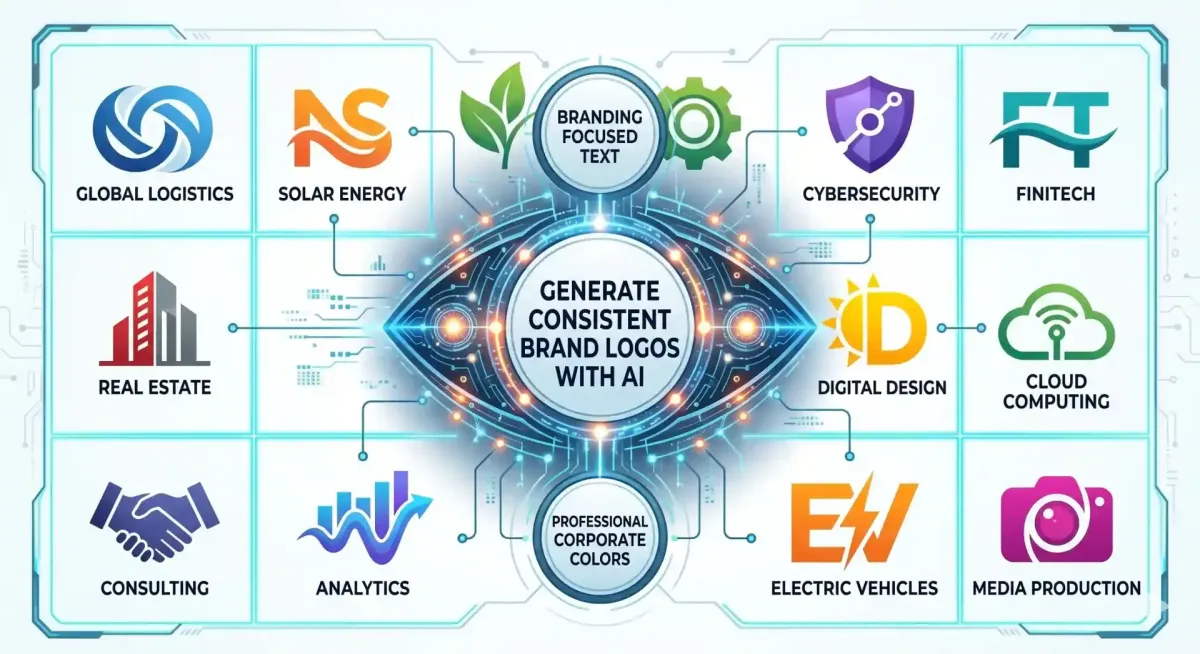
Logo design in 2026 is no longer about finding a nice icon. Modern AI tools generate Responsive Logo Systems. When you prompt for a logo, the AI provides a primary logo, a simplified favicon version, and a spatial 3D version for AI-driven virtual offices. These logos are delivered in vector format (SVG), allowing for infinite scaling without quality loss.
3. Ensuring Visual Consistency with Style References
Tools like Midjourney v7 have introduced "Style Reference" (SREF) tags in 2026. By using a unique style code, you can ensure that an image generated for a blog post has the exact same texture and "vibe" as the image generated for an email header. This prevents the "fragmented look" that occurs when multiple designers use different AI tools without a central style guide.
4. Automating Brand Asset Packs
In 2026, creating a "Brand Kit" is a one-click process. Once the core logo and colors are approved, Generative Design Systems automatically produce:
- Social Media Templates: Optimized for every platform's specific dimensions.
- Email Signatures & Stationery: Using consistent typography and voice.
- Presentation Decks: With layouts that automatically adjust to the content length.
5. The Role of Vector-Native AI
A major breakthrough in 2026 is Vector-Native Generation. Earlier AI models produced pixels (raster); modern branding AI (like Adobe Firefly 4) produces actual paths and nodes. This allows professional designers to take an AI-generated asset and manually tweak individual curves in Illustrator, providing a perfect blend of AI speed and human precision.
6. Dynamic Assets for Personalization
Branding in 2026 is increasingly "Dynamic." Using AI-driven data management, brands can generate personalized assets for specific user segments. If a customer is in a tropical region, the brand assets they see might have warmer, sunnier backgrounds, while a customer in a colder climate sees a more "winterized" version of the same brand identity—all while keeping the core logo and typography identical.
7. Voice and Sound: The Sonic Brand Identity
Consistency isn't just visual. With the rise of Advanced NLP Voice Assistants, brands are now using AI to generate a consistent "Sonic Brand." This includes a custom-trained AI voice that reflects the brand’s personality and unique UI sounds that are consistent across mobile apps and smart devices.
8. Ethical Branding and Trademark Safety
At TipsForAITech, we emphasize the importance of Trademark Verifiability. In 2026, professional branding AI includes a "Similarity Check" that scans existing global trademarks to ensure your new AI-generated logo doesn't accidentally infringe on another company's design. This protects businesses from expensive legal battles in the AI era.
9. Scaling Branding for Fast-Paced Marketing
In the world of fast-paced social media marketing, you need new visuals every hour. AI allows you to take your core brand assets and "remix" them instantly for trending topics without ever breaking the established brand rules. This agility is what separates successful 2026 brands from those that feel "stuck in the past."
10. Conclusion: The Brand as an Intelligent Ecosystem
Using AI to generate brand assets is not about "outsourcing" your identity; it is about "scaling" your vision. In 2026, your brand is a living, breathing ecosystem of intelligent assets that can adapt to any medium while remaining unmistakably *you*. By mastering these AI-driven systems, you ensure your brand remains consistent, professional, and future-proof.
Stay ahead of the branding revolution by following our technical guides at TipsForAITech. Whether you are retouching professional photos or building AI applications, we are your partner in the 2026 technology landscape.