Using NLP for Sentiment Analysis in Customer Feedback in 2026
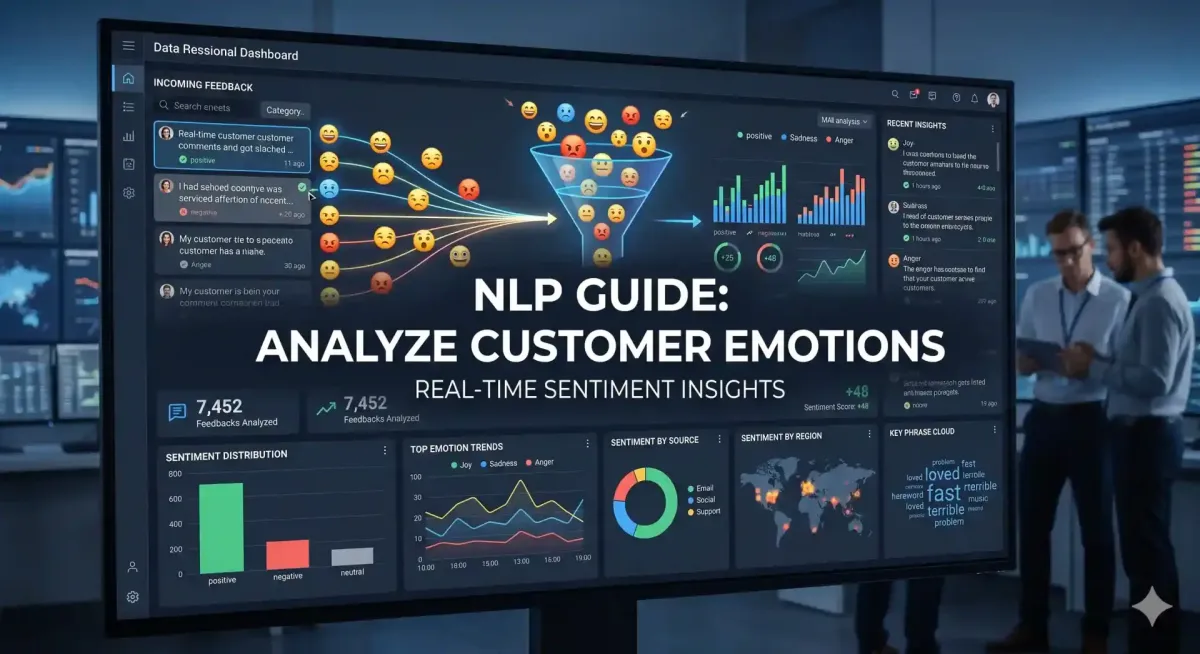
In the data-driven economy of 2026, understanding "what" your customers are saying is no longer enough. To build a truly resilient brand, you must understand "how" they feel. Sentiment Analysis, powered by Natural Language Processing (NLP), has become the ultimate tool for capturing the emotional pulse of a market. At TipsForAITech, we are seeing businesses transform their customer experience by turning thousands of raw reviews into a real-time emotional dashboard.
This 1500+ word comprehensive guide explores the mechanics and strategies of using NLP for sentiment analysis in 2026. Whether you are learning the science of NLP or managing fast-paced social marketing, mastering sentiment is your key to customer loyalty.
1. Beyond Positive, Negative, and Neutral
In the early 2020s, sentiment analysis was binary. In 2026, modern NLP models perform Granular Sentiment Analysis. Instead of just identifying a review as "positive," the AI can detect specific emotions such as Frustration, Delight, Sarcasm, or Hesitation. This nuance allows brands to differentiate between a customer who is slightly annoyed by a shipping delay and one who is fundamentally dissatisfied with the product quality.
As we discussed in 10 ways AI is transforming technology, this emotional depth is what defines the next generation of business intelligence.
2. Aspect-Based Sentiment Analysis (ABSA)
One of the most powerful techniques in 2026 is Aspect-Based Sentiment Analysis (ABSA). A customer might write: "The battery life is amazing, but the screen is too dim." A traditional tool might mark this as "neutral." ABSA, however, breaks the feedback down: Battery (Positive) and Screen (Negative). This level of detail provides product teams with surgical insights into exactly what needs improvement.
3. The Role of Context and Sarcasm Detection
Sarcasm used to be the "Achilles' heel" of NLP. In 2026, Contextual Embeddings and Transformer models have solved this. By analyzing the relationship between words and comparing them against a massive database of cultural context, AI can now identify when a customer is being sarcastic (e.g., "Great, another update that breaks everything"). This is a vital component of making chatbots sound more human and empathetic.
4. Real-Time Feedback Loops for Crisis Management
In 2026, sentiment analysis happens in real-time. Brands use Streaming NLP Pipelines to monitor social media and review sites. If the sentiment score for a specific product drops by 10% within an hour, the system automatically alerts the crisis management team. This proactive defense is far more effective than waiting for a weekly report to identify a growing PR disaster.
5. Multilingual and Cross-Cultural Sentiment
As highlighted in our guide on Real-Time Language Translation, global brands must handle feedback in hundreds of languages. Modern NLP uses Cross-Lingual Sentiment Mapping, where the AI understands the emotional weight of words across different cultures. A "polite complaint" in one culture might be interpreted as a "severe warning" in another; 2026 AI accounts for these cultural nuances.
6. Integrating Sentiment with AI-Driven Data Management
Sentiment data is most powerful when combined with operational data. By integrating NLP results into your seamless AI-driven data management systems, you can correlate emotional trends with sales figures. For example, you might discover that a specific emotional trigger in reviews is a leading indicator of a future spike in product returns.
7. Improving Customer Support through Emotion AI
When a customer reaches out to support in 2026, the Advanced NLP Voice Assistant already knows their "Sentiment History." It can see that the customer has been frustrated in their last three interactions and automatically routes them to a senior human agent with a summary of the emotional context. This reduces friction and makes the customer feel truly "heard."
8. Ethical Considerations: The Privacy of Emotion
At TipsForAITech, we emphasize the ethical side of "Emotion Mining." In 2026, analyzing customer sentiment must be done with transparency. Using Edge AI to process feedback locally can help maintain privacy, ensuring that personal emotional states are not stored indefinitely on cloud servers without explicit consent.
9. Using AI Writing Assistants to Respond to Sentiment
Once you understand the sentiment, you must respond. Professionals use advanced writing assistants to craft personalized responses that mirror the customer’s emotional state—showing empathy for frustrations and genuine appreciation for positive feedback. This "Emotional Mirroring" is the gold standard for brand communication in 2026.
10. Conclusion: Listening with Machine Intelligence
Sentiment analysis via NLP has turned the "Voice of the Customer" into a quantifiable, actionable metric. In 2026, the brands that win are those that don't just collect data, but those that listen to the heartbeat of their audience. By mastering these emotional insights, you turn every piece of feedback into a brick in the foundation of a stronger, more empathetic brand.
Stay ahead of the customer intelligence revolution by following TipsForAITech. Whether you're looking for automation productivity or scheduling mastery, we are your partner in the 2026 technology landscape.