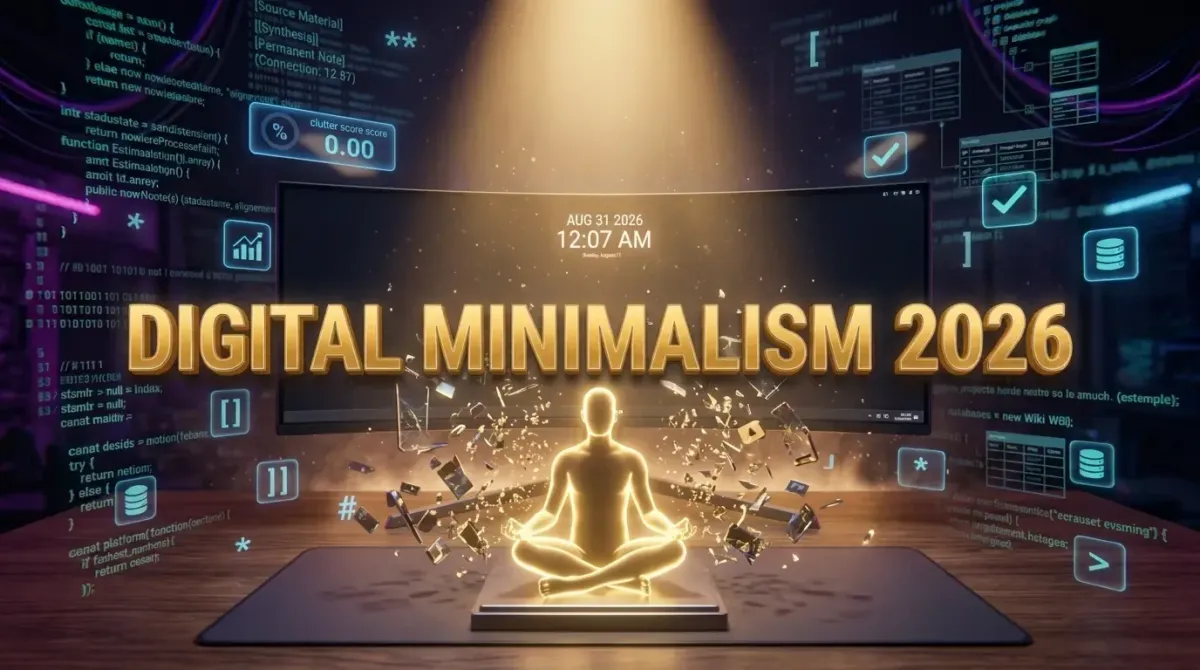
In an era where artificial intelligence can draft emails, write code, and analyze data in seconds, the modern professional is facing a paradox of unprecedented productivity tools and catastrophic attention fragmentation. Digital minimalism is no longer just a lifestyle choice for tech skeptics; it is a critical, high performance cognitive strategy required to survive the 2026 attention economy. By ruthlessly eliminating low value digital noise, optimizing your hardware and software environments for zero friction, and leveraging AI to automate shallow tasks rather than generate more distractions, you can reclaim the contiguous blocks of time necessary for deep, meaningful work. This comprehensive guide details the neuroscience of attention, the exact technical workflows for executing a digital declutter, and the hardware configurations required to build a frictionless, distraction proof sanctuary for peak cognitive output.
The Neuroscience of Attention Residue and Cognitive Load
Direct Answer: Digital minimalism unlocks peak focus by systematically eliminating low value digital noise, reducing cognitive load, and protecting your dopamine baseline from algorithmic hijacking. By implementing strict notification boundaries, adopting local first software architectures, and utilizing AI to automate shallow tasks, professionals can reclaim contiguous blocks of time required for deep, uninterrupted cognitive work.
To understand why digital minimalism is the ultimate lever for productivity, we must first examine the biological mechanics of human attention. The human brain is not designed to process the relentless, high frequency stimuli generated by modern social media algorithms, infinite scroll interfaces, and real time messaging platforms. When you shift your focus from a complex coding task to a fleeting Slack notification, you incur a severe cognitive penalty known as attention residue. Coined by business professor Sophie Leroy, attention residue occurs when a portion of your cognitive processing remains stuck on the previous task, severely degrading your performance on the new task.
In 2026, the cost of this context switching is magnified by the sheer volume of AI generated content flooding our feeds. Every time you check a news aggregator or a social platform, you are subjecting your brain to a dopamine spike followed by a sharp crash. This chronic fluctuation damages your dopamine baseline, making the slow, rewarding burn of deep work feel physically uncomfortable and boring. Digital minimalism acts as a neurological reset. By stripping away the super normal stimuli of the digital world, you allow your dopamine receptors to recalibrate. Over time, the deep, sustained focus required to master complex skills or solve intricate architectural problems becomes naturally rewarding again.
Furthermore, minimizing your digital environment reduces your overall cognitive load. Every open tab, every unread email badge, and every background application consumes a fraction of your working memory. By adopting a minimalist approach to your digital life, you free up massive amounts of mental bandwidth. For tech leaders and developers trying to scale their own effectiveness, exploring 10 productivity frameworks that actually work for tech founders reveals how digital minimalism serves as the foundational layer upon which all other advanced operational strategies are built.
Step by Step Guide to Executing a Digital Declutter
Transitioning to a minimalist digital lifestyle requires a systematic, uncompromising approach. You cannot simply rely on willpower to ignore notifications; you must architect your digital environment to make distraction impossible and focus inevitable. The following workflow will guide you through a comprehensive digital declutter.
Phase 1: The 30 Day Digital Audit
Before you delete anything, you must understand the true cost of your current digital habits. For the next 30 days, track every single minute spent on non essential digital activities. Use built in operating system tools or dedicated tracking software to log your screen time. Categorize your usage into three buckets: Deep Work, Shallow Work, and Pure Distraction. The data is often shocking. Most professionals discover they are losing up to four hours a day to pure distraction, fragmenting their attention before they even begin their core tasks.
Phase 2: The Ruthless Elimination Protocol
Once the audit is complete, it is time to purge. Delete all social media applications from your mobile devices. If a platform does not directly contribute to your income, your core learning, or your immediate personal relationships, it must go. Unsubscribe from every newsletter that you have not read in the last 30 days. Turn off all non human notifications. Your phone should only buzz or light up when a real human being is trying to contact you directly via call or text. No news alerts, no promotional emails, no game reminders.
Phase 3: Rebuilding with Intention
Minimalism is not about living in a digital cave; it is about being intentional with the tools you choose to keep. After the 30 day purge, you may reintroduce tools that provide massive value, but only under strict conditions. If you bring back a social media app, it must be restricted to desktop use only, and you must schedule a specific 20 minute window to check it. If you use a news aggregator, it must be accessed via an RSS reader that strips away algorithmic recommendations and clickbait headlines. Implementing managing digital wellbeing best apps to control screen time ensures that these boundaries are enforced at the operating system level, removing the need for constant willpower.
Designing a Frictionless Minimalist Tech Stack
Your software and hardware environments must reflect your minimalist philosophy. A cluttered desktop, a browser with fifty open tabs, and a chaotic file system are the digital equivalents of a hoarder's house. They induce anxiety and destroy focus. Designing a frictionless tech stack means creating an environment where the path of least resistance leads directly to deep work.
Operating System and Browser Minimalism
Your operating system should be configured to get out of your way. Disable all visual animations, hide the dock or taskbar when not in use, and rely entirely on keyboard driven navigation. For Mac users, mastering mastering macOS Sequoia 10 hidden productivity hacks for power users allows you to strip away the default visual bloat and create a lightning fast, distraction free environment that responds to your thoughts rather than your mouse clicks.
The web browser is traditionally the biggest source of digital clutter. To combat this, transition to a minimalist, AI native browser that enforces strict tab management and blocks intrusive elements by default. Learning how to build a frictionless workflow using Arc Browser and Raycast provides the exact blueprint for creating isolated workspaces, automating tab archiving, and launching applications without ever touching your trackpad, keeping your hands on the keyboard and your mind in a state of flow.
Hardware Optimization for Cognitive Endurance
Physical hardware plays a massive role in sustaining long focus sessions. Your equipment should never be a source of friction, fatigue, or visual noise. A cluttered desk with tangled cables and multiple mismatched monitors creates subconscious visual stress. Opt for a single, high resolution ultrawide monitor mounted on an articulating arm to reclaim desk space and maintain perfect ergonomic alignment. Knowing how to choose a monitor for deep work resolution refresh rate and eye safety is critical when you are spending hours reading dense documentation or writing code, as visual fatigue is a primary trigger for breaking your focus state.
Similarly, your input devices must be optimized for long sessions. A high quality, wireless mechanical keyboard with tactile but quiet switches provides the sensory feedback necessary to maintain a rhythmic typing flow without disturbing others. Understanding how to select the perfect mechanical keyboard for long coding sessions ensures that your physical interaction with your machine is satisfying, reducing the subtle physical friction that can pull you out of a deep work state.
Integrating AI Without Destroying Focus
Artificial intelligence is the ultimate double edged sword for digital minimalists. On one hand, AI can automate the shallow, repetitive tasks that clutter your schedule, freeing up hours for deep work. On the other hand, the endless generation of AI content, the temptation to constantly chat with bots, and the influx of AI generated emails can create a new layer of digital noise. The key is to use AI as a shield that protects your focus, rather than a sword that fractures it.
Using AI to Automate the Shallow
Before you sit down for a deep work block, you must clear your mental RAM of all pending shallow tasks. This is where AI excels. You can use AI scheduling assistants to negotiate meeting times, AI email drafters to summarize and respond to routine communications, and AI data processors to organize your research materials. By offloading these tasks to automated systems, you enter your deep work block with a completely clear mind. Utilizing top 5 AI tools to automate your daily repetitive tasks ensures that your shallow work is handled in minutes, leaving the vast majority of your day untouched and available for high leverage cognitive efforts.
Prompting AI for Brevity and Precision
When you do interact with AI during your work, the way you communicate with it dictates the level of distraction it causes. Long, meandering conversations with large language models are a form of digital procrastination. You must train yourself to use AI with extreme precision. Learning the art of prompt engineering how to talk to AI in 2026 allows you to extract exactly the information you need in a single, highly structured prompt, rather than engaging in a ten minute back and forth dialogue that fragments your attention and pulls you out of your primary task.
Tool Comparison: Digital Wellbeing and Focus Apps
To maintain a minimalist digital lifestyle, you need tools that enforce your boundaries when your willpower inevitably falters. The following table compares the leading applications designed to block distractions, monitor screen time, and enforce deep work sessions in 2026.
| Application | Core Functionality | Enforcement Level | Platform Support | Estimated Cost |
|---|---|---|---|---|
| Cold Turkey | Hard blocking of websites and applications | Extreme (Cannot be bypassed once started) | Windows, macOS | Approximately 40 USD one time purchase |
| Opal | Mobile app blocking and screen time analytics | High (System level blocking on iOS and Android) | iOS, Android, macOS | Approximately 8 USD monthly |
| Freedom | Cross device website and app blocking | Medium (Locked mode available) | All major platforms | Approximately 10 USD monthly |
| One Sec | Forces a deep breath before opening distracting apps | Behavioral (Interrupts the dopamine loop) | iOS, Android, macOS, browsers | Approximately 35 USD annually |
For professionals who struggle with the compulsive urge to check their phones, the behavioral interruption provided by One Sec is often more effective than a hard block. By forcing a ten second delay and a deep breath before opening a social media app, it breaks the unconscious habit loop, allowing your prefrontal cortex to regain control and choose whether to actually open the app or return to work.
Real World Workflows for Developers and Creators
Digital minimalism looks different depending on your profession. For software engineers, data scientists, and digital creators, the challenge is maintaining a minimalist environment while still having access to the complex tools required for their craft. The solution lies in strict environment separation and local first architectures.
The Developer Deep Work Environment
For developers, the terminal and the code editor are the only things that should exist during a deep work block. This means closing Slack, muting Discord, and shutting down all web browsers. If you need to reference documentation, use a local first knowledge base that allows you to search your saved notes and offline documentation without opening a browser and falling down a rabbit hole of unrelated tabs. Setting up how to set up a local first AI knowledge base with Obsidian and Smart Connections ensures that your reference materials are instantly searchable, completely offline, and free from the distracting pull of the open internet.
Furthermore, developers must protect their data and their focus from cloud based telemetry. By keeping your projects, notes, and AI models local to your machine, you eliminate the latency of cloud syncing and the anxiety of data privacy concerns. Understanding why 2026 is the year of total data sovereignty taking back your digital footprint highlights the psychological peace of mind that comes from knowing your intellectual property and personal workflows are entirely contained within your physical hardware.
The Creator Focus Protocol
For content creators, writers, and designers, the primary enemy of focus is the temptation to constantly check analytics, read comments, or tweak the formatting of a work in progress. A minimalist creator workflow mandates that the creation phase and the distribution phase are completely separated. When you are writing or designing, your device must be in airplane mode or connected to a network that blocks all social media and analytics dashboards. You create in a vacuum. Only when the work is completely finished do you reconnect to the digital world to publish, engage, and analyze. This separation prevents the emotional volatility of audience feedback from infecting the delicate process of creative generation.
Overcoming the Withdrawal Phase and Rebuilding Dopamine Baselines
When you first implement digital minimalism, you will not immediately feel a sense of peace and clarity. You will feel bored, anxious, and phantom vibrations in your pocket. This is the withdrawal phase. Your brain, accustomed to the high frequency dopamine hits of modern technology, is essentially going through a chemical detox. Understanding and preparing for this phase is critical to long term success.
Embracing Productive Boredom
The first rule of overcoming the withdrawal phase is to stop running from boredom. When you finish a task and feel the urge to immediately pick up your phone, you must resist. Sit in the boredom. Stare at a wall. Take a walk without listening to a podcast or music. Boredom is not a negative state to be avoided; it is the crucible in which deep creativity and problem solving are forged. When your brain is deprived of external stimulation, it activates the Default Mode Network, which is responsible for connecting disparate ideas, generating novel insights, and consolidating complex information.
Physical Anchors for Mental Focus
To help your brain transition away from digital stimulation, introduce physical anchors into your daily routine. Engage in activities that require manual dexterity and physical presence but low cognitive load. Cooking, woodworking, gardening, or even simply doing the dishes by hand can provide a sensory grounding that helps reset your nervous system. These physical activities satisfy the brain's need for engagement without triggering the dopamine spikes associated with screens. Additionally, ensuring your physical health is optimized is crucial. Monitoring your overall wellness and maximizing battery life on your smartphone proven AI optimized tips ensures that your portable devices do not become a source of anxiety when you are trying to disconnect and recharge your own biological battery.
Future Trends: Neuroadaptive Environments and Biometric Focus Tracking
As we look toward the latter half of the decade, the tools and techniques surrounding digital minimalism and focus will become deeply integrated with our biological feedback loops. The future of focus is not just about blocking distractions; it is about creating environments that actively adapt to your cognitive state.
Biometric Feedback and Adaptive Workspaces
Wearable technology is advancing beyond simple step counting. Future minimalist setups will utilize non invasive biometric sensors to monitor your cognitive load, heart rate variability, and eye tracking data in real time. When the system detects that your attention is fracturing or your cognitive fatigue is peaking, it will automatically adjust your environment. It might dim the lights, alter the ambient soundscape, or automatically pause incoming communications until your biometric markers indicate you are ready to resume. This creates a truly frictionless workflow where the technology serves your biological needs rather than exploiting them.
The Rise of Local AI Focus Agents
Instead of relying on cloud based services to track your habits, the future of digital minimalism will be powered by local AI agents that run entirely on your device's Neural Processing Unit. These agents will monitor your application usage, your typing cadence, and your calendar, acting as a silent, private gatekeeper. They will automatically draft polite decline messages to meeting requests that threaten your deep work blocks, summarize your communications so you only see the absolute essentials, and gently nudge you away from distracting websites based on your personal productivity goals, all without ever sending a single byte of data to the cloud.
Securing Your Minimalist Environment
A minimalist digital environment is highly concentrated. Because you are storing your most valuable thoughts, code, and workflows in a streamlined, local first architecture, the security of that environment becomes paramount. You cannot afford to have your focus shattered by a security breach or a compromised account.
Implementing robust security measures ensures that your digital sanctuary remains impenetrable. This means utilizing hardware security keys for all critical accounts, enforcing strict password policies, and ensuring that your local devices are encrypted. Following the ultimate guide to using two factor authentication safely guarantees that your minimalist setup is not only free from distractions but also fortified against the increasingly sophisticated cyber threats of 2026. True peace of mind requires knowing that your digital life is both quiet and secure.
Conclusion
Digital minimalism is the ultimate competitive advantage in the modern economy. As artificial intelligence continues to automate the shallow, repetitive tasks that once consumed our days, the only remaining source of unique human value is the ability to engage in deep, complex, and creative thought. However, this ability is under constant assault by an attention economy designed to fragment our focus and hijack our dopamine systems.
By embracing digital minimalism, you are not merely decluttering your desktop or deleting a few apps. You are taking a fundamental stand for your cognitive sovereignty. You are rebuilding your dopamine baseline, eliminating the crippling effects of attention residue, and architecting a physical and digital environment that makes deep work the path of least resistance. The transition will be uncomfortable, and the withdrawal from constant digital stimulation will test your resolve. But on the other side of that discomfort lies a level of focus, clarity, and productivity that the distracted majority will never experience. Protect your attention, curate your digital inputs, and reclaim your mind.