Future Trends: What to Expect from Machine Learning in the Next 5 Years (2026-2031)
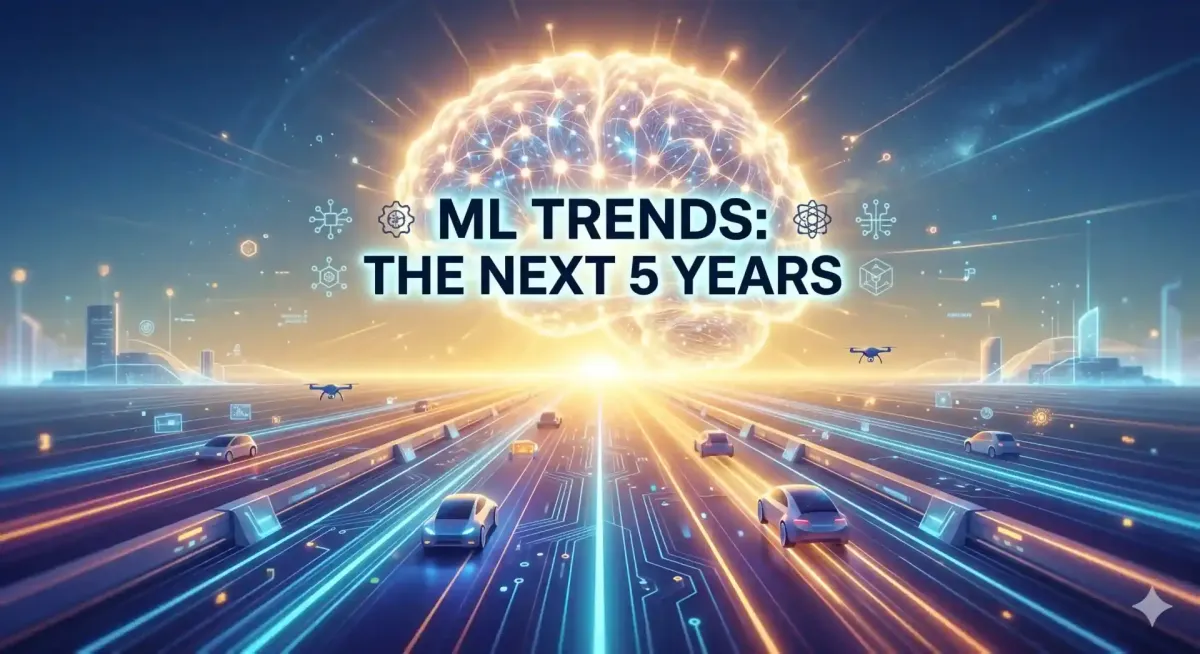
By 2026, Machine Learning (ML) has already woven itself into the fabric of daily life—from personalizing our shopping to diagnosing diseases. However, we are only at the foothills of what is possible. The next five years (2026–2031) will represent a period of "Exponential Maturity," where ML transitions from a tool we *use* to an environment we *inhabit*. At TipsForAITech, we are tracking the critical shifts that will redefine humanity’s relationship with silicon.
This 1500+ word forecast explores the technological landscape of the near future. Whether you are learning the fundamentals of ML or building AI-native applications, these trends will dictate your strategy for the next half-decade.
1. The Transition from LLMs to LAMs (Large Action Models)
By 2028, the era of Large Language Models (LLMs) will have evolved into the era of Large Action Models (LAMs). While today's AI can write about tasks, the next generation will autonomously execute them across complex, multi-step environments. We will see AI agents that don't just suggest a travel itinerary but actually book flights, negotiate refunds, and handle visa applications without human intervention.
As we noted in 10 ways AI is transforming technology, the move toward "Agency" is the most significant leap since the invention of the neural network.
2. Quantum Machine Learning (QML): The Infinite Speed-Up
By 2030, the integration of Quantum Computing and Machine Learning will move from research labs to industrial applications. Quantum Machine Learning will solve optimization problems that are currently impossible for classical computers—such as simulating complex molecular structures for new materials or optimizing global logistics in real-time. This will trigger a secondary "Big Bang" in modern research capabilities.
3. The Emergence of "Small Data" and On-Device Intelligence
The trend of "Bigger is Better" in model training will hit a plateau. Between 2026 and 2031, the focus will shift to Efficient Learning. We will see highly capable "Small Language Models" that run entirely on Edge AI—your phone, your watch, or even smart clothing—without needing a cloud connection. This Local-First AI will provide total privacy and zero-latency interactions, a major evolution for Advanced NLP Voice Assistants.
4. Multi-Modal Sensory Fusion
Machine Learning will move beyond text, image, and voice. By 2029, models will incorporate Haptic, Olfactory, and Bio-Sensing Data. AI will be able to "smell" chemical leaks, "feel" structural weaknesses in bridges through vibration sensors, and monitor human emotional states through biometric feedback in virtual office environments.
5. The Road to AGI: Reasoning and Logic
The next five years will see AI moving from "Probabilistic Guessing" to "Deterministic Reasoning." We are moving toward Artificial General Intelligence (AGI) foundations where models can perform long-horizon planning and self-correction. By 2031, ML systems will be able to explain their logic in a way that is verifiable, solving the "Black Box" problem that currently limits AI in legal and high-stakes financial sectors.
6. Hyper-Personalized Education: The AI Tutor for Life
Education will be completely disrupted. Every child born in the late 2020s will likely have a "Lifelong AI Tutor" that grows with them, understanding their specific learning style, strengths, and weaknesses. This tutor will curate generative educational content in real-time, making the concept of a "standardized curriculum" a relic of the past.
7. Autonomous Sustainability and Climate Modeling
Machine Learning will become our primary weapon against climate change. In the next five years, autonomous ML grids will manage renewable energy distribution with 99.9% efficiency. We will see Digital Twins of the Earth that can predict the impact of specific environmental policies with pinpoint accuracy, allowing for data-driven global climate management.
8. The Democratization of Complex Engineering
With advanced AI-assisted coding and generative design, the barrier to creating complex software and hardware will vanish. By 2031, a single individual will be able to design, simulate, and launch a satellite or a complex web platform using natural language commands, as AI handles the underlying engineering and compliance protocols.
9. Ethical Governance and AI Bill of Rights
As ML becomes more autonomous, the next five years will see the rise of Algorithmic Law. We will transition from "guidelines" to "hardcoded ethics" where ML models are legally required to have transparency and "Right to Explain" features. This will be critical for maintaining trust as AI begins to manage more of our global data infrastructure.
10. Conclusion: From Tool to Teammate
The next five years will be the most transformative in the history of computing. Machine Learning is evolving from a software feature into a sentient-like teammate that understands our world as deeply as we do. For those who prepare by staying at the edge of these trends, the future is not something to be feared, but a canvas to be painted on.
At TipsForAITech, we are committed to being your guide through this rapid evolution. Whether you are interested in automation, communication, or productivity, we will provide the insights you need to thrive in the 2030s and beyond.