
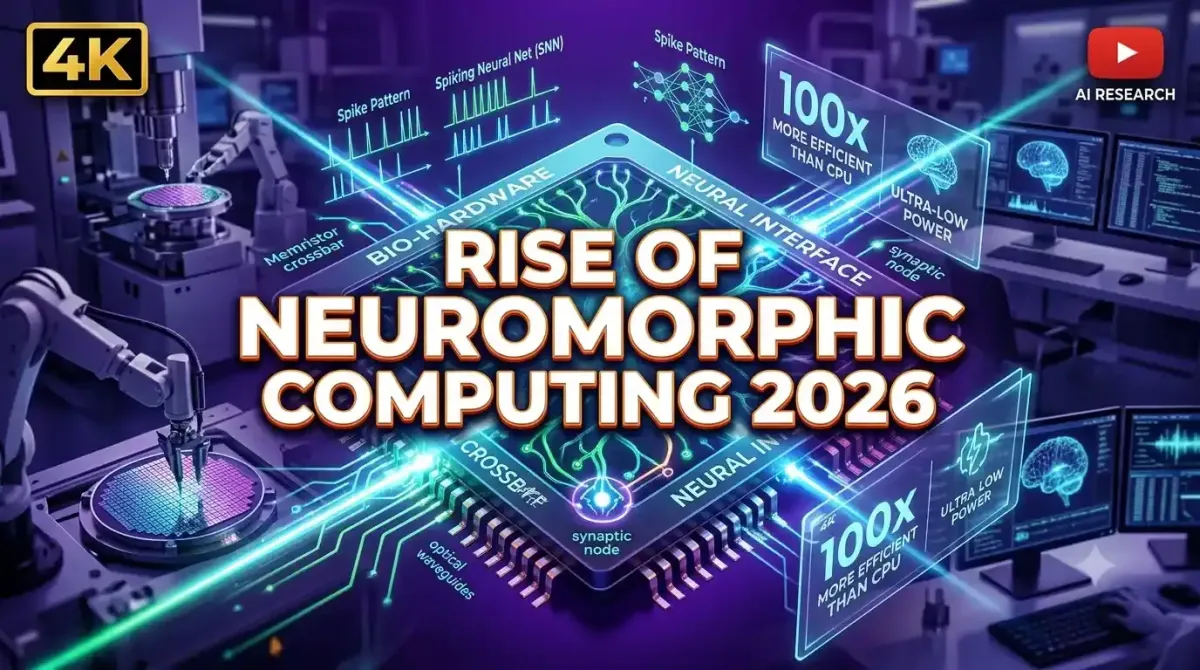
The Rise of Neuromorphic Computing: Efficiency Research Beyond Silicon Chips
The artificial intelligence revolution of the 2020s was built on the back of brute-force silicon. By stacking billions of transistors onto traditional von Neumann architectures, researchers achieved unprecedented leaps in generative AI, computer vision, and natural language processing. However, as we navigate the second half of 2026, the industry is colliding with a harsh physical and economic reality: the AI energy crisis. Training and running massive neural networks on traditional GPUs consumes gigawatts of electricity, generating immense heat and requiring massive cooling infrastructure. To achieve true Artificial General Intelligence (AGI) and deploy ubiquitous edge AI, the fundamental architecture of computing must change. Enter Neuromorphic Computing. Inspired directly by the biological structure of the human brain, neuromorphic hardware abandons the traditional separation of memory and processing. By utilizing memristors, spiking neural networks (SNNs), and even photonic (light-based) pathways, these brain-inspired chips are achieving computational efficiencies that traditional silicon simply cannot match. This comprehensive technical guide explores the cutting-edge research defining neuromorphic computing in 2026, the mechanics of event-driven processing, and how this paradigm shift is poised to solve the most critical bottlenecks in modern machine learning.
The Von Neumann Bottleneck: Why Traditional Silicon is Hitting a Wall
To understand the necessity of neuromorphic computing, one must first understand the limitations of the architecture that has dominated computing for the last 70 years: the von Neumann architecture. In a traditional CPU or GPU, the processing unit and the memory (RAM) are physically separated. Data must constantly travel back and forth across a bus between memory and the processor.
In the era of deep learning, this creates the infamous "Memory Wall" or "Von Neumann Bottleneck." Moving data requires significantly more energy and time than actually performing the mathematical computation. When training a billion-parameter model, as detailed in our analysis of the role of GPUs in speeding up AI model training, the GPU spends a massive portion of its time and energy simply fetching weights from memory rather than computing. Furthermore, traditional silicon operates on continuous clock cycles, meaning the processor is constantly drawing power and generating heat, even when idle or waiting for data. The human brain, by contrast, operates on roughly 20 watts of power—equivalent to a dim lightbulb—while performing complex, multi-modal reasoning that requires megawatts of power in a modern data center. Neuromorphic engineering seeks to close this gap by mimicking the brain's physical structure.
Core Technologies: The Building Blocks of Brain-Inspired Hardware
Neuromorphic computing is not a single technology, but a convergence of several advanced materials science and architectural breakthroughs that allow hardware to behave like biological tissue.
1. Memristors and In-Memory Computing
The most critical hardware innovation in neuromorphic computing is the memristor (memory resistor). Unlike traditional transistors that are strictly binary (on or off), a memristor's electrical resistance changes based on the history of the voltage applied to it. It "remembers" its state even when power is removed. In a neuromorphic chip, memristors are arranged in crossbar arrays that physically mimic biological synapses. Because the computation (matrix multiplication) happens exactly where the data is stored (in the memristor array itself), the von Neumann bottleneck is entirely eliminated. This "in-memory computing" allows for massive parallel processing with a fraction of the energy required to move data across a traditional bus.
2. Spiking Neural Networks (SNNs)
Traditional artificial neural networks (ANNs) process continuous, dense values (floating-point numbers) at every single layer during every clock cycle. SNNs, the software counterpart to neuromorphic hardware, operate differently. They use discrete "spikes" or events. A neuron in an SNN remains completely dormant until it receives enough input stimuli to cross a specific threshold. Once the threshold is crossed, it fires a spike to the next layer and then resets. This event-driven nature means that if a specific part of the network is not needed for a given input, it consumes zero energy. For a broader understanding of how these continuous-time, biologically plausible networks function, exploring understanding liquid neural networks the next frontier in brain inspired AI highlights the broader ecosystem of brain-inspired algorithms that complement SNNs.
3. Photonic and Optical Computing
Pushing beyond traditional electron-based silicon, 2026 has seen the maturation of photonic neuromorphic chips. By using photons (light) instead of electrons to transmit data and perform matrix multiplications via Mach-Zehnder interferometers, these chips operate at the speed of light with virtually zero heat generation and minimal energy loss. Photonic neuromorphic processors are currently being deployed in high-frequency trading and massive-scale data center routing, where latency and thermal limits are the primary constraints.
Event-Driven Processing: The Secret to Extreme Efficiency
The defining characteristic of neuromorphic hardware is asynchronous, event-driven processing. In a traditional GPU, the entire chip is synchronized to a global clock. Even if only one pixel in an image changes, the entire vision pipeline might be triggered to re-evaluate the scene.
Neuromorphic sensors and processors, such as Dynamic Vision Sensors (DVS) or "silicon retinas," mimic the human optic nerve. They do not capture frames at a fixed framerate (e.g., 60fps). Instead, each individual pixel operates independently and only outputs a signal when it detects a change in brightness. If a robot is navigating a static room, the visual cortex of the neuromorphic chip consumes almost no power. The moment a human walks into the room, only the pixels corresponding to the human's movement fire spikes, instantly alerting the processing cores. This sparse, asynchronous communication is why neuromorphic chips can achieve up to a 1000x reduction in power consumption compared to traditional vision pipelines.
Real-World Applications of Neuromorphic Hardware in 2026
While traditional GPUs and NPUs dominate cloud data centers and consumer laptops, neuromorphic chips have carved out a massive,不可替代 (irreplaceable) niche in environments where power, weight, and latency are strictly constrained.
Edge AI and Always-On IoT
When evaluating mobile hardware, consumers often look at Neural Processing Units (NPUs). However, as detailed in the ultimate laptop buying guide 2026 choosing between NPU powered AI PCs, NPUs are still largely von Neumann architectures optimized for matrix math. True neuromorphic chips are moving into the ultra-edge: smart home sensors, wearable health monitors, and industrial IoT devices that must run AI models for years on a single coin-cell battery. Because an SNN only draws power when a physical event occurs (like a specific sound or motion), neuromorphic chips enable "always-listening" and "always-watching" devices without the need for constant cloud connectivity or frequent battery replacements.
Autonomous Robotics and Bipedal Locomotion
The physical dexterity required for next-generation robotics demands millisecond latency and extreme energy efficiency. A humanoid robot cannot afford the thermal output or latency of a cloud-connected GPU when balancing on one foot. Neuromorphic chips are being integrated directly into the motor controllers of robotic limbs, processing proprioceptive sensor data via SNNs to generate real-time reflex adjustments. This localized, brain-like processing is a core enabler of the rise of humanoid robots how they will impact the workforce, allowing machines to operate safely and dynamically alongside humans in unstructured environments.
Space Exploration and Deep Edge Environments
In deep space, the latency of communicating with Earth makes real-time cloud AI impossible, and the radiation environment can cause bit-flips in traditional silicon memory. Neuromorphic hardware, particularly radiation-hardened memristor arrays, is being deployed on deep-space probes and Mars rovers. By utilizing event-driven processing, these probes can autonomously identify scientific anomalies (like a rare geological formation) and only wake up high-power communication arrays to transmit the data, conserving precious spacecraft power. This autonomous efficiency is a critical component of nasas next big leap how ai is assisting the mars missions.
Neuromorphic vs. Traditional AI Hardware: A Technical Comparison
Understanding where neuromorphic computing fits requires a direct comparison with the dominant paradigms of 2026.
| Feature | Traditional GPUs / NPUs | Neuromorphic Hardware (SNNs) | Photonic Neuromorphic |
|---|---|---|---|
| Architecture | Von Neumann (Separated Memory/Compute) | Colocated (In-Memory Computing) | Optical Interferometry |
| Processing Style | Synchronous (Clock-driven) | Asynchronous (Event-driven) | Continuous / Analog |
| Power Consumption | High (Watts to Kilowatts) | Ultra-Low (Milliwatts to Microwatts) | Near-Zero (Thermal limits) |
| Latency | Microseconds | Nanoseconds (Event response) | Speed of Light |
| Best Use Case | LLM Training, Batch Processing | Edge AI, Robotics, IoT Sensors | Datacenter Routing, HFT |
| Data Representation | Dense Floating Point (FP16/FP8) | Sparse Binary Spikes | Light Phase/Amplitude |
The Software Challenge: Bridging the Gap
The hardware of neuromorphic computing is advancing rapidly, but the software ecosystem has historically lagged. Traditional deep learning relies heavily on backpropagation and gradient descent—mathematical frameworks that require continuous, differentiable functions. SNNs, which rely on discrete, binary spikes, are notoriously difficult to train using standard backpropagation because the spike function is non-differentiable.
In 2026, researchers have made massive strides in overcoming this via "Surrogate Gradient" methods and specialized neuromorphic software frameworks like Intel's Lava and IBM's NorthPole SDK. Furthermore, the industry is shifting toward alternative learning paradigms. Because SNNs excel at temporal data and unsupervised pattern recognition, they align perfectly with understanding the basics of supervised vs unsupervised learning, allowing neuromorphic chips to learn environmental patterns continuously without the need for massive, human-labeled datasets. This continuous, on-device learning capability is vital for maintaining privacy and adaptability in edge deployments.
Convergence: Neuromorphic, Liquid, and Quantum Paradigms
Neuromorphic computing does not exist in a vacuum; it is part of a broader rebellion against the limits of traditional silicon. In late 2026, we are seeing the convergence of multiple beyond-silicon paradigms.
For instance, the integration of Liquid Neural Networks (which utilize continuous-time differential equations) onto memristive neuromorphic hardware is creating a new class of "analog AI" that is incredibly robust to noise and sensor degradation. Meanwhile, as researchers map the path to AGI leading research breakthroughs expected in late 2026, it is becoming clear that AGI will not run on a single type of hardware. The future architecture of general intelligence will likely be a heterogeneous system: a massive, cloud-based Transformer for high-level symbolic reasoning and planning, paired with localized, neuromorphic SNNs for real-time sensory processing, motor control, and continuous environmental adaptation.
Furthermore, while quantum computing operates on entirely different physical principles (superposition and entanglement), the software frameworks being developed to map quantum states are beginning to intersect with the sparse, graph-based routing of neuromorphic SNNs. For a deeper look at how these alternative physics-based compute methods are evolving, see the future of artificial intelligence powered by quantum tech.
The Sustainability Imperative: AI's Environmental Ethics
Beyond raw performance, neuromorphic computing is becoming a moral and environmental imperative. The carbon footprint of training a single frontier LLM in 2024 was equivalent to dozens of transatlantic flights. As AI models grow larger and are deployed to billions of edge devices, the energy demand threatens to outstrip global power grid capacities.
Neuromorphic hardware offers a path to sustainable AI. By reducing the energy cost of inference by orders of magnitude, memristor and photonic chips allow us to deploy intelligent systems without catastrophic environmental consequences. This shift from brute-force compute to elegant, biologically-inspired efficiency is a central theme in the ethics of AI in 2026 why neutrality is no longer enough, proving that the hardware we choose to build has profound implications for the planet's future.
Overcoming the Remaining Hurdles
Despite the promise, neuromorphic computing faces significant commercialization hurdles. The manufacturing of memristors and photonic chips requires specialized foundries that are not yet as mature or cost-effective as TSMC's advanced CMOS nodes. Furthermore, the industry suffers from a fragmented ecosystem; a model trained on an Intel Loihi chip cannot be easily ported to an IBM TrueNorth or a custom photonic array without significant re-engineering.
To solve this, 2026 has seen the push for standardized neuromorphic APIs and cross-platform SNN compilers. As these software bridges mature, the barrier to entry for data scientists will lower, allowing the broader AI community to harness the power of event-driven processing without needing a PhD in solid-state physics.
Conclusion: The Biological Blueprint for the Future
The rise of neuromorphic computing represents a fundamental philosophical shift in computer science. For decades, we attempted to force the physical world into the rigid, binary, clock-driven boxes of the von Neumann architecture. We succeeded in building machines that can calculate faster than any human, but we failed to build machines that can perceive, adapt, and exist efficiently in the physical world. Neuromorphic computing corrects this by looking to the only existing proof-of-concept for general intelligence: the human brain.
By embracing memristors, spiking neural networks, and event-driven processing, researchers are unlocking a new era of AI hardware that is asynchronous, ultra-low power, and inherently adaptive. While traditional GPUs will continue to dominate the cloud-based training of massive language models, the physical interaction between AI and the real world—the robots, the sensors, the autonomous vehicles, and the edge devices—will be governed by neuromorphic silicon. In the race toward sustainable, ubiquitous, and truly general artificial intelligence, the future does not belong to the fastest clock speed; it belongs to the most efficient synapse.