The Impact of AI on Jobs: Ethical Strategies for Reskilling Workers in 2026
In 2026, the global workforce is undergoing its most profound shift since the Industrial Revolution. Artificial Intelligence is no longer just a tool for automation; it has become a collaborator in almost every professional field. While AI brings immense efficiency, it also presents a significant ethical challenge: how do we ensure that the rise of machines doesn't leave millions of humans behind? The focus has shifted from "Job Replacement" to "Job Transformation." At TipsForAITech, we are exploring the ethical strategies for Reskilling and Upskilling the workforce to thrive in an AI-powered era.
This 1500+ word comprehensive guide dives into the future of work. Whether you are following AI regulations or optimizing your productivity stack, the human element remains the most vital asset in 2026.
[Image showing a diverse group of professionals in a high-tech training center, using VR headsets and AI tablets to learn new technical skills]1. The Reality of 2026: Collaboration Over Replacement
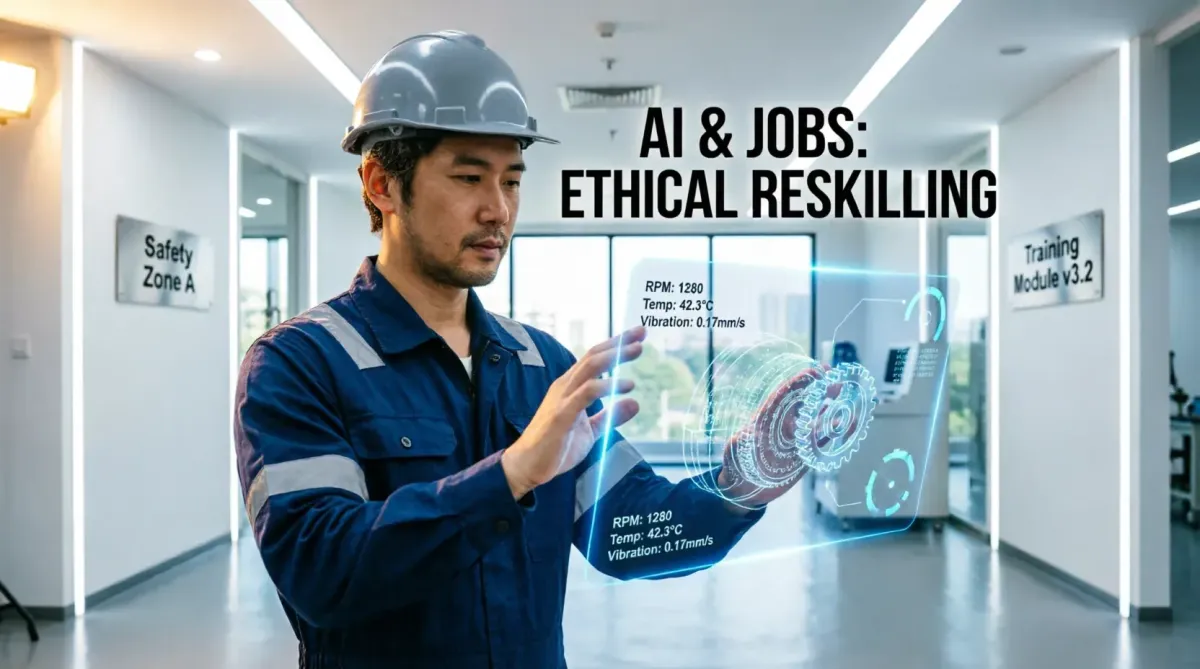
The fear of total job loss in 2026 has been replaced by the reality of Augmented Roles. Most jobs now involve managing an AI system rather than performing the manual task itself. This shift requires a foundational understanding of how machine learning works, turning administrative roles into data-oversight positions.
2. Ethical Reskilling: A Corporate Responsibility
In 2026, leading companies treat reskilling as a moral obligation. Instead of layoffs, ethical firms invest in "Internal Academies" to transition workers into new high-growth roles, such as AI Ethics Officers or Prompt Engineers. This proactive approach is a hallmark of safe and responsible AI governance.
3. Soft Skills: The "Human Premium"
As AI handles data and logic, human-centric skills like empathy, critical thinking, and complex negotiation have become more valuable than ever. In 2026, reskilling programs focus heavily on these "Soft Skills." Humans remain the ultimate decision-makers in disaster response and high-stakes missions where ethical nuance is required.
4. Personalized AI Tutors for Rapid Learning
How do you train thousands of workers quickly? In 2026, we use AI-Powered Tutoring Systems. These personalized platforms adapt to each worker's learning speed and style, making complex subjects like full-stack development or data analysis accessible to everyone, regardless of their background.
5. The Rise of the "Gig-Plus" Economy
In 2026, many workers use AI to manage multiple specialized freelance roles simultaneously. Reskilling strategies now include training in automation tools and financial management software, allowing individuals to operate as "Companies of One."
[Image showing a career transition path: From a traditional manual role to an AI-assisted specialist, highlighting the training milestones along the way]6. Universal Basic Income (UBI) and Retraining Grants
To support workers during their transition, many 2026 governments are piloting Retraining Grants. These ensure that workers have the financial security to focus on learning new skills without the immediate threat of poverty, a policy trend we monitor in our global policy reports.
7. Lifelong Learning as a Service (LLaaS)
In 2026, education is no longer a one-time event. It is a continuous, subscription-based service. Workers regularly update their "Skill Badges" to stay relevant in the fast-moving tech landscape, utilizing advanced AI assistants to summarize the latest industry trends.
8. Security: Protecting Employee Training Data
Personalized training generate massive amounts of behavioral data. In 2026, protecting this "Learning Profile" is critical. Companies use encrypted data pipelines and passkey-secured logins to ensure that an employee’s learning history remains private.
9. Using AI Writing Assistants for Career Coaching
Job seekers in 2026 use advanced writing assistants to optimize their resumes for AI-driven hiring systems and to draft cover letters that highlight their human value, ensuring maximum professional productivity.
10. Conclusion: Empowering the Human Spirit
The impact of AI on jobs in 2026 is a call to action for empathy and innovation. By adopting ethical reskilling strategies, we aren't just protecting livelihoods; we are empowering the human spirit to reach new heights of creativity and purpose. AI is a powerful wind in our sails, but humans must remain at the helm. As we navigate this transition together, the goal is not just to survive the age of AI, but to flourish within it. The future of work is not human vs. machine; it is human and machine, working toward a better world for all.
Stay at the forefront of the labor and AI revolution by following TipsForAITech. Whether you're looking for OS comparisons or development frameworks, we are your partner in the 2026 technology landscape.