
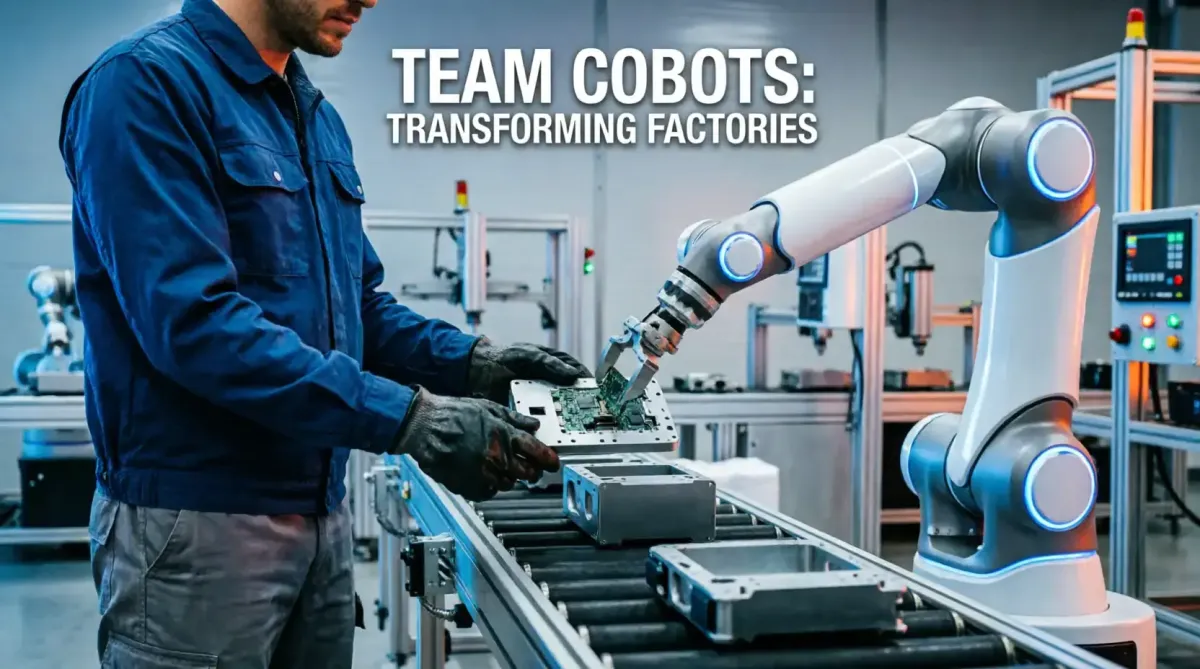
How Collaborative Robots (Cobots) are Transforming Small Factories in 2026
In 2026, the image of a factory filled with massive, caged robots is becoming a relic of the past—especially for small and medium-sized enterprises (SMEs). Enter the era of Collaborative Robots, or Cobots. Unlike their industrial predecessors, Cobots are designed to work safely alongside humans, acting as an extra pair of hands rather than a replacement. At TipsForAITech, we are exploring how these versatile machines are democratizing automation and allowing small factories to compete on a global scale.
This 1500+ word comprehensive guide dives into the Cobot revolution. Whether you are tracking humanoid robotics or monitoring smart agriculture, the rise of the Cobot is a defining story for 2026 manufacturing.
1. Defining the Cobot: Why They Are Different
In 2026, the primary differentiator for a Cobot is its Sensor-Driven Safety. Traditional robots are powerful but blind; a Cobot is self-aware. Equipped with high-fidelity proximity sensors and force-limited joints, a Cobot instantly stops if it touches a human. This eliminates the need for expensive safety fencing, making them ideal for the cramped floor plans of smaller workshops, a spatial efficiency we also see in modern domestic robotics.
2. Affordability and Rapid ROI for SMEs
Historically, automation was only for giants like Tesla or Ford. In 2026, the price of a mid-range Cobot has dropped significantly, often reaching parity with a standard used car. Combined with low installation costs and the Robots-as-a-Service (RaaS) model, small factories can achieve a Return on Investment (ROI) in as little as six months. This economic shift mirrors the automation of business accounting and costs.
3. Ease of Use: Programming via Demonstration
You don't need a PhD in robotics to program a Cobot in 2026. Most modern units feature Hand-Guiding or "Lead-Through Programming." A worker simply moves the robot arm manually to show it the task, and the AI records the motion. This ease of use is a direct result of the no-code/low-code revolution we see in software development.
4. Versatility: One Robot, Many Jobs
Small factories need to be agile. In 2026, a single Cobot might perform Pick-and-Place tasks in the morning, Screw-driving in the afternoon, and Quality Inspection in the evening. By swapping the "End-Effector" (the robot's hand), the machine adapts to the factory’s changing needs, much like how versatile frameworks adapt to different web projects.
5. AI Vision and Quality Control
Equipped with 2026-grade Computer Vision, Cobots can identify defects that are invisible to the human eye. They can count items, verify labels, and ensure that every product leaving the line meets professional standards. This ensures seamless data and quality management for small-scale manufacturers.
6. Improving Worker Ergonomics and Safety
Cobots excel at the "Dull, Dirty, and Dangerous" tasks. By taking over repetitive motions that cause strain injuries, Cobots improve the long-term health of the human workforce. In 2026, factory workers are transitioning from "Manual Laborers" to "Robot Supervisors," a shift supported by advanced scheduling and management tools.
7. The Role of 5G and Edge Computing
In 2026, small factories are increasingly "Smart." Cobots are connected via Private 5G Networks, allowing them to share data in real-time with the factory's AI-driven CRM and ERP systems. This connectivity ensures that any bottleneck is identified and solved instantly, often through autonomous debugging.
8. Security: Protecting the Connected Factory
A connected robot is a potential entry point for cyberattacks. Small factories in 2026 must implement Industrial Cybersecurity. This includes using open-source security tools to monitor traffic and ensuring that all robot firmware updates are verified via passkeys.
9. Using AI Writing Assistants for Documentation
Small factory owners now use advanced writing assistants to document their automated workflows and train new staff. This ensures that the knowledge of how to operate the Cobots is preserved and easily shared, maintaining maximum professional productivity.
10. Conclusion: The New Industrial Revolution
The transformation of small factories through Cobots in 2026 is a testament to the power of human-robot synergy. By removing the financial and technical barriers to automation, Cobots are allowing the "little guys" to innovate faster and produce higher-quality goods. The future of manufacturing is not a world without humans; it is a world where humans are empowered by intelligent machines to achieve the extraordinary. Small is the new big.
Stay at the forefront of the robotics and tech revolution by following TipsForAITech. Whether you're looking for OS comparisons or security tips, we are your partner in the 2026 technology landscape.