Transforming Sketches into Masterpieces: The Power of AI Art Tools in 2026
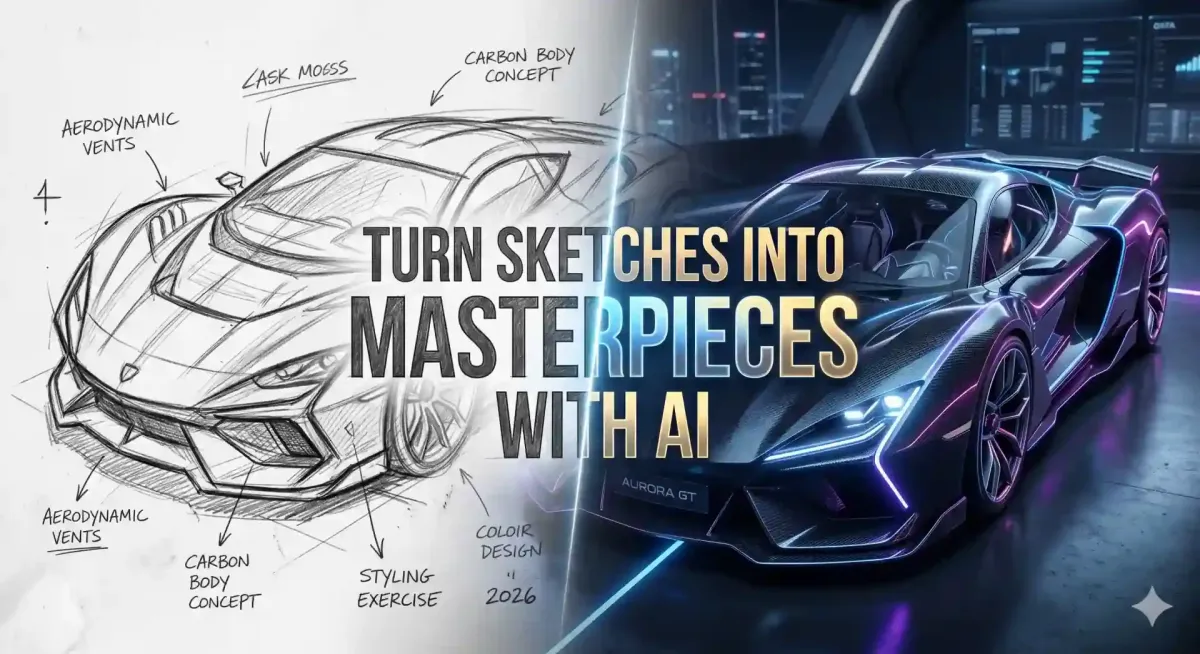
For centuries, the bridge between a rough sketch and a finished masterpiece required thousands of hours of manual labor, specialized skills, and expensive tools. In 2026, that bridge is built by Artificial Intelligence. We have entered an era where your initial charcoal doodle or digital napkin sketch can be transformed into a high-fidelity cinematic render in seconds. At TipsForAITech, we are seeing a revolution where "Creative Intent" matters more than "Technical Execution."
This 1500+ word deep dive explores how 2026’s AI art tools are turning sketches into professional-grade masterpieces. Whether you are creating high-quality marketing visuals or mastering the perfect prompt, understanding sketch-to-image technology is a game-changer for every creative professional.
1. The Evolution of Image-to-Image (Img2Img) Technology
In the early days of AI art, tools were mostly "text-to-image," leading to unpredictable results. By 2026, Image-to-Image (Img2Img) synthesis has become the industry standard. This allows the AI to use your sketch as a structural blueprint. The AI doesn't just guess what you want; it follows the lines, depth, and composition of your original drawing, ensuring that the final output retains your unique artistic vision.
As we discussed in 10 ways AI is transforming technology, this precision is what makes 2026 the year of "Professional AI Mastery."
2. ControlNet: The Secret Sauce of Precise Artistry
The real breakthrough in 2026 is the mainstream adoption of ControlNet models. These models allow artists to provide specific "Control Layers" to the AI.
- Canny Edge Detection: The AI traces every line of your sketch with 100% accuracy.
- Depth Mapping: It understands which parts of your sketch are in the foreground and which are in the distance.
- Pose Estimation: If you sketch a human figure, the AI understands the anatomy and ensures the final masterpiece has a realistic and consistent posture.
3. From Doodles to 3D: Luma and Midjourney Integration
In 2026, the transformation isn't limited to 2D. Using professional AI tools like Luma Dream Machine 3, you can take a 2D sketch of a character or a building and convert it into a fully textured 3D model. This "Sketch-to-Spatial" workflow is currently revolutionizing game development and architectural prototyping, allowing for rapid iteration that was previously impossible.
4. Enhancing Storyboarding and Concept Art
For filmmakers and game designers, AI sketch tools have replaced traditional storyboarding. Instead of spending weeks on refined boards, artists create quick "thumbnail sketches" and use AI to generate high-fidelity lighting and texture. This allows teams to "see" the final movie or game environment during the earliest stages of planning, saving millions in pre-production costs.
5. The Role of "Real-Time" AI Sketching
One of the most exciting developments in 2026 is Real-Time Latent Consistency. Tools like Krea.ai and Leonardo.ai now allow you to draw on one side of the screen while the AI generates a finished masterpiece on the other side in real-time. Every stroke of your brush instantly updates the AI’s interpretation, creating a truly collaborative dance between human and machine.
6. Maintaining Brand Consistency in Marketing
Marketers are using sketch-to-image tools to ensure their fast-paced social media content remains unique. Instead of using generic AI-generated images, brands sketch their specific product layouts and use AI to "skin" them with high-end textures and backgrounds. This ensures that the marketing visual is not just "pretty," but strategically aligned with the product's actual dimensions.
7. Ethical Creativity: Ownership of the "Blueprint"
As we emphasize at TipsForAITech, the use of a human sketch as the foundation of an AI piece provides a stronger legal and ethical claim to the work. In 2026, "Human-Initiated AI Art" is increasingly recognized as a unique category of intellectual property. Since the structural "soul" of the masterpiece comes from the human sketch, it bypasses many of the copyright concerns associated with purely prompt-based generation.
8. Upscaling Your Masterpiece for High-End Use
Once your sketch has been transformed, the next step is Generative Upscaling. Tools like Magnific AI in 2026 add "synthetic detail" to the image, such as skin pores, fabric weaves, or atmospheric dust, making the final masterpiece look like it was captured by a professional lens or painted by a classical master. This is essential for large-format prints and high-definition digital displays.
9. Integrating AI Art with Advanced Knowledge Systems
In 2026, your creative workflow is synced with your AI-powered note-taking apps. If you have a specific description of a character in your notes, the AI can read those notes and apply them as "Contextual Constraints" to your sketch, ensuring the final image matches your written lore exactly.
10. Conclusion: The New Renaissance of the Artist
The power of AI art tools to transform sketches into masterpieces hasn't made artists obsolete; it has made them more powerful. In 2026, the technical ability to render a shadow or paint a texture is a button click away. What remains irreplaceable is the **Vision**—the initial sketch, the creative spark, and the decision of which masterpiece truly speaks to the human soul.
Stay at the forefront of the AI art revolution by following TipsForAITech. Whether you're interested in generative content or advanced NLP applications, we are here to help you master the technology of 2026.