Quantum Machine Learning: How Quantum Computers are Training Models Faster
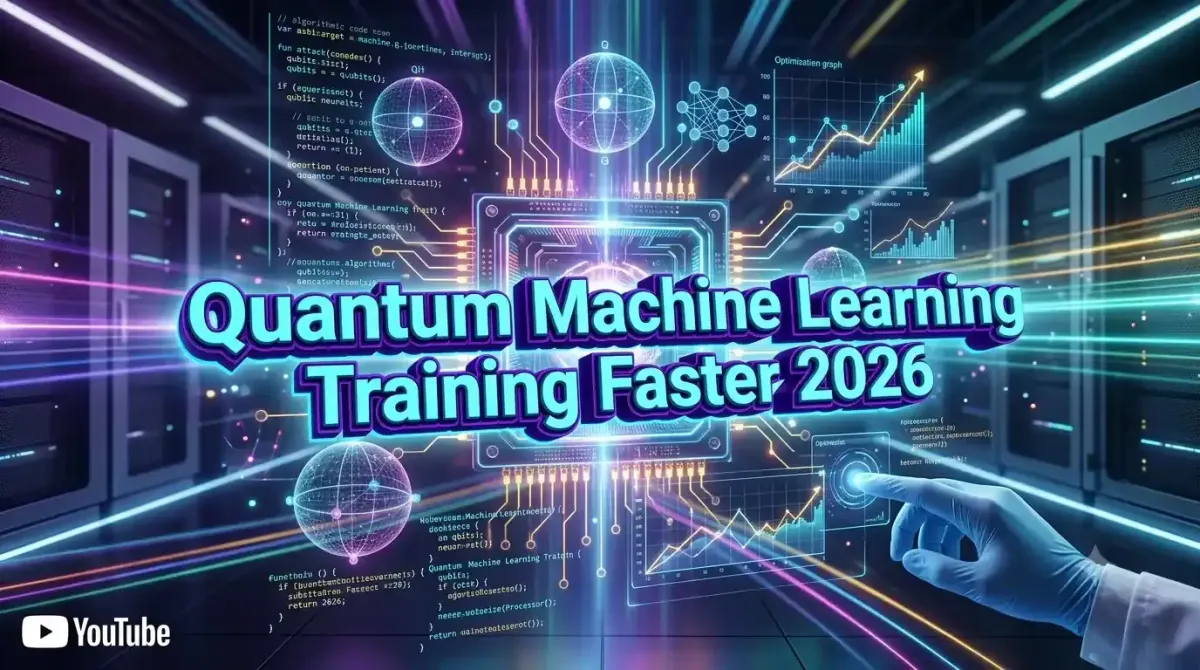
The intersection of quantum mechanics and artificial intelligence has birthed one of the most transformative fields in modern computer science: Quantum Machine Learning (QML). As we navigate the second half of 2026, the relentless scaling of classical neural networks is beginning to hit fundamental physical and economic walls. While traditional GPUs have driven the generative AI boom, they struggle to efficiently process the exponentially large, high-dimensional datasets required for next-generation scientific and financial models. Enter quantum computing. By leveraging the principles of superposition, entanglement, and quantum interference, quantum processors (QPUs) are uniquely positioned to traverse vast optimization landscapes and accelerate model training at speeds that classical hardware simply cannot match. This comprehensive technical guide explores the mechanics of QML, the algorithms driving the quantum advantage, the hybrid architectures dominating 2026, and the real-world industries already reaping the benefits of quantum-accelerated AI.
The Classical Wall: Why GPUs Are Hitting Their Limits
For the past decade, the training of deep learning models has been synonymous with massive clusters of Graphics Processing Units (GPUs). These chips excel at parallel matrix multiplications, making them the engine behind the large language model (LLM) revolution. However, as detailed in our analysis of the role of GPUs in speeding up AI model training, classical hardware operates on binary logic (bits) and deterministic memory architectures.
When machine learning tasks involve simulating molecular interactions, optimizing global supply chains with millions of variables, or mapping non-linear quantum states, classical computers face the "curse of dimensionality." The computational resources required to represent these states grow exponentially with each added variable. A classical computer must evaluate these possibilities sequentially or through limited parallelization. This bottleneck is not merely a hardware speed issue; it is a fundamental limitation of classical physics. To break through this wall, researchers turned to the very physics that governs the subatomic world.
The Quantum Advantage: Superposition, Entanglement, and Interference
Quantum Machine Learning does not just make classical algorithms faster; it fundamentally changes how data is represented and processed. QML relies on three core quantum mechanical phenomena:
- Superposition: Unlike a classical bit that is strictly a 0 or a 1, a quantum bit (qubit) can exist in a superposition of both states simultaneously. This allows a quantum computer to represent and process a vast, exponentially large solution space in a single computational step.
- Entanglement: Qubits can be entangled, meaning the state of one qubit is instantly correlated with the state of another, regardless of distance. In QML, entanglement is used to capture complex, non-linear correlations within high-dimensional datasets that classical neural networks struggle to map efficiently.
- Quantum Interference: Quantum algorithms use interference to amplify the probability of correct answers (constructive interference) while canceling out incorrect paths (destructive interference). This allows QML models to navigate massive optimization landscapes and converge on global minima much faster than classical gradient descent.
For a broader understanding of how this paradigm shift fits into the larger technological landscape, exploring the future of artificial intelligence powered by quantum tech provides essential context on the convergence of quantum hardware and AI software.
Core Quantum Machine Learning Algorithms
In 2026, QML is not a monolithic concept but a diverse toolkit of algorithms designed to solve specific computational bottlenecks. The most impactful algorithms driving faster model training include:
1. Variational Quantum Circuits (VQC) and Quantum Neural Networks (QNN)
Quantum Neural Networks are the quantum analog to classical deep learning. Instead of classical neurons and weights, QNNs use parameterized quantum circuits. The data is encoded into the quantum states of qubits, and a series of quantum gates (the "layers") manipulate these states. A classical optimizer then measures the output and adjusts the quantum gate parameters to minimize the loss function. Because the quantum circuit can evaluate complex, high-dimensional feature spaces natively, QNNs often require significantly fewer training epochs to converge than their classical counterparts.
2. Quantum Kernel Methods
Support Vector Machines (SVMs) rely on "kernel tricks" to map data into higher dimensions to find separating hyperplanes. Classical computers struggle to compute kernels for extremely complex, high-dimensional data. Quantum computers, however, naturally operate in Hilbert spaces of exponential dimensions. Quantum Kernel Estimation allows QML models to map data into these massive quantum feature spaces effortlessly, enabling the classification of highly complex datasets—such as genomic sequences or financial market anomalies—with unprecedented accuracy and speed.
3. Quantum Annealing for Combinatorial Optimization
Many machine learning training processes, particularly in reinforcement learning and unsupervised learning, are fundamentally optimization problems. Finding the absolute best configuration of weights or the most efficient routing path is akin to finding the lowest energy state in a complex landscape. Quantum annealers are purpose-built to solve these Quadratic Unconstrained Binary Optimization (QUBO) problems. By utilizing quantum tunneling, these systems can "tunnel" through energy barriers that would trap classical optimization algorithms in local minima, drastically accelerating the training of complex models. For foundational knowledge on how these models categorize data, reviewing understanding the basics of supervised vs unsupervised learning highlights the optimization challenges that quantum annealing solves.
The Reality of 2026: Hybrid Quantum-Classical Architectures
A common misconception is that quantum computers will entirely replace classical servers. In reality, the dominant paradigm in 2026 is the Hybrid Quantum-Classical Architecture. Quantum processors are currently highly specialized; they are exceptional at specific mathematical operations but terrible at running standard operating systems or rendering user interfaces.
In a hybrid setup, the classical CPU/GPU handles data preprocessing, standard matrix operations, and user interaction. When the algorithm encounters a computational bottleneck—such as calculating the ground state energy of a molecule or optimizing a massive portfolio—the workload is offloaded to the QPU via cloud APIs. The QPU performs the quantum calculation and returns the result to the classical system, which continues the training loop. This symbiotic relationship allows enterprises to achieve a "quantum advantage" without needing to build a fully fault-tolerant, standalone quantum supercomputer.
Industry Applications: Where QML is Delivering ROI
The acceleration of model training via QML is not just theoretical; it is generating massive returns in industries where classical computing has plateaued.
| Industry | QML Application | Classical Bottleneck | Quantum Advantage |
|---|---|---|---|
| Pharmaceuticals | Molecular Simulation & Drug Discovery | Exponential scaling of electron interactions | Natively simulates quantum chemistry, reducing discovery timelines from years to months. |
| Finance | Portfolio Optimization & Risk Analysis | Combinatorial explosion of market variables | Quantum annealing finds global optimal portfolios in seconds, not hours. |
| Materials Science | Battery & Superconductor Design | Inability to model complex atomic lattices | Accurate prediction of material properties at the subatomic level. |
| Logistics | Global Supply Chain Routing | Traveling Salesman Problem at massive scale | Real-time optimization of millions of variables and constraints. |
Drug Discovery and Materials Science
Perhaps the most profound impact of QML is in the simulation of nature. Classical computers cannot efficiently simulate quantum systems (like molecules) because the variables scale exponentially. QML models, however, speak the language of nature. By using Variational Quantum Eigensolvers (VQE), researchers can train models to predict molecular binding affinities and chemical reactions with high fidelity. This capability is fundamentally altering the landscape of how quantum computing will revolutionize drug discovery, allowing pharmaceutical companies to screen millions of potential drug candidates in a fraction of the time.
Financial Modeling and Cryptography
In finance, QML is being used to train predictive models that account for thousands of correlated market variables simultaneously, optimizing trading strategies and risk assessments. Furthermore, as the financial sector prepares for the post-quantum cryptographic era, QML is being utilized to develop and stress-test new encryption algorithms. Understanding this dual nature of quantum tech is vital, as explored in how quantum computing will break and fix current encryption.
Overcoming the Noise: The Path to Fault-Tolerance
The greatest challenge in QML has been "noise." Current quantum processors operate in the NISQ (Noisy Intermediate-Scale Quantum) era, where qubits are highly susceptible to environmental interference, leading to decoherence and calculation errors. If a qubit flips its state due to a stray photon or thermal fluctuation, the entire QML training run can be corrupted.
In 2026, researchers are combating this through advanced Quantum Error Correction (QEC) and Error Mitigation techniques. By encoding a single "logical qubit" across multiple physical qubits, systems can detect and correct errors on the fly. Furthermore, machine learning itself is being used to optimize quantum hardware; classical AI models are trained to predict and mitigate quantum noise, creating a fascinating feedback loop where AI improves quantum computing, and quantum computing accelerates AI.
Democratizing QML: The Software Ecosystem
Historically, programming a quantum computer required a PhD in quantum physics. Today, the software ecosystem has matured dramatically. Frameworks like PennyLane, Qiskit, and TensorFlow Quantum allow data scientists to build hybrid QML models using familiar Python syntax. Data scientists who are getting started with data science in 2026 a roadmap for beginners can now integrate quantum layers into their classical neural networks via simple API calls to cloud-based QPUs. This democratization is accelerating the pace of discovery, as thousands of developers experiment with quantum algorithms daily.
The Future Trajectory: QML and the Path to AGI
As we look toward the horizon, the integration of QML is poised to play a critical role in the broader pursuit of Artificial General Intelligence (AGI). True general intelligence requires the ability to reason across vast, multidimensional concept spaces and understand the physical universe at a fundamental level. The computational requirements for modeling continuous, real-world physics and causal reasoning may ultimately necessitate quantum architectures. For a deeper analysis of how these quantum breakthroughs intersect with the broader timeline of machine cognition, reviewing the path to AGI leading research breakthroughs expected in late 2026 provides a comprehensive roadmap of the next frontier in AI research.
Furthermore, as outlined in future trends what to expect from machine learning in the next 5 years, the industry is shifting away from the brute-force scaling of classical parameters toward algorithmic efficiency. QML represents the ultimate expression of this shift, achieving exponential computational power without the exponential energy consumption of massive GPU data centers.
Conclusion: The Quantum Leap in Artificial Intelligence
Quantum Machine Learning is no longer a distant theoretical promise; it is an active, accelerating reality. By harnessing the fundamental laws of quantum mechanics, researchers are bypassing the classical bottlenecks that have long constrained artificial intelligence. From accelerating the training of complex neural networks to natively simulating the molecular building blocks of life, QML is unlocking capabilities that were previously confined to the realm of science fiction.
While fully fault-tolerant, universal quantum computers are still on the horizon, the hybrid quantum-classical architectures of 2026 are already delivering tangible advantages in high-stakes industries. For data scientists, researchers, and enterprise leaders, understanding QML is no longer optional—it is a prerequisite for maintaining a competitive edge in the post-classical era of computing. The quantum leap in AI has begun, and it is training the future faster than we ever thought possible.