
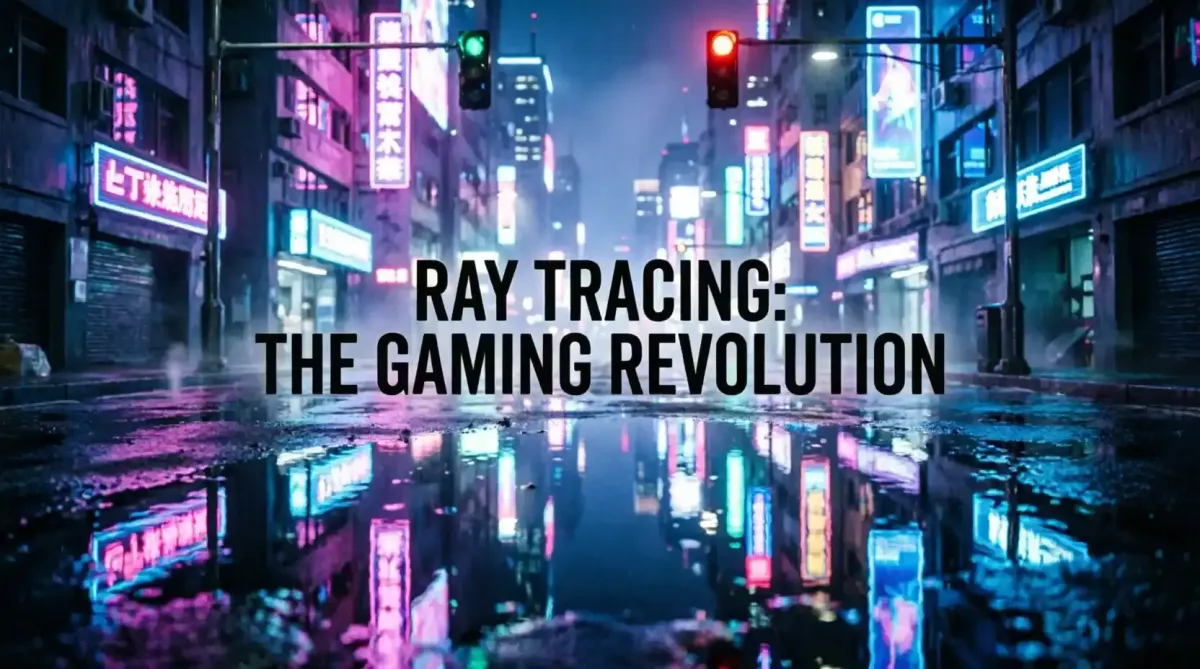
How Ray Tracing is Changing the Realism of Modern Video Games in 2026
In 2026, the line between reality and virtual worlds has become almost indistinguishable. The primary architect of this visual revolution is Ray Tracing. For decades, video games relied on "rasterization"—a series of clever tricks and pre-baked textures to simulate light. Today, modern GPUs physically simulate the behavior of light as it bounces, refracts, and reflects off surfaces in real-time. At TipsForAITech, we are exploring how this "Holy Grail" of graphics is transforming the gaming experience from simple entertainment into an immersive digital reality.
This 1500+ word comprehensive guide dives into the physics of lighting. Whether you are upgrading to an RTX 50-series GPU or optimizing your CPU architecture, understanding ray tracing is essential for the 2026 gamer.
1. What is Ray Tracing? The Science of Light
In 2026, ray tracing works by tracing millions of individual paths of light from the camera (the player's eye) back to the light source. It calculates exactly how light interacts with every object—whether it's a muddy puddle or a neon sign. This results in Physically Accurate Reflections that respond to changes in the environment, a level of realism essential for advanced computer vision simulations.
2. Beyond Reflection: Global Illumination and Ambient Occlusion
Ray tracing in 2026 is about more than just shiny surfaces. Global Illumination ensures that light "bleeds" from one surface to another. If a character stands near a red wall, their clothes will catch a subtle red tint. Combined with ray-traced Ambient Occlusion, shadows in corners and crevices look soft and natural, mirroring the visual intelligence required for modern home robotics.
3. Path Tracing: The Next Frontier of 2026
The latest breakthrough is Path Tracing (often called Full Ray Tracing). Unlike standard ray tracing, which only traces a few bounces, path tracing simulates the entire light transport for every pixel. Games in 2026 are using this to create cinema-quality lighting on high-end hardware, a task made possible by the parallel processing power of modern GPUs.
4. The Impact of DLSS 4 and AI Reconstruction
Ray tracing is computationally expensive. In 2026, DLSS 4 (Deep Learning Super Sampling) uses AI to "predict" where light rays will hit, allowing the GPU to trace fewer rays while delivering a sharper image. This synergy between AI and graphics is a cornerstone of 2026 technology transformation.
5. Dynamic Environments and Interactive Lighting
In 2026, lighting is no longer static. If a player shoots a lamp, the entire room’s lighting and shadows recalculate instantly. This interactivity deepens the immersion, making virtual worlds feel "alive" and responsive, a feature we also see in robotic environmental awareness during rescue missions.
[Image showing the path of a light ray: Bouncing off multiple surfaces with different properties like metallic, rough, and transparent]6. Ray Tracing in Consoles: PS5 Pro and Beyond
Ray tracing isn't just for PCs. In 2026, the latest mid-gen consoles have dedicated ray-tracing hardware that allows for 60FPS gaming with ray-traced reflections. This has democratized high-end visuals, much like how satellite internet has democratized global connectivity.
7. Sound Tracing: Audio Realism
An unexpected evolution in 2026 is Ray-Traced Audio. By using the same math used for light, games now trace sound waves as they bounce off walls and floors. This creates 3D spatial audio that changes based on the room's geometry, enhancing digital wellbeing and immersion.
8. Security and Driver Performance
Rendering these complex scenes requires massive amounts of data. In 2026, GPU drivers are protected by passkey-secured administrative access to ensure that malicious shaders or scripts cannot compromise your hardware while monitoring network security.
9. Using AI Writing Assistants for Graphical Reviews
Game reviewers and technical artists use advanced writing assistants to describe these complex visual changes to their audience, maintaining maximum professional productivity during the busy launch season.
10. Conclusion: The Realism Revolution
The role of ray tracing in 2026 has fundamentally changed our expectations of what a video game can be. It is no longer about just "better graphics"; it is about creating a cohesive, believable world that obeys the laws of physics. As hardware continues to evolve and AI upscaling becomes even more efficient, ray tracing will move from a high-end luxury to a standard feature for every digital experience. We aren't just playing games anymore; we are stepping into alternate realities that look, feel, and sound like our own. The light has been turned on—and the view is spectacular.
Stay at the forefront of the hardware and AI revolution by following TipsForAITech. Whether you're looking for OS comparisons or development frameworks, we are your partner in the 2026 technology landscape.